
LSA-2106
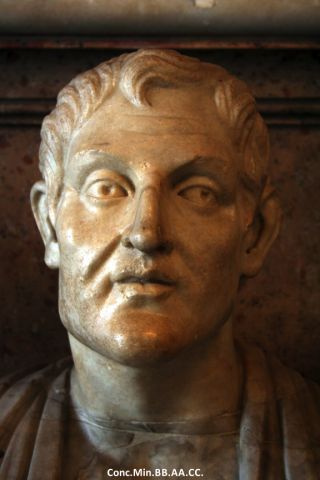
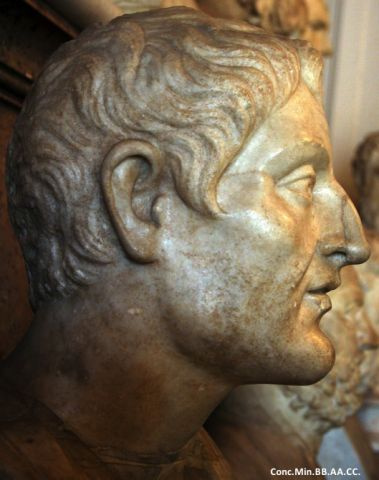
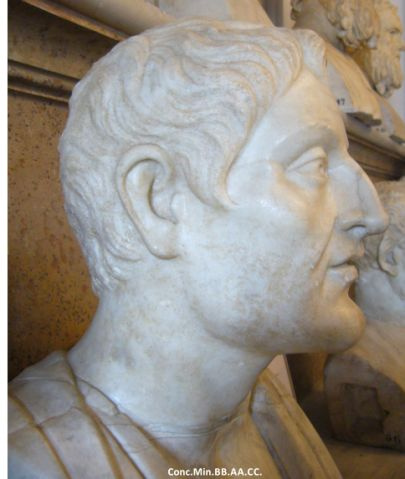
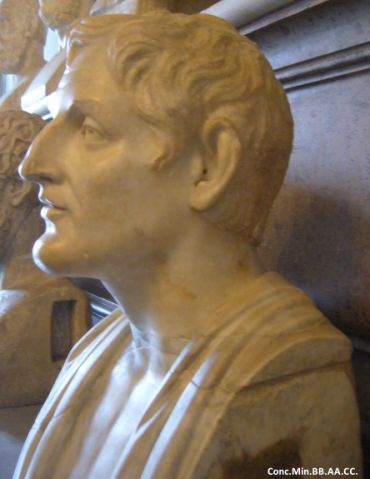
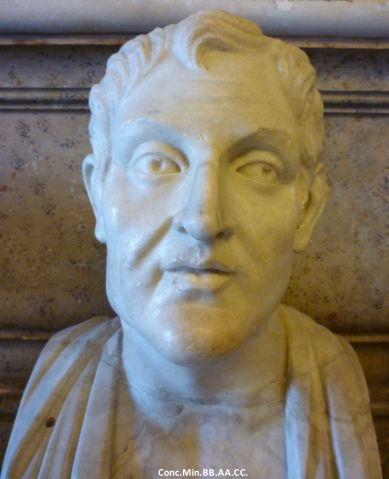
Portrait head of Menander. From Italy. Fourth century.
Record details
Photographs
Bibliography
- Picozzi, M.G. 'Sul ritratto tardo antico di Menandro della Stanza dei Filosofi del Museo Capitolino', Studi Miscellanei 29. Scritti di Antichità in Memoria di Sandro Stucchi, Vol. 2, Rome 1991-2, 271-8
- Stuart Jones, H. (ed.), A catalogue of the ancient sculptures preserved in the municipal collections of Rome. [Vol.1]. The sculptures of the Museo capitolino , Oxford 1912, 240, no. 53
Discussion
DESCRIPTION (Object)
Portrait head (on modern herm bust). H (with herm) : 57, H (head from chin to crown): 26.5 cm. Large-grained white marble. Isotopic analysis suggests that the marble is from Asia Minor.
The head with the entire neck and the drapery around the base of the neck are ancient. The herm bust is not ancient but has been repaired.
The pupils are deeply drilled out in a crescent shape, and the irises are unmarked. The hair is rendered with a flat chisel. On the right side of the head , the hair is most carefully worked. Around the left ear and the back of the head the hair is only summarily rendered. There is a defined area above the neck in the hair at the back of the head which is very roughly worked; the neck below it is finished but not as highly polished as the face or front of the head. Picozzi concludes that this head has been taken from a shield portrait and that it was attached to the background at the back of the head.
PROVENANCE
The head belonged to Cardinal Alessandro Albani and was published as Aristotle already in 1741. When it was attached to the herm bust is unknown.
DESCRIPTION (Subject)
The portrait shows a clean-shaven man with an open mouth who wears drapery (probably a chiton and a himation) around his neck. It is a recognizable version of the portrait of the beloved playwright, Menander; there are c. 75 copies of this type.
It presents the salient aspects of the of the physiognomy and the hairstyle of the type: the clean-shaven but mature face with a strong chin and a large curving lock over the centre of the tall brow.
The facial structure and features however have been distorted. The face is too long; the eyebrows are high arches; the naso-labial folds are deep; and the mouth is open.
DATE
This is a loose rendition of a well-known model. It animates the portrait with emphatically marked eyes and moving mouth. The eye-markings and calculated distortion of the model should place this portrait in the fourth or even fifth century.
HONORAND
The portrait of Menander is the most popular Roman period image of a cultural figure. It is probably not surprising that this continues into late antiquity. There are six other late-antique versions of the portrait recorded in LSA; LSA-238, LSA-680, LSA-1193, LSA-2109 ,LSA-2110, LSA-2111. Most of these come from shield portraits.
Discussion references
- Danguillier, C., Typologische Untersuchungen zur Dichter- und Denkerikonographie in römischen Darstellungen von der mittleren Kaiserzeit bis in die Spätantike, Oxford 2001, 253, no. 19 (unsure, possibly 3rd c.)
- Richter, G.M.A., The Portraits of the Greeks, London 1965, II, 230 no. 9, figs. 1553-5
Cite: Last Statues of Antiquity, LSA-2106 (J. Lenaghan).