
LSA-2107
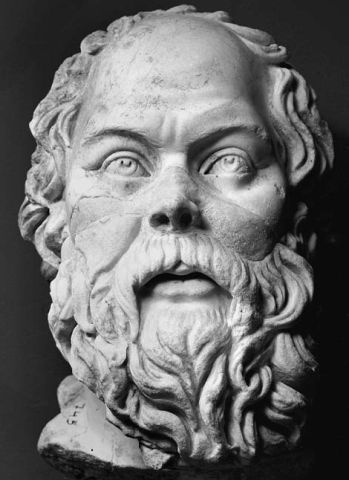
Portrait head of Socrates from a bust. Ephesus (Asia). Late fourth century to early fifth century.
Record details
Photographs
Bibliography
- Bammer, A., R. Fleischer, and D. Knibbe , Führer durch das Archäologische Museum in Selçuk-Ephesos, Vienna 1974, 68-9
- Gauer, W. 'Die griechischen Bildnisse der klassischen Zeit als politische und persönliche Denkmäler', Jahrbuch des Deutschen Archäologischen Instituts, 83, Berlin 1968, 124
Discussion
DESCRIPTION (Object)
Life-size head from a bust. H: 31cm. Fine-grained white marble.
Head broken at neck. Found in two pieces, broken underneath eyes, nose and parts of cheeks on both sides of the nose are totally restored. Traces of garment on both sides of the neck. Minor chips are missing in the beard and on the right side of the head.
Beginning of the bust seen on the back, hollowed with rough chisel. Beard and hair with broad drill chanals and holes, drill canal between the lips. Inner corner of the eyes and pupils are drilled - pupils halfmoon, iris graved. Hairs of the eyegrows engraved. Flesh polished. Back of the head worked out.
PROVENANCE
Northwest of the Baths of Scholasticia, from rubble above Baths. Found in 1957.
DESCRIPTION (Subject)
Male head of the philosopher Socrates, from a bust. The precise reproduction is astonishing (Scheibler).
DATE
Because of stylistic reasons for the bust two dates exist, one early around 300 (Zanker), and a later one at the second half of the fourth (Scheibler) and beginning of the fifth century (Fleischer, Danguillier). Scheibler is more detailed, she compares the kind of drill use for the eyes and the anxious hair with some heads from Chiragan. In addition the bust was made in an aphrodisian workshop.
Discussion references
- Auinger, J. and M. Aurenhammer. 'Ephesische Skulptur am Ende der Antike', Byzanz – das Römerreich im Mittelalter. Teil 2, 2 Schauplätze, Mainz 2010, 659-660, fig. 8
- Danguillier, C., Typologische Untersuchungen zur Dichter- und Denkerikonographie in römischen Darstellungen von der mittleren Kaiserzeit bis in die Spätantike, Oxford 2001, 257-8, no. 45
- Scheibler, I. 'Rezeptionsphasen des jüngeren Sokratesporträts in der Kaiserzeit', Jahrbuch des Deutschen Archäologischen Instituts 119, Berlin 2004, 238, no. 27, fig. 30 a-c
- Smith, R.R.R., "Late Roman philosopher portraits from Aphrodisias", JRS 80 (1990), 140
- Zanker, P., Die Maske des Sokrates : Das Bild des Intellektuellen in der antiken Kunst, Munich 1995, 300-1, fig. 174
Cite: Last Statues of Antiquity, LSA-2107 (J. Auinger).