
LSA-2108
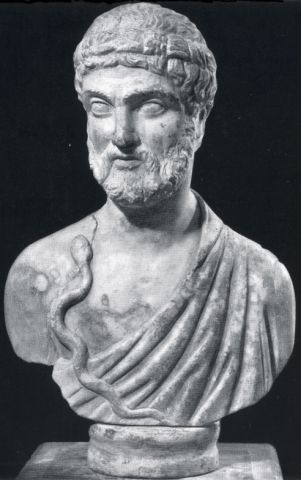
Portrait bust of doctor (?) with wreath and snake. From Ostia. Fourth century.
Record details
Photographs
Bibliography
- Calza, R. (ed.), Scavi di Ostia. v.5. I Ritratti, pt. 1. Ritratti greci e romani fino at 160 circa d.C., Rome 1964, 18, no. 7, pl. 4.7
Discussion
DESCRIPTION (Object)
Over life-size bust, recomposed from two fragments. H: 47, W: 33 cm. H (of head): 27 cm. Italian ‘Luni’ marble.
The right shoulder has been reattached. The round base on which the bust rests is not original. The tip of the nose has been restored.
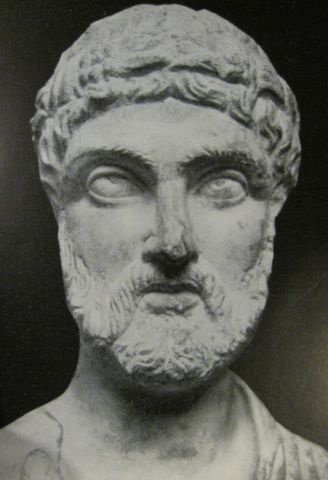
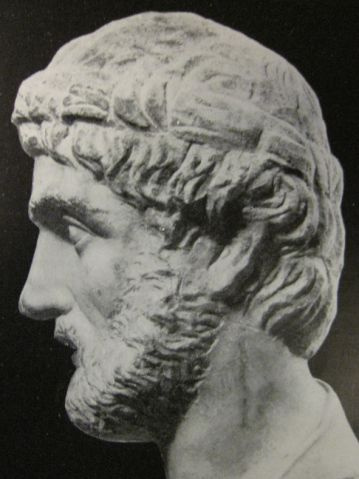
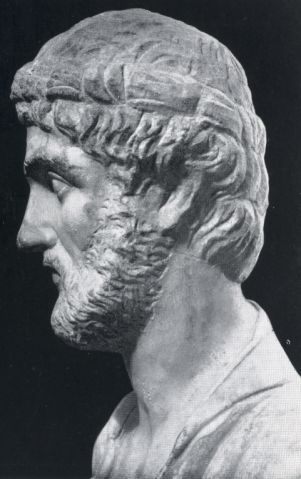
All of the hair (head, beard, moustache, eyebrows) is rendered with flat chisel work. The irises are represented by finely engraved arcs, just greater than semi-circular. The pupils are cut-out and have a crescent shape. The wreath is flat and at the back is only summarily modelled. The hair above the wreath at the sides and probably also all of the hair at the back of the head is roughly defined by a large uneven flat chisel work.
PROVENANCE
The head was found with fragments of an Achilles sarcophagus and various epigraphic fragments in the fill of tomb outside the Porta Romana in Ostia in 1910.
DESCRIPTION (Subject)
The portrait shows a bearded man from below the pectorals upwards, including only the upper arms. A snake crosses his chest and wears a wreath made of laurel and cloth which features berries at the front.
He also wears a heavy mantle draped diagonally; its upper border runs from under the right armpit to the left side of the neck. The upper left arm is covered. The folds are broad and schematic. The portion of exposed chest is summarily modelled. A sinuous, but rather flat, snake slithers upwards from the bottom centre of the bust to the right shoulder.
The wreath runs horizontally above the ears. The hair below it falls in thick locks which partially cover the ears and reach the middle of the brow. The hair is parted at the centre of the brow. Over the centre of the brow, the locks are short and pushed to one side or the other in order that their ends create an even arch. At the temples the hair is longer.
The head turns to his right. The face is long and slightly narrow beneath the full hair and crown. The eyes are hooded and accentuated by thick and regularly arching eyebrows. They taper inorganically to the inner canthi, and the eyeball bulges at the outer side of the eyes. The pupils and irises are emphatically marked. The nose is straight, and the mouth is small and bow-shaped. The cheeks and upper lips are covered by a full beard and long moustache.
DATE
The bust has been variously dated. Becatti placed it in the first century BC, considering it based on an Italic-Etruscan model of the fourth or third century BC. Calza avoids assigning a date. Von Sydow placed it in the fourth century AD.
This latter date is most appropriate. The rendering of the eyes and eyebrows belongs surely to that period. It seems furthermore to this author to have probably been re-worked from an earlier portrait. The circumference of the head above the temples around the hair and wreath is broad with respect to the lower face and particularly with respect to the top of the head. There hair seems to have been removed, probably in order to create the projection of the wreath. The face is also shallow, and the right ear is strangely high. Given the bust size (which makes Becatti’s first century BC conjecture untenable), the beard, and the lack of drilling in the hair, one might imagine that the original work dated to the second quarter of the second century AD.
IDENTIFICATION
The snake and wreath are particular attributes. They suggest the world of medicine and culture. Becatti therefore identified the head as Pythagoras. Von Sydow suggested a doctor.
The find context, the funerary realm of Ostia, makes the latter possibility more appealing. The former cannot be entirely excluded; a comparison with the labelled portrait tondo of Pythagoras from Aphrodisias, LSA-210shows a similarly bearded man with a long moustache, full hair, and a central part.
Discussion references
- Beccatti, G. 'Ritratto di un vate antico', Bollettino d'Arte 34, Milan 1949, 97-109, figs. 1-3
- Von Sydow, W., Zur Kunstgeschichte des spätantike Porträts im 4. Jahrhundert. n. Chr, Bonn 1969, 93 and 98 (portait of doctor c. 400)
Cite: Last Statues of Antiquity, LSA-2108 (J. Lenaghan).