
LSA-2109
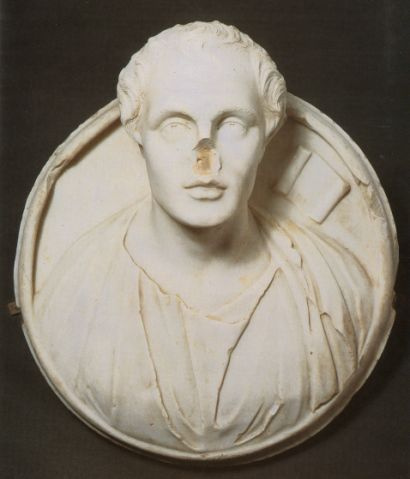
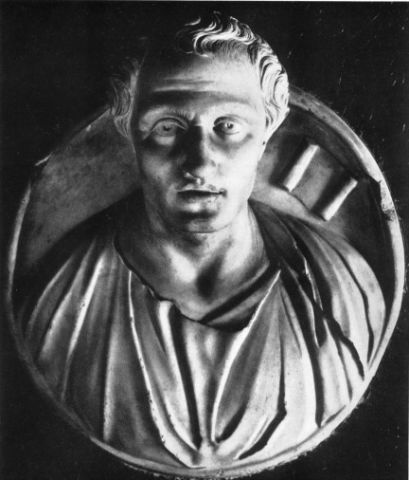
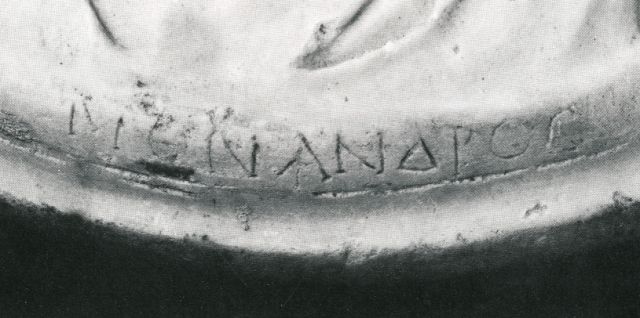
Inscribed shield portrait of Menander. Italy. Fourth century.
Record details
Photographs
Bibliography
- Christie's London, Property from Marbury Hall. July 7, 1987, London 1987, 28-9, no. 9
- Richter, G.M.A., The Portraits of the Greeks, London 1965, II, , 227, no. 2, figs. 1528-1530
Discussion
DESCRIPTION (Object)
Shield portrait. H: 55, W: 48, D: 23 cm. Marble.
The nose is restored. The irises are indicated by finely engraved arcs that are three-quarters of a circle. The pupils are indicated by deeply-drilled, heavy crescent shapes.
PROVENANCE
The exact provenance is unknown. It was previously in Marbury Hall and therefore acquired by James Smith Barry in Rome in 1776. It was sold at auction at Christie’s London in 1987 (10 July). The Sackler Museum at Harvard acquired it in 1991.
DESCRIPTION (Subject)
The shield portrait shows a clean-shaven man who wears a chiton and a himation draped over the shoulders; one end falls in front of the left shoulder. On the background above this left shoulder is a partially opened scroll. On the lower rim, the name Menandros is inscribed in Greek.
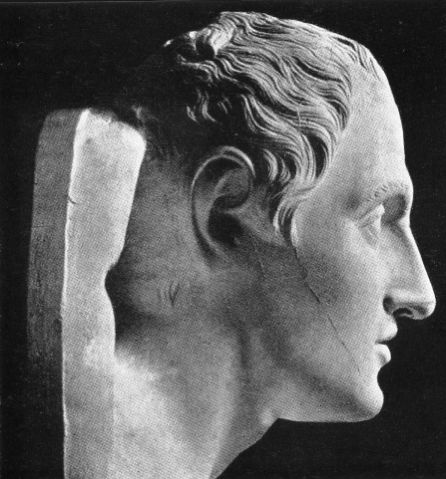
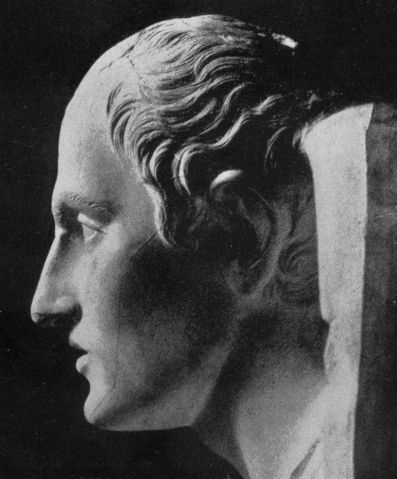
The portrait head is a readily recognizable version of the portrait of the most beloved playwright of the Roman period; there are c. 75 copies of this type. It presents the salient aspects of the of the physiognomy and the hairstyle of the type: widely-spaced eyes and flat cheeks that taper to a broad chin, a bow-shaped mouth with a full lower lip, a large curving lock over the centre of the brow, and medium-length locks around the ears.
The hair on the left side, however, is brushed forward rather than backward, and the face lacks the guant cheeks and naso-labial folds of the model. It has instead two creases across the brow.
DATE
This is a loose rendition of a well-known model. It simplifies the anatomy and puts greater emphasis on the eyes and thoughtful brow. In addition, the rendering of the pupils indicates a date no earlier than the later third century. This portrait might well belong to the fourth or even fifth century.
The scroll in the background appears on several other tondi portraits from Rome: see, the Demosthenes LSA-2440<k, the Bornova-Heidelberg type LSA-2441<k, Socrates LSA-2511<k. This tondo is of the same scale and, though this one has differently carved eyes, all may once have come from the same context.
HONORAND
The portrait of Menander is the most popular Roman period image of a cultural figure. It is probably not surprising that this continues into late antiquity. There are six other late-antique versions of the portrait recorded in LSA; LSA-238, LSA-680, LSA-1193, LSA-2106 ,LSA-2110, LSA-2111.
Discussion references
- Fittschen, K.'Zur Rekonstruktion griechischer Dichterstatuen. 1. Die Statue des Menander', Mitteilungen des Deutschen Archäologischen Instituts, Athenische Abteilung 106, Berlin 1991, 248, no. 26
Cite: Last Statues of Antiquity, LSA-2109 (J. Lenaghan).