
LSA-2111
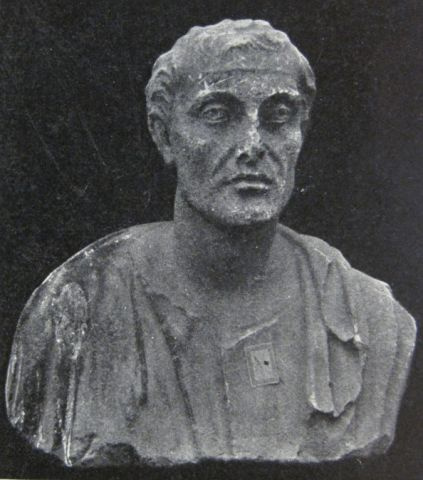
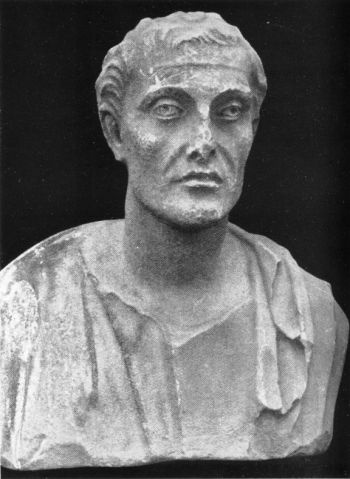
Portrait bust of Menander. Antiochia ad Pisidiam (Pisidia). Fourth century.
Record details
Photographs
Bibliography
- Buckler, W. et. al. 'Monuments from Iconium', Journal of Roman Studies 14, London 1924, 46, no. 33, pl. 7
Discussion
DESCRIPTION (Object)
Bust. H: 50 cm. White marble.
The tip of the nose is missing. The left shoulder ends abruptly; it may be broken. There is little drill work; the hair is done completely with a flat chisel. The pupils are wide, deep, circular hollows.
PROVENANCE
The bust was seen and published by W.H. Buckler, W. M. Calder, and C.W.M Cox in the Konya Museum in 1924. Mendel had not seen it there in 1902 when he published an inventory of objects in that Museum in Bulletin de correspondance hellénique. W. Ramsay excavated in Antioch (Pisidia) in 1914 and had brought items of statuary to the Konya Museum. J.F. Crome in 1952 writes that he was notified by W. H. Buckler that the bust came from Antioch and not Konya. This certainly the correct provenance.
DESCRIPTION (Subject)
The portrait is another late antique version of the ever-popular Menander type (see also LSA-238, LSA-680, LSA-1193,LSA-2106, LSA-2109, and LSA-2110,). It is recognizable by its clean-shaven face with broad cheekbones, brushed forward hair around the ears, and above all by the twisting lock that comes forward and to the proper left over the centre of the brow. It wears a chiton and himation, one end of which falls in front of the left shoulder and the rest of which is draped behind both shoulders. This loosely refers to the clothing scheme of the original statue.
The portrait is a simplified version of the Menander type and is much like LSA-238 and LSA-680 in its simplification. Eyes and mouth have been given a new and greater emphasis. The eyebrows have a high, accentuating arch, and the pupils are large. The broad mouth is framed by deep naso-labial folds and has full lips. The brow has a deep crease.
DATE
The rendering of the eyes and the simplification of the original model suggest a date in later third through fifth centuries. Menander was the most represented of all culture heros in this period as the seven portraits in LSA (this and six listed above) attest.
Discussion references
- Crome, J. F., Das Bildnis Vergils, Mantova 1935, 68, no. 11, fig. 44 (photograph: W. Ramsay)
- Crome, J. F. 'Il volto di Vergilio', Atti e memorie. Accademia virgiliana di Mantova 28, Mantua 1952, 6 (corrects provenance)
- Danguillier, C., Typologische Untersuchungen zur Dichter- und Denkerikonographie in römischen Darstellungen von der mittleren Kaiserzeit bis in die Spätantike, Oxford 2001, 252-3, no. 18 (Theodosian)
- Richter, G.M.A., The Portraits of the Greeks, London 1965, II, 233, no. 46, fig. 1637
Cite: Last Statues of Antiquity, LSA-2111 (J. Lenaghan).