
LSA-2112
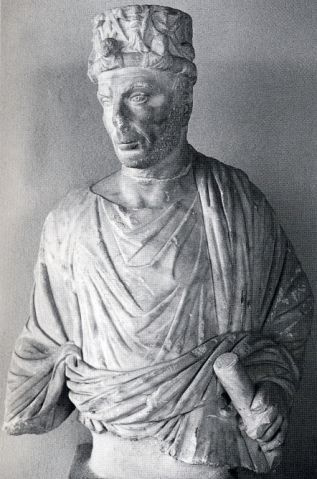
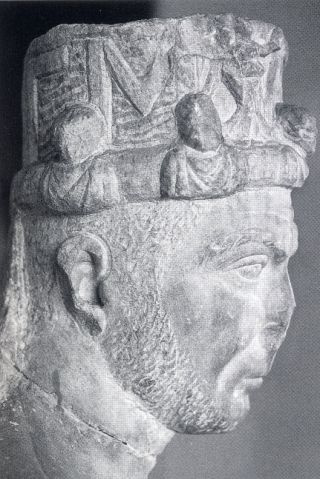
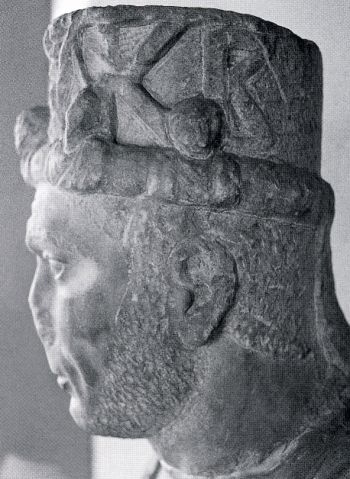
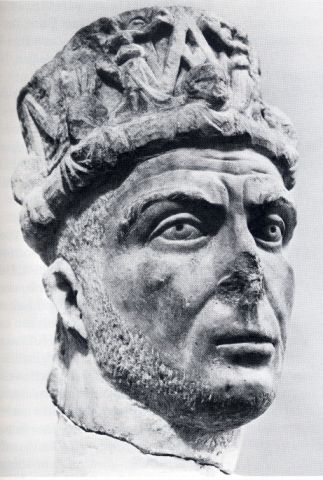
Portait statue of priest wearing himation and bust crown of earlier third century. From Soloi-Pompeiopolis (Cilicia). Reused in late third or early fourth century?.
Record details
Photographs
Bibliography
- Frey, L. 'Das Bildnis eines Kaiserpriesters aus Pompejopolis in Kilikien', Antike Welt 13, Zurich 1982, 27-39, figs. 1-5, 11, and 13 (mid 3rd c.)
- Inan, J. and E. Rosenbaum, Roman and Early Byzantine Portrait Sculpture in Asia Minor, Oxford 1966, 204-205, no. 282, pl. 157 (early fourth century)
- Weiss, P. ' Гβ und ГГ auf den Münzen von Tarsos und Anazarbos', Chiron 9, Munich 1979, 551, fn. 25 (AD 235-255)
Discussion
DESCRIPTION (Object)
Over life-size statue preserved from waist up. H (of head): 35.5, W (of head): 15.2 cm. Coarse-grained, greyish-white marble.
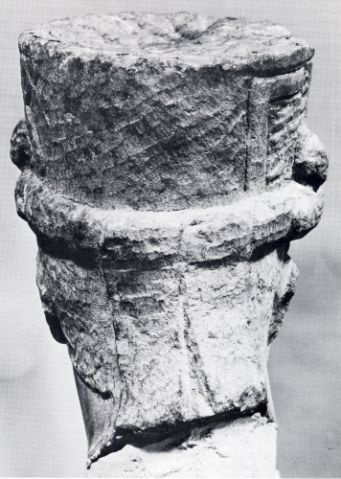
The head has broken from the statue and been re-attached in the modern period. The statue and head were, however, worked together in one piece of marble. The tip of the nose and three of the five busts on the crown are chipped. The back of the crown is roughly finished with a broad flat chisel.
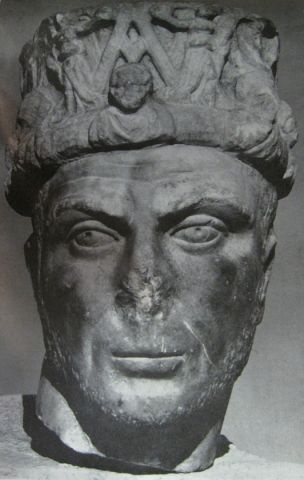
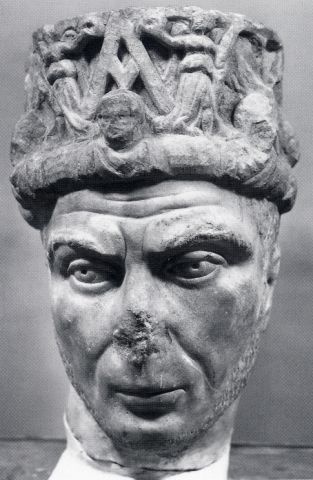
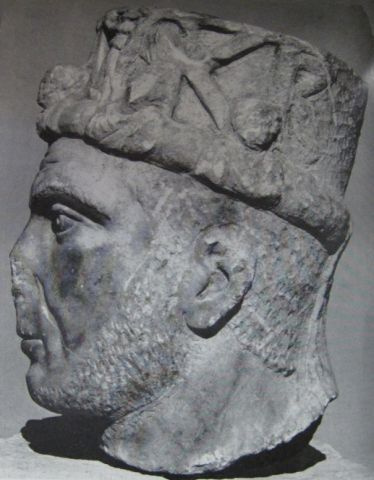
The head seems to this author to have been re-cut. The indications of re-cutting include: (1) the removal of a moustache which has left a flat almost non-existent upper lip and an unusually deep and irregular crease (naso labial fold) on the left side. (2) Chisel work in the beard has removed fuller hair and has left crudely rendered short hair within clearly marked perimeters, visible on both the cheek and neck, of a full beard. (3) The removal of a fuller beard has also given the portrait a markedly receding lower face. (4) The chisel has also been used to remove hair on the head and give the appearance of short-cropped hair; the upper edge of both ears, once presumably covered with hair and non-existent, has been defined by a drill line into the hair—this makes the ears appear to cling to the head. The single and deep drill holes, which define the pupils and add forceful emphasis, as well as the bushy arching eyebrows and creases across the brow and above the nose may also have been added and worked over.
Lore Frey does not note the potential re-cutting but does comment upon the fact that the cheeks are carefully modelled in comparison to the mouth and that the ears are short and carelessly worked with a drill.
PROVENANCE
Found near or on the colonnaded street. Many of the columns bear inscribed consoles for honorific statuary.
DESCRIPTION (Subject)
The figure wears a chiton, himation, and large bust crown. It holds a scroll in its left hand and probably held a phiale in its missing right hand. The himation drapes over the left shoulder and is pulled across the body at the waist: it follows a well-known (Koan) type for himation statues (see, for example, LSA-2583.)
The head turns to its right. The face is distinctive; it has a furrowed and contracted brow, deep lines around the mouth, and a receding chin. The hair and beard are cut short; there is no moustache.
The tall crown is detailed. It has a lower band decorated with five male busts. The ends of this band fall the back of the head. The busts are either broken or so crudely worked or poorly preserved that they cannot be identified specifically. They are all draped and mainly seem to wear military cloaks draped around the necks and fastened on the right shoulders. Between the busts and supported by a tall cylindrical element (modius) are five letters which are generally agreed to refer to the city of Tarsus:
Γ = τριῶν [ἐπαρχειῶν προκαθεζομένη] [being in public domain] of the three eparchies [of Cilicia, Isauria, and Lycaonia]
Μ =μεγίστη, greatest
Α =πρώτη, first
Κ = καλλίστη, most beautiful
Β =δὶς [νεωκόρος], twice (guardian of temple)
Two Nikes holding wreaths and palm branches frame the central Alpha.
DATE
On the basis of fashion and technical style Inan and Rosenbaum dated the head to the early fourth century (comparing it, for example, to LSA-37), and Von Sydow considered it Tetrarchic. P. Weiss dated it betweem 235 and 255 with a small potential narrowing to 238-255 on the basis of the reference to twice neokoros on the crown and numismatic evidence. Epigraphic evidence from Anazarbus and Tarsus, the major cities of Cilicia, show that those cities were awarded a second (Β) neokoros under Commodus and a third (Γ) neokoros in the middle of the third century, respectively 249-250 and 253-260. Thus after the period of Valerian the crown of a Ciliarch would have had two gammas rather than a gamma and a beta. Moreover, a single Nike appears on the coins until the era of Gordian; for this reason, he offered the potential terminus post quem of 238 rather than 235. His dating has been accepted and disseminated by Frey, Rumscheid, and Burrell (with minor adjustment).
Frey reintroduced the discussion of fashion and technique and argued that this portrait head is similar to the portrait generally accepted as Trajan Decius (AD 249-251) in the Capitoline Collection. Frey went on to suggest that other portrait heads assigned to the late third century, especially those with pupils denoted as single drill holes, LSA-371and LSA-701 (both probably from eastern Asia Minor) should be considered on the basis of this portrait to belong to the middle of the third century.
A recurrent and important problem in the discussion of this and all of the above-mentioned heads is that they have often been re-cut from earlier portraits. This statue may well have been re-cut (see above), presumably for a second use. The five busts of the crown have large heads and outlines which suggest full beards and hairstyles. The central figure is certainly fully bearded and wears a military cloak; it presents the general appearance of a second-century emperor.
The epigraphic and historic work of Weiss and Burrell provides a secure terminus ante quem for the original statue of c. 255. The question remains, was the statue (made 190-240) re-used in c. 250 or re-used in c. 290 or even 320? Historically, this area of Cilicia suffered the invasions of Shapur in the 240s and 260s and regained stability in the Tetrarchic period.
Discussion references
- Burrell, B., Neokoroi : Greek cities and Roman emperors
, Leiden 2004, 215, fn. 25 (mid 3rd c.) - Rumscheid, J., Kranz und Krone : zu Insignien, Siegespreisen und Ehrenzeichen der römischen Kaiserzeit, Tübingen 2000, 131-2, no. 34, pl. 21 (AD 238-253)
- Von Sydow, W., Zur Kunstgeschichte des spätantike Porträts im 4. Jahrhundert. n. Chr, Bonn 1969, 114-115 (Tetrarchic)
Cite: Last Statues of Antiquity, LSA-2112 (J. Lenaghan).