
LSA-2120
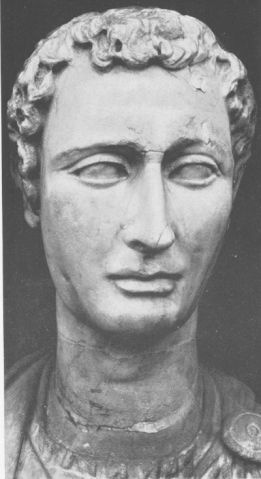
Portrait head of clean-shaven man, awkwardly re-cut. From Italy. Fifth century?
Record details
Photographs
Bibliography
- Calza, R. et al. (eds.), Antichità di Villa Doria Pamphilj, Rome 1977, 307-8, no. 380, pl. 219
- L'Orange, H. P., Studien zur Geschichte des spätantiken Porträts, Oslo 1933, no. 106, fig. 196
Discussion
DESCRIPTION (Object)
Life-size head. H: 22 cm. Marble.
The head was mounted on an alien bust with an added marble neck piece between the two. It was acid washed so that no original surface was preserved. The nose, part of the forehead, and the ear were modern restorations.
The head was almost assuredly re-worked from an earlier portrait. Strands of hair were indicated by lines of the flat chisel, and there was minor drill work between locks. A heavy drill line also defined the upper line of the upper eyelid. The eyes were unmarked.
PROVENANCE
The provenance is unknown.
DESCRIPTION (Subject)
The portrait depicted a clean-shaven man of middle age. The hair was full, brushed forward, and ended in curls. It, however, recedee slightly at the corners of the brow.
The face was long with an unusually tall brow. The cheekbones protruded, and the eyes seemed large and wide-set. This was because the lower face was significantly narrower than the upper face, and the jaw, though strong and rectangular, receded. The naso-labial folds were indicated, and the mouth was broad with full lips.
DATE
Because of long smooth face which gave it a delicate and mannered appearance, the head has been associated with portraits of the late fourth to early fifth century (see, for example, LSA-906 and LSA-907, both of which, however, feature light facial hair). It is difficult to make any secure assessment about the head, now lost, on the basis of one frontal photograph.
It can only be said that it was probably re-cut from an early second century or Hadrianic portrait. This explains the rendering of the hair, the unusual proportions of the head, and the lack of eye markings. At times in re-worked portraits, the original eye surfaces were not touched (for example, LSA-245, LSA-246 and LSA-1203).
Cite: Last Statues of Antiquity, LSA-2120 (J. Lenaghan).