
LSA-2122
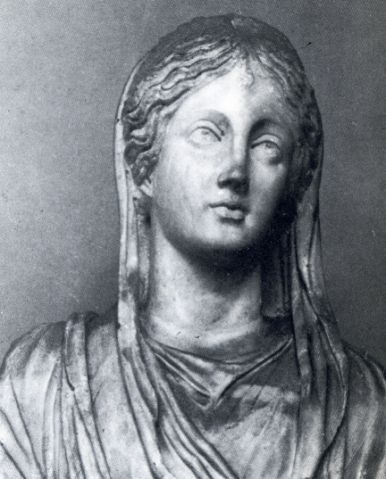
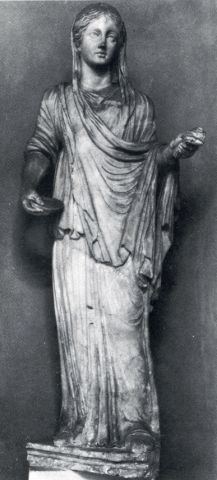
Veiled portrait head of woman set on draped statue. From Italy. Fourth century.
Record details
Photographs
Bibliography
- Calza, R. et al. (eds.), Antichità di Villa Doria Pamphilj, Rome 1977, 306-307, no. 379, pl. 219
Discussion
DESCRIPTION (Object)
Life-size head mounted on life-size statue. H: 179 cm. Greek marble.
The head has been attached to the body with great care and the seam disguised. Without taking the two apart, it is difficult to ascertain when this occurred. The portrait has probably been re-worked from an earlier head.
The right forearm and hand and the left hand are restorations.
There is some drill work in the hair, arching drill line above the upper lid of each eye, a deep drill channel between the lips, and the pupils have been drilled out in the form of a pelta. The irises are slightly raised three-quarter circles.
PROVENANCE
The statue has no recorded provenance.
DESCRIPTION (Subject)
The statue is life-size and shows a young woman with a physiognomy and hairstyle similar to those of a bust in the Capitoline collection (LSA-592). The two portraits might even be based on the same model. The careful join of the head to the statue body and the suitability of the body type suggest that the two were joined together in antiquity.
The face is a smooth oval that remains unbroken by the chin and is marred by no creases or folds. The brow is tall, the eyes large, the nose straight, and the mouth small with bow-shaped lips.
The hair is parted in the centre and pulled back, covering the tops of the ears. An S-shaped lock descends from the central part. The hair at the back of the head is covered by a veil but must be gathered into two braids which appear around the upper portion of the head, forming a diadem in front of the edge of the veil.
This head has been set on a draped statue, a version of a frequently copied type (the ‘Hera Campana’ type in which the head is generally covered). It turns to its left. The body weight rests on the right leg; the right arm is free of drapery, and probably held an attribute. The left arm, bent at 90 degrees, rests at the side and supports the outer garment.
The statue wears a belted chiton; the edge of the overfold crosses the body at the hips. Over this is a himation which covers the head and is slung diagonally across the body from the right shoulder to the left thigh. The feet wear covered shoes.
There is no statue support, and the plinth has a moulded front edge.
DATE
The handling of the eyes (crescent-shaped pupils and raised irises) places the head in the fourth century or later. The seeming presence (unnoted by Calza) of a encircling braid, a popular hairstyle of the fourth century, would confirm this date.
STATUE TYPE
The body type is a variation of the Hera Campana Type which was popular in the second century AD. Two statues of Vestal Virgins from the House of the Vestals in the Roman Forum, one of which preserves a second century portrait head, follow this type [see, E.van Deman ‘The Value of the Vestals as Originals’ American Journal of Archaeology 12 (1908) 326-7 figs.1-2]. It is used elsewhere for priestess and goddesses since it leaves the right hand free to hold an attribute or make a commanding gesture. This particular variation is small and awkward. Some of the clumsiness may be a result of re-carving. For example, the area of the left thigh is usually covered by the heavy himation and here the himation ends abruptly revealing a poorly worked series of U-folds on the chiton. This, however, is difficult to judge securely from published photographs. The relatively low and moulded plinth would suggest a high imperial date.
HONORAND
The portrait head seems to follow the same model as that used for a portrait bust in the Capitoline collection (LSA-592). The two share the same idealized physiognomy and particular hairstyle. Calza, who notes this, suggests that the two might both have represented a Theodosian empress. It might also be possible that the portrayed was a Vestal Virgin. The Capitoline bust has holes for an unusual head ornament, and the Pamphili statue follows a type favoured by the Vestals. Moreover, the hairstyle of both is particular and personal. Had it been the hairstyle of an Empress one would expect to find yet more variations and echoes of it in the visual record.
Cite: Last Statues of Antiquity, LSA-2122 (J. Lenaghan).