
LSA-2123
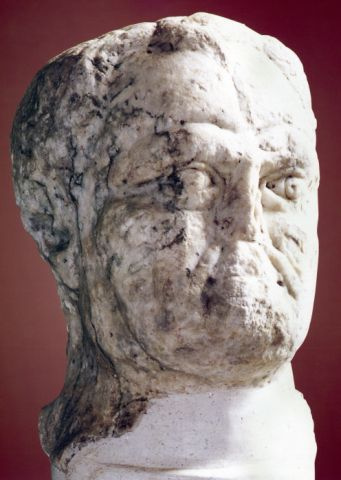
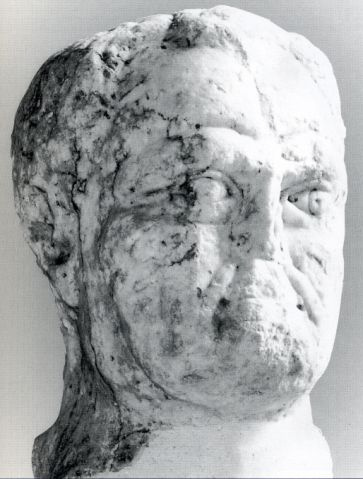
Portrait head of man with thick neck and receding hair. Luceria (Apulia et Calabria). Fourth century.
Record details
Photographs
Bibliography
- Todisco, L., Scultura antica e reimpiego in Italia meridionale. II Puglia Basilicata, Bari 2002, 219, fig. 22
Discussion
DESCRIPTION (Object)
Over life-size head preserved for insertion. H: 31, W: 21.5, D: 23.5 cm. H (chin to brow) 20 cm. Bluish white marble with grey streaks.
The front of the neck, nose, and chin have broken off. The surface is badly abraded.
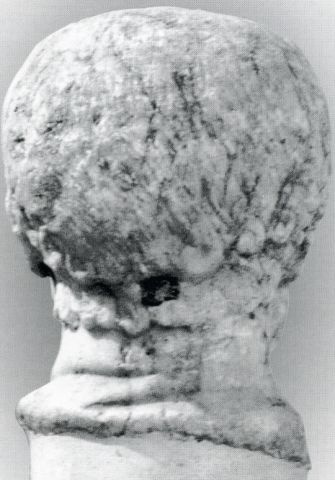
The head was worked separately for insertion into a statue. Where preserved, the finished edge is close to the neck which meant that it was originally inserted into a statue with a small socket, most likely a cuirassed statue. It was re-cut from an earlier portrait. The hair at the back of the head has been removed with a claw chisel. The front plane of the face also cuts back below the forehead.
The extant locks of hair are rendered with a broad flat chisel and possibly some drill work over the brow. Deep creases in the forehead, around the eyes, around the mouth and jaw, and in the neck as well as the irises appear to be made with flat chisels. The pupils are marked with one single, relatively small, central drill hole.
PROVENANCE
The head is recorded as coming from the territory of Lucera.
DESCRIPTION (Subject)
The head was once inserted into a statue and turned to its left. It portrays a powerful man with a lined face.
The hair is combed forward in wavy locks, the end of which curled over the brow and around the ears. The hairline however recedes significant at the corners of the brow. The back of the head has been worked over and is devoid of representation until the neck where two tiers of hair are visible. Each tier consists of vertical locks which end in curls.
The brow is unusually tall and marked by deep creases which follow and emphasize the arch of the eyes. Below the lower lids of the eyes another set of creases serves to model the skin and again draw attention to the eyes. The eyes themselves are small and not strongly marked, though the upper line of the upper eyelids continues well beyond the outer corners where there are crow’s feet wrinkles. The nose is remarkably short, and around its nostrils originate deep naso-labial folds. The mouth, mainly missing now, seems to have been broad and down-turned. The jaw is marked by a continuous fold that runs from cheekbone to cheek bone. It creates a double chin. At the back of the neck, deep folds also suggest a thick and powerful man.
DATE
The head has been re-worked from an earlier portrait; its state of preservation is poor; and the photographic record is limited. Legrottaglie publishes it a Flavian portrait, possibly even Titus, re-cut at the end of the third century. The combed forward hairstyle with curls does suggest an original of the late first century or early second century. The re-working might however be slightly later than the 260-290 date proposed by Legrottaglie. The portrait is clean-shaven, a fashion that was re-introduced by Constantine.
HONORAND
No part of the portrait (physiognomy, hairstyle, iconography) can be associated with an imperial figure. The epigraphic record from Apulia and Calabria testifies to numerous statues of non-imperial men.
Cite: Last Statues of Antiquity, LSA-2123 (J. Lenaghan).