
LSA-2124
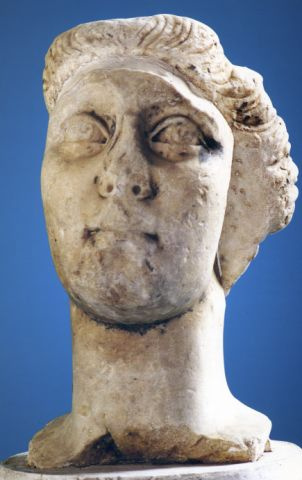
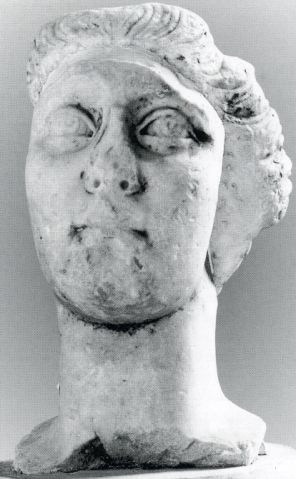
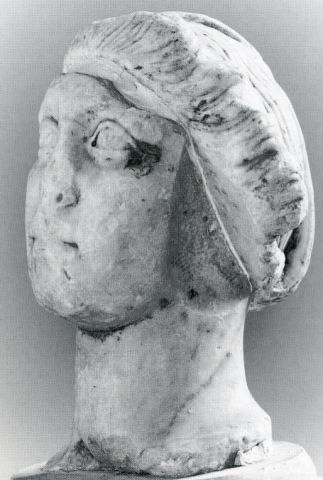
Portrait head of woman worked in separate pieces. Luceria (Apulia et Calabria). Earlier fourth century.
Record details
Photographs
Bibliography
- Legrottaglie, G., Ritratti e statue iconiche di età romana nel Museo Civico G. Fiorelli di Lucera, Bari 1999, 81-8, pl. 20 (AD 260-90)
- Todisco, L., Scultura antica e reimpiego in Italia meridionale. II Puglia Basilicata, Bari 2002, 219, fig. 23 (Tetrarchic to Constantinian)
Discussion
DESCRIPTION (Object)
Over life-size head for insertion preserved in two separately worked fragments. H: 31.5, W: 17, D: 22 cm. H (chin to brow) 16.5 cm. White marble.
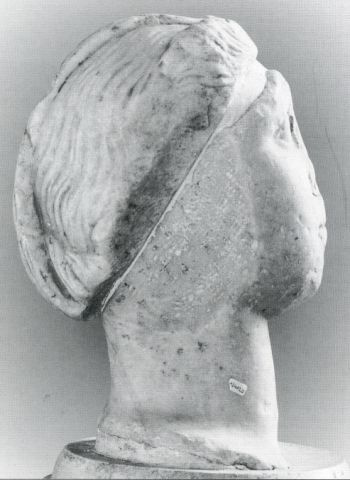
The hair has been worked separately from the neck and face. They have been joined by mortar in the 1950s-60s. Missing are two other separately worked pieces, each of which included an ear, a portion of cheek around the ear, and the edge of the hair at the temple. The front edge of the base of the neck has broken and is also missing. The tip of the nose has chipped off. The lips and chin also are chipped.
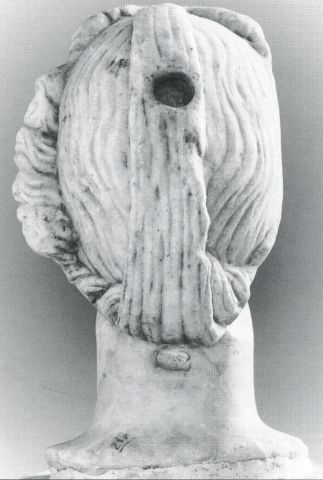
Below the hair on the nape of the neck is, what appears to be, a rectangular strut; it is however described by Legrottalgie as a rectangular hole. Another round hole appears at the top of the back of the head in the central braid.
The hair is defined with a broad flat chisel. The irises are semi-circles which touch both lids. The pupils are drilled out in U-shapes. Drill points also mark the inner canthi, and are visible in the nostrils of the broken nose.
PROVENANCE
The head is recorded as coming from the territory of Lucera.
DESCRIPTION (Subject)
The head was probably once inserted into a statue. It is set on a long cylindrical neck and turns slightly to its left. It portrays an adult woman with a full round face and a central braid hairstyle.
The brow, uncovered by the brushed back hair, is tall and smooth. The eyes are large with emphatic inner markings. Additional lines beneath the lower lids draw more attention to them and make them seem more deeply set. The cheeks are solid and uncreased. The line defining the parting of the mouth is broad and has down-turned corners. The broad chin continues the oval perimeter of the face harmoniously, without interruption.
The hair is parted in the centre and then brushed back and upward off the brow. It is twisted on to itself forming a roll of hair from ear to ear. This rolls thins behind the ears and then rises in a vertical band to the front of the head; this band is c. 5 cm wide. The hair on either side of the vertical band is thick and gently wavy.
DATE
The head may have been re-worked from an earlier portrait. The full face with solid cheeks seems to belong to the early first century AD. Legrottaglie argues that the head has been worked from a ‘nodus’ hairstyle like that of Livia.
The markings in the eyes cannot however date before the fourth century. Also the central braid hairstyle is a third and fourth century phenomenon. The relatively narrow form of the braid, the fact that it reaches to the front of the head, and the brushed back and upward fringe hair has parallels in two portraits that are generally dated to the first half of the fourth century (LSA-144 and LSA-573).
The piecing may belong to the original portrait of the first century when such piecing was common
or may be the result of the fourth century re-working. A similar problem is presented by LSA-995.
HONORAND
Although the epigraphic record from Apulia and Calabria does not attest even one statue for any fourth-century woman, it does testify to statues of private and imperial men at a ratio of 1:2. This female head is of virtually the same dimensions as an early fourth-century portrait of a local man from Luceria, LSA-2123. It is therefore perhaps easiest to assume that this is a local woman.
Cite: Last Statues of Antiquity, LSA-2124 (J. Lenaghan).