
LSA-2125
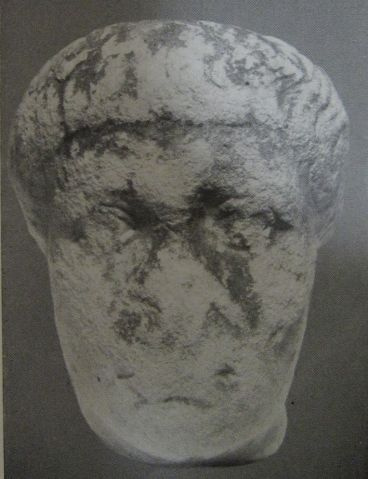
Heavily abraded portrait head of clean-shaven man with hair combed forward. From Sicily? Fourth century?
Record details
Photographs
Bibliography
- Bonacasa, N., Ritratti greci e romani della Sicilia. Catalogo, Palermo 1964, 126, no. 166, pl. 75.6
Discussion
DESCRIPTION (Object)
Life-size head. H: 21 cm. Large-grained marble.
The head is broken through the upper part of the neck and is badly abraded.
The hair appears to be worked without the use of the drill. The eyes are described by Bonacasa as having a fixed and far off gaze. Thus, one imagines that there is some trace of drilling in the eyes.
PROVENANCE
The head has no recorded provenance but presumably the head was found in Sicily.
DESCRIPTION (Subject)
The life-size head shows a man with hair that is brushed forward on to the brow. The ends of the fringe are compact and uninterrupted. The eyelids are heavy rolls, and the eyes appear large. The drilled corners of a broad mouth are also visible and the curve defining the upper edge of the chin. Interestingly there is no evidence of the ears in the frontal photograph.
DATE
The state of preservation and the published photograph make it difficult to assess. The hairstyle could be late first to early second century (Trajanic) or fourth century (Constantinian). Both Bonacasa and von Sydow believe that the latter date is the correct one. Bonacasa’s reference to the gaze of the portrait might indicate that an autopsy of the head would show traces of drillwork in the eyes. The eyes, in any case, appear wider than one would expect from a portrait of the late first to early second century.
The similarity in hairstyle between the late first to early second century (Trajanic) portraits and the fourth century (Constantinian) portraits causes a problem for dating (see, for example, LSA-1196 or the Age of Spirituality no. 6 and Copenhagen, Ny Carlsberg Glyptotek, inv. no. ). To make matters yet more complicated some late first century heads have been re-used in the fourth century (LSA-799 and LSA-832).
Discussion references
- Von Sydow, W., Zur Kunstgeschichte des spätantike Porträts im 4. Jahrhundert. n. Chr, Bonn 1969, 64
Cite: Last Statues of Antiquity, LSA-2125 (J. Lenaghan).