
LSA-2126
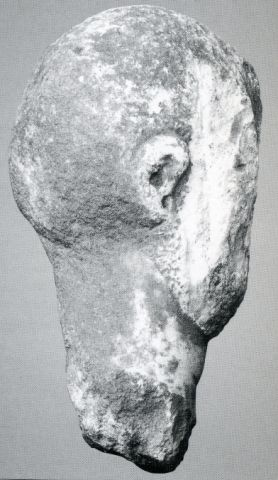
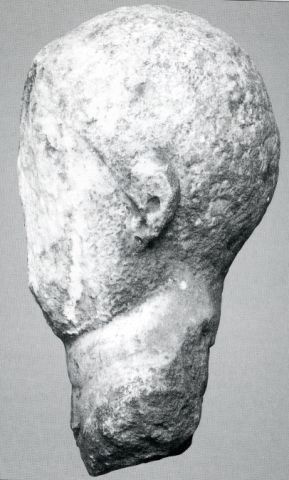
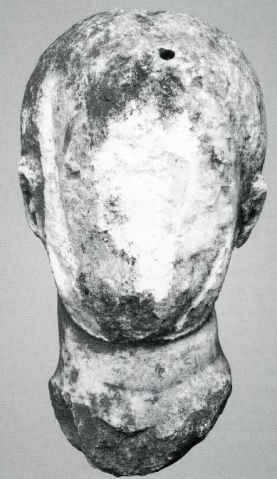
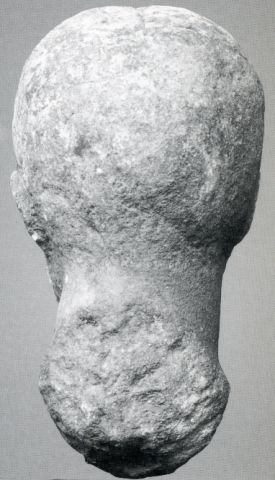
Battered portrait head for insertion of man with stubble beard. Luceria (Apulia et Calabria). Late third to early fourth century.
Record details
Photographs
Bibliography
- Legrottaglie, G., Ritratti e statue iconiche di età romana nel Museo Civico G. Fiorelli di Lucera, Bari 1999, 97-100, pl. 25
Discussion
DESCRIPTION (Object)
Over life-size head preserved for insertion. H: 32, W: 17.5, D: 18 cm. H (chin to brow): c. 16 cm. Marble.
The face is completely missing; some of this is modern damage but it may also have been deliberately destroyed in antiquity. There is a clear divide between the damaged head and the well-preserved neck surface. In the centre of the hair over the brow is a hole (Diameter: 1, Depth: 1.5 cm).
The head was worked separately for insertion into a statue. The head was re-cut; the hair has been taken down and left smooth at the top and back with only a trace of the original hair in front of the crown of the head. Traces of shortened locks are visible over the left side of the brow and near the left ear. A beard has been engraved regularly with a small chisel into the cheeks. In addition the back of the neck and socket have been worked down with point chisel.
PROVENANCE
The head is assumed to be from the area of Lucera since the Museum contains only such objects.
DESCRIPTION (Subject)
Although missing its face, enough remains to show that the head was re-cut from an earlier portrait (see above) and that it once depicted man with a stubble beard and short hair. The areas of the cheek around the ears show regular chisel marks within a defined a band. The cut-back hair clings to the shape of the skull and the ends of it stand clearly off the brow around the left temple. The face has a full oval form with possibly some loose skin around the mouth and jowls. The well-preserved neck is modelled and has two horizontal creases.
DATE
The head has been re-worked in the late third century. The stubble beard, short hair, and general mode of re-use are similar to those of other Tetrarchic period heads, especially from Italy; see, for example, LSA-1055 from Ostia and LSA-1031 in Milan, as well as Alba Fucens LSA-1045, Minturnae LSA-1114, and Sperlonga LSA-1043.
OTHER COMMENTS
The head may also have suffered a damnatio memoriae, given the distinction between face and neck; Legrottaglie dismisses this possibility unconvincingly by attributing the difference merely to the re-working.
The hole at the centre of the forehead remains difficult to interpret. One would generally assume that it was for the attachment of headgear.
Cite: Last Statues of Antiquity, LSA-2126 (J. Lenaghan).