
LSA-2130
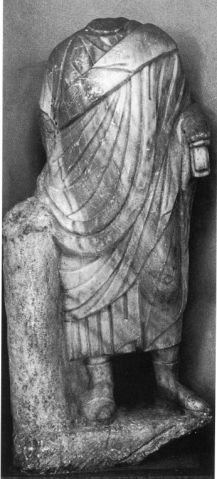
Headless portrait statue of man in short toga. Alexandria (Aegyptus). Third century.
Record details
Photographs
Bibliography
- Graindor, P., Bustes et statues-portraits d'Égypte romaine, Cairo 1937, 106-107, no. 50, pl. 42b
- Tkaczow, B., The topography of ancient Alexandria (An archaeological map), Warsaw 1993, 257 no. 196
Discussion
DESCRIPTION (Object)
White marble with light blue veining, H 157 cm. The head is broken at the base of the neck; it was worked from the same block with statue and plinth. The right arm is broken off, thumb and first two fingers of the left hand are chipped. At the front face of the plinth a layer of marble is broken off.
The folds are schematic, broad, flat, parallel lines in low relief with little plastic differentiation. The statue is of a striking rectangularity; the bent left knee is the only point where the underlying body is made visible.
PROVENANCE AND CURRENT LOCATION
The statue was found in the so-called cemetery of the legionaries west of the legionary camp in the modern suburb of Sidi Gaber (Tkaczow 1993, 174-5 site 143; plan II; map A; fig. 70). This is the same area where other togate statues from Alexandria were found (Tkaczow no. 193 (unpublished), 194 (LSA-2129), 195 (LSA-1663)).
It is today in Alexandria, Graeco-Roman Museum, inv. no. 3907.
DESCRIPTION (Subject)
The portrayed wears a short toga with a contabulated umbo(Goette 1990 type C b), a tunic, and plain boots (calcei). The contabulated umbo ascends from the centre of the breast to the left shoulder; it is separated from the balteus (the bulge of cloth coming from the back and ascending at the front side from the right hip) by a simple incised line (Goette 1990 lists this statue under his type D, with fully contabulated umbo. However, the umbo is the inner lacinia which is drawn over the balteus at the frontside of the body. The inner lacinia here is perfectly in line with the incision that separates the two portions of the bulge at the breast; the portion at the right side of the separation comes from the back). In his left hand he is holding a scroll (the lengthy object of stiff material is certainly not a mappa, as suggested by Graindor 1938: the mappa is of soft material, and it is held in the right hand. As an attribute of honorific statues it comes into use only in the late 4th century, when the late antique toga type was established (cf. Gehn 2012). Graindor 1938 recorded a ring at the ring finger of the left hand. The support at the right leg has the shape of a large tree trunk without decorations.
The statue stands with its weight over the right leg, the left foot is slightly turned outwards, the left knee bent. The left forearm is stretched forward; the right arm was held tight to the body; Graindor 1938 suggested that the right hand once grasped the seam of the toga (for the gesture see LSA-1663).
The costume stresses the romanitas of the portrayed; the toga, the ring on his left hand, and the plain boots indicate that he was possibly of equestrian rank (and certainly not of senatorial rank). He was possibly a member of the imperial administration of Egypt; if so, the volume in his left hand is a hint at his office and the virtues connected with it.
DATE
The unclassical appearance of the statue has traditionally made it a suspect for late antique date. Graindor 1938 assessed that it had to be the most recent of the Alexandrian togates (‘Cette statue est, de loin, la plus lourde et la plus maladroit de celles des togati du Musée d’Alexandrie et doit surement se placer à la fin de la série’, Graindor l. c. 106). Graindor did not specify a date, but had already dated LSA-1663 (his no. 49) to the 4th century because of its poor quality.
As in the case of the other marble toga statues from Alexandria, the late antique date for our statue is based on stylistic, or rather quality considerations alone (on the difficulties of stylistic dating particularly in Egypt cf. Bergmann 2010). The toga type displayed by the statue was developed in the later 2nd century and had its prime in the late 2nd and earlier 3rd centuries, although it is testified to also in the later 3rd century (Goette 1990, no. C b 18 pl. 37, 3; no. C b 21 pl. 39, 1.2). While the stylistic properties appear to point to the late 3rd century, the typology rather suggests an earlier date.
Discussion references
- Gehn, U., Ehrenstatuen in der Spätantike. Chlamydati und Togati, Wiesbaden 2012
- Goette, H.R., Studien zu römischen Togadarstellungen, Mainz 1990, 146, no. D 20, pl. 44.3
Cite: Last Statues of Antiquity, LSA-2130 (Ulrich Gehn).