
LSA-2132
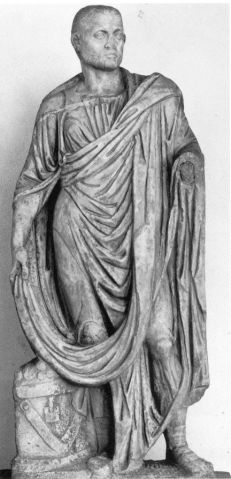
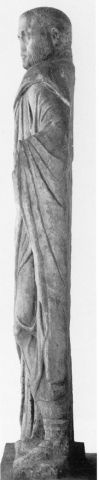
Portrait statue of man with stubble beard in toga. From Carthage. Late third to early fourth century.
Record details
Photographs
Bibliography
- Goette, H.R., Studien zu römischen Togadarstellungen, Mainz 1990, 58 and 144, no. Cb 21, pl. 39.1-2
Discussion
DESCRIPTION (Subject)
The statue is worked from one block with head and plinth; it is fully preserved save only the left forearm. There are no published measurements.
The portrait head has a cubic form; hair and beard are indicated by rough pickings (from the published photos it is not clear wether the pickings are the result of a re-cut). The folds of the garment are indicated by wood-cut like carvings. The back of the statue is flat.
PROVENANCE AND CURRENT LOCATION
The statue was first recorded by Goette 1990 in the Algier museum (without published inv. no.).
DESCRIPTION (Subject)
The portrayed is a man of mature age with short cropped hair and a stubble beard. He is wearing a toga with a semi-contabulated umbo (Goette type Cb) and a tunic. His feet are clad in closed boots (calcei); the horizontal arrangement at the shins probably indicates that these are senatorial boots (although the strings of such boots are usually hanging down at the front of the shin). At his right foot there is a container (capsula) for script rolls (rotuli). The container is decorated with a horizontal band and a handle; a further rectangular piece of decoration is possibly a locker (?). On top of the container, there are five rotuli lying loose.
The man is standing over his right leg; the right hand gripes into the seam of the toga and extends it to the right. The left arm is bent in the elbow, the hand stretched forward. The head is turned to the left.
The gesture of the right hand is often visible on togate figures from the Hadrianic period onwards. The gesture extends the straight side of the semicircular garment on which the purple stripe indicating magistracies (clavus) was applied (Wrede 2001, 71). The portrayed was possibly a local or an imperial office holder. The picked hair and stubble beard mark him as a ‘man on campaign’ and the script rolls possibly refer to magistratic duties. The gesture of the right hand underlines the dignity of the portrayed by extending the purple clavus.
DATE
The stylistic features of the portrait head, such as picked beard and hair, indicate a date in the mid- late 3rd/ early 4th century; the style of the garment supports such a date. The toga type with the semi contabulated umbo speaks in favour of a 3rd-century rather than a 4th-century date.
Discussion references
- Bergmann, M., Studien zum römischen Porträt des 3. Jahrhunderts n. Chr., Bonn 1977, 138-40; 154-6
- Wrede, H., Senatorische Sarkophage Roms: der Beitrag des Senatorenstandes zur römischen Kunst der hohen und späten Kaiserzeit, Mainz 2001
Cite: Last Statues of Antiquity, LSA-2132 (Ulrich Gehn).