
LSA-2133
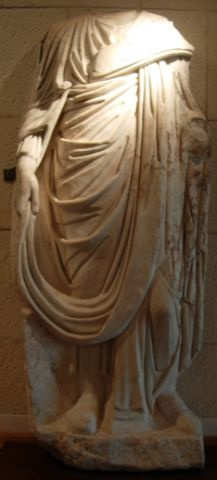
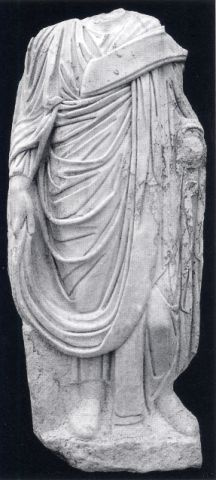
Headless portrait statue in toga 'contabulata.' From Segobriga. Late third to fourth century.
Record details
Photographs
Bibliography
- Noguera, J.M., J.M. Abascal, and R. Cebrián, ‘El programa escultórico del foro de Segobriga’, Escultura romana en Hispania V, Murcia 2008, 294-8, 325, figs. 7-9 (early third century)
Discussion
DESCRIPTION (Object)
Life-size statue. H: 157 cm. Proconnesian marble.
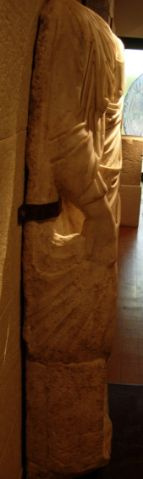
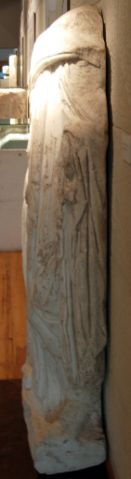
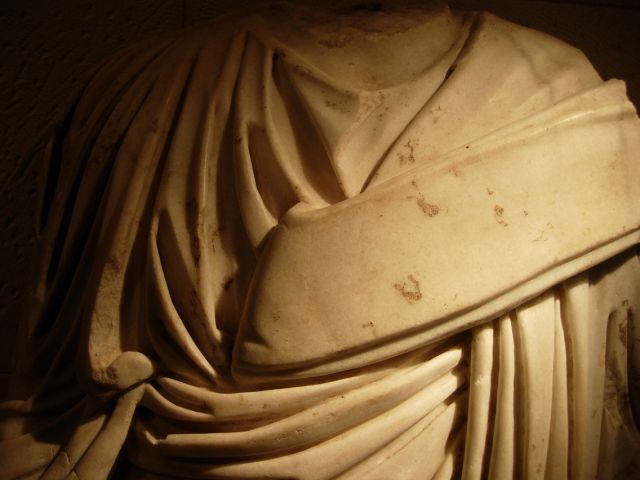
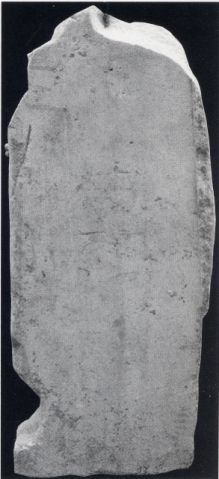
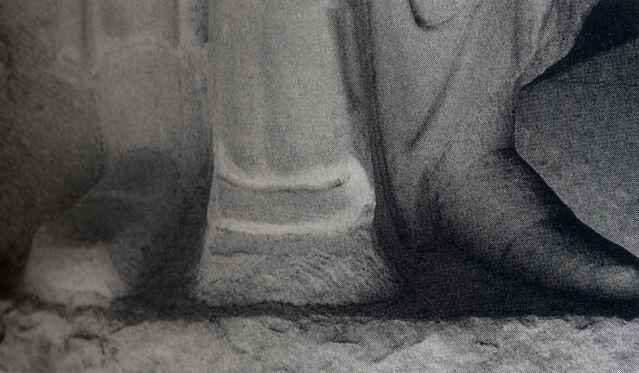
The statue is missing its head which was worked separately and dowelled on. Part of the dowel is still preserved and the diameter of the hole is c. 1.7 cm. The right forearm and the outer portion of the right upper arm are also missing. The back of the statue is cut smoothly. The right side is not fully finished. The bottom edge of the lacinia has not been fully worked from the plinth; it looks unfinished. In contrast the folds of the toga are highly polished.
PROVENANCE
The statue was excavated in 2003. It was found in the south portico of the Forum. It lay face down in a ditch in front of the entrance to the fourth taberna of the portico. The floor level, which covered it, is datable by pottery to the middle of the fourth century AD. The finds from the ditch, in which the statue was placed, seem to belong to the late third or early fourth century.
DESCRIPTION (Subject)
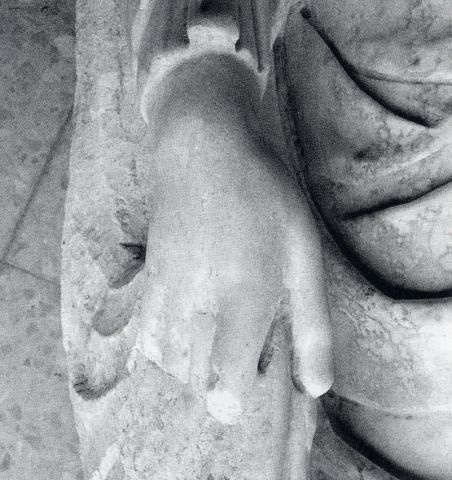
The statue wears a toga contabulata, a long-sleeved tunic, a tunic with three-quarter length sleeves, and soft leather shoes without straps. On the right side is a tall rectangular box which serves as a support. The weight rests over the right leg; the right arm rests by the side and the hand holds the sinus. The left foot is withdrawn, and the left forearm extends forward and supports the end of the toga.
DATE
Noguera, Abascal, and Cebrián (at p. 325) suggest with caution that this is a statue of an early third century emperor who suffered a damnatio memoriae. The toga contabulata type and the context provide a secure chronological frame; the contabulata became popular in the third century, and the floor under which this was found belongs to the mid-fourth century. The long-sleeved tunic is however usually dated to the later third or fourth century.
Several technical details and details of preservation are puzzling and again suggest a later rather than earlier date. The head was added separately, in a manner that suggests a repair or a re-use. Sockets rather than pins were the normal choice for a separately worked head ex novo. The back is cut flat and the sides are hardly rendered; this suggests a position against a wall and a desire to save marble (see for example LSA-2132). The fine surface preserved on the upper body indicates that the statue was not exposed to weathering; either it was inside or it was buried after a short use.
The non-senatorial footwear would seem to lessen the possibility that the statue represented an emperor.
Cite: Last Statues of Antiquity, LSA-2133 (J. Lenaghan).