
LSA-2134
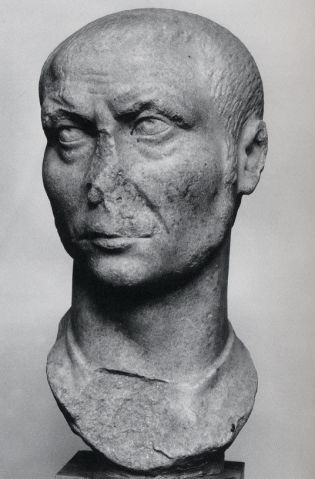
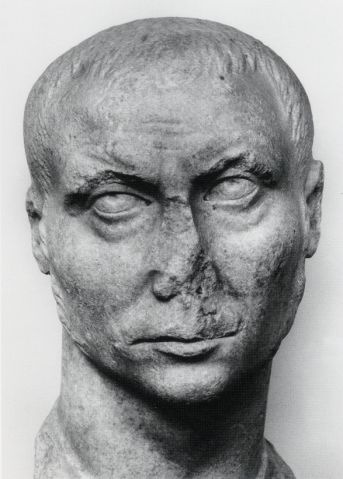
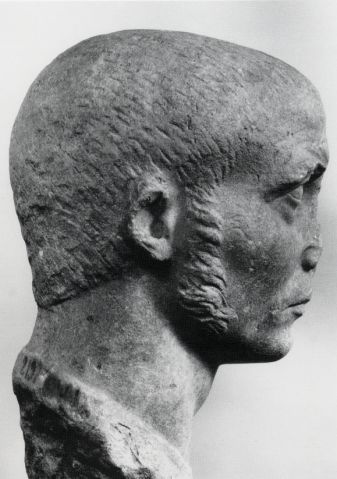
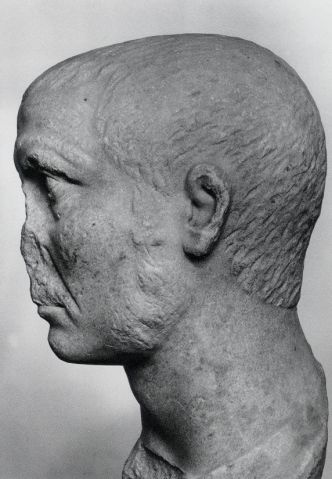
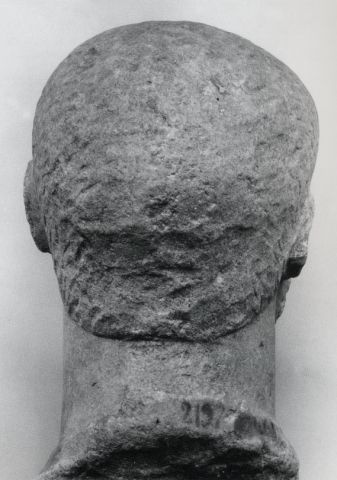
Portrait head for insertion of clean-shaven man with sideburns. Rome. Earlier fourth century.
Record details
Photographs
Bibliography
- Fittschen, K., P. Zanker, and P. Cain, Katalog der Porträts in den Capitolischen Museen und den anderen kommunalen Sammlungen der Stadt Rom. Band II. Die männliche Privatporträts, Berlin 2010, 175, no. 174, pls. 216-218 (290-310)
- Forti, L. 'Quattro ritratti ed un rilievo del nuovo Museo del Campidoglio', Rendiconti della Accademia di archeologia, lettere e belle arti, 30, Naples 1955, 16-19, pl. 3.
Discussion
DESCRIPTION (Object)
Life-size head, worked separately for insertion. H: 35, H (chin to crown): 21 cm. Marble
The head is preserved with its neck and tenon for insertion into a statue (or bust). The nose and parts of both ears are missing.
The hair at the front and sides is engraved with parallel, diagonal slashes of a large flat chisel. The back of the head is without representational detail. The irises are lightly engraved, and the pupils are marked by round drill holes.
The portrait has been re-cut from an earlier head. The hair has been taken back, the eyebrows raised, and both ears abbreviated. Probably the folds under the eyes are secondary additions. Possibly the high neckline of the tunic is actually the higher surface of the original portrait.
PROVENANCE
Found in 1937 on the via della Bocca della Verità.
DESCRIPTION (Subject)
The head represents an older man who turns to his right and wears a tight-fitting garment with a high neckline. He has short hair which recedes at the corners of the brow. Across the centre of the brow the hair ends in short, separated, triangular locks. In front of each ear are long sideburns which reach below the level of the mouth.
The face is distinctive. The brow is creased, and there are lines of contraction above the root of the nose as well as echoes of the high arching eyebrows. The cheekbones are wide-set and protruding. Beneath the eyes are heavy folds. The naso-labial folds are also deeply marked. The mouth is broad, and the chin is short and receding.
DATE
The portrait presents a clean-shaven older man with long sideburns. Scholarship has generally placed him between the later third century and the early fourth century for reasons of technique. Von Heintze considered the portrait to be c. 250-260; Meischner c. 270-285; Bergmann, and Fittschen-Zanker-Cain have all placed it more fully in the Tetrarchic period.
One of the main considerations for the date is the use of short slashes of the flat chisel to denote hair. This is certainly a tendency of the later third and early fourth century. It is an effective way to denote short hair on a re-cut surface. In the case of this head, two interesting points have not been given enough attention. First, the portrait with the most similar fashion style, LSA-2116, is usually dated as later fourth century. Second, the clothing represented is tight and high around the neck. This can only be the innermost, sleeved tunic of a late-antique toga. These togas should date to the end of the fourth-century and in the West there are only two extant examples (LSA-1068 and , LSA-1069).
Discussion references
- Bergmann, M., Studien zum römischen Porträt des 3. Jahrhunderts n. Chr., Bonn 1977, 140, fn. 556 (Tetrarchic)
- Helbig, W. (ed.), Führer durch die öffentlichen Sammlungen klassischer Altertümer in Rom. II. Die Städtischen Sammlungen: Kapitolinische Museen und Museo Barracco. Die Staatlichen Sammlungen: Ara Pacis, Galleria Borghese, Galleria Spada, Museo Pigorini, Antiquitaten auf Forum und Palatin, Tübingen, 429-430, no. 1635 (von Heintze: 250-260)
- Meischner, J., Bildnisse der Spätantike : 193-500 : Problemfelder : die Privatporträts , Berlin 2001, 174 (270-285)
Cite: Last Statues of Antiquity, LSA-2134 (J. Lenaghan).