
LSA-2135
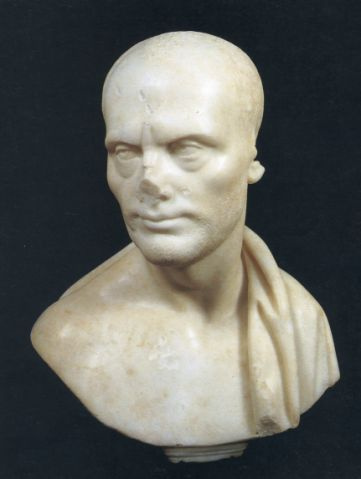
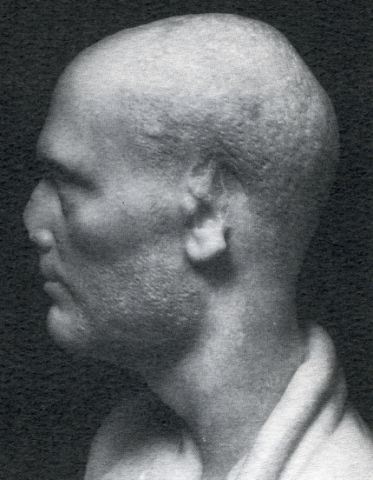
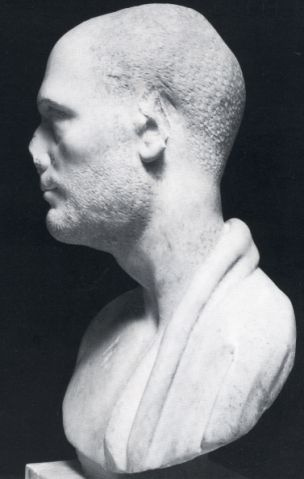
Second-century portrait bust of man wearing himation, re-worked. From Rome. Late third to early fourth century?
Record details
Photographs
Bibliography
- Faccena, D. 'II. Via Cassia (Km 11)', Notizie degli scavi di antichità, Rome 1948, 271-7, fig. 6
- Giuliano, A. (ed.), Museo Nazionale Romano. Le Sculture I,9. Magazzini. I Ritratti. Parte II, Rome 1988, 392-4, no. R294 (A.L. Cesarano)
Discussion
DESCRIPTION (OBJECT)
Bust with moulded tabula. H: 47; H (chin to brow): 21 cm. Fine-grained marble.
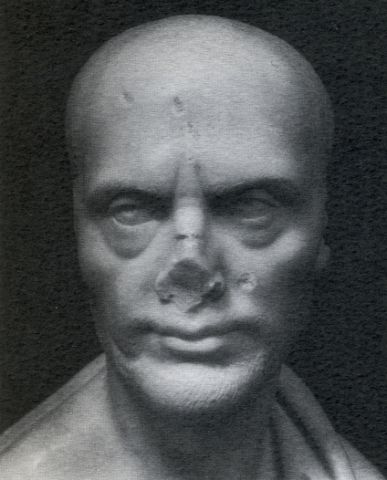
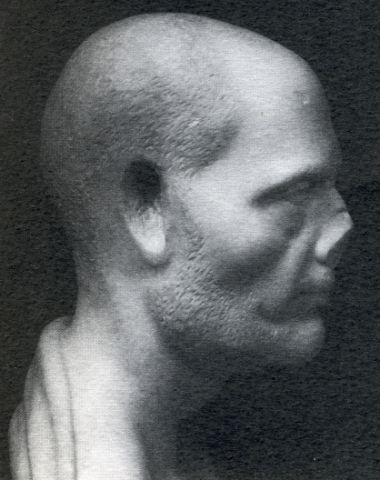
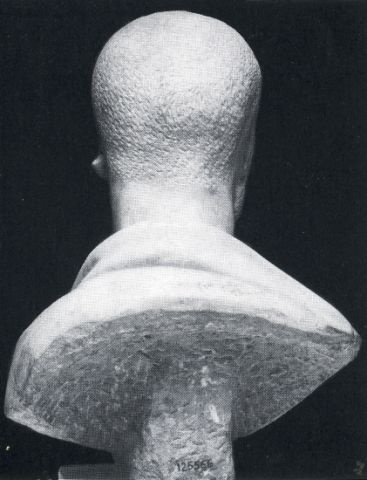
The tip of the nose, and the shell of the left ear are broken. The shell of the right ear is missing; it was worked separately and inserted.
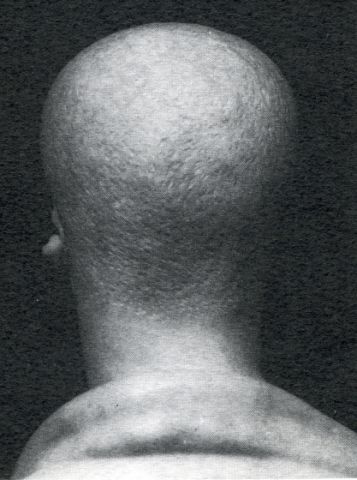
The back of the bust is roughly picked. It has a thick spine which is also roughly picked at the sides and back. At the front it is masked by a moulded panel or tabula. The bottom of the spine has a hole (Diameter 5.5 cm, Depth 7 cm) for a dowel to hold it to its base.
The hair, beard, and moustache are carefully engraved with small short strokes of a flat chisel. The eyebrows are indicated by longer engraved lines. The irises are also engraved. The pupils consist of two contiguous drill points.
The head has been re-worked from another portrait. The shape of a fuller moustache can still be seen over the upper lip and at the corners of the mouth. The right ear of the earlier portrait was probably entangled in hair and broke off when the hair was removed. It was thus replaced with an insert. Some of the outer rim of the left ear might also have been repaired during the re-cutting. The eyes and eyebrows of the original portrait, however, have been mainly untouched. Only the deep lines that follow the lower edge of the eye socket are probably also additions to the original portrait.
PROVENANCE
From a Villa at km 11.5 on the via Cassia. The Villa consists of a large domestic area with a bath complex which was excavated in 1948 as well as an agricultural production area excavated in the 1980s. Mosaics, marble revetment, and floors of cipollino marble indicate the luxury and wealth of the Villa and are characteristic of late residences. Preserved brick stamps range from the second century AD to the Tetrarchic and Constantinian periods. Faccena initially thought that all the bricks with the earlier stamps were simply reused in a late third or fourth century context (Faccena, NSc 1948, 276). This portrait and one of Caracalla were found in the largest room which was paved with cipollino marble.
DESCRIPTION (Subject)
The portrait bust shows a mature man with balding short-cropped hair wearing only a himation over his bare chest. The bust extends from shoulder to shoulder and to the middle of the pectorals.
The head is turned dramatically to its right. The sternocleido-mastoids are indicated as is the clavicle. No other anatomy is indicated, and on the right shoulder the folds of the himation are thick and regular.
The hair is engraved regularly into the skull which has a tall domed shape. Over the corners of the brow the hair recedes. The brow thus appears tall and broad. Two vertical lines of concentration rise over the root of the nose; the root of the nose has two horizontal creases as well. The eyebrows flare upwards at their outer corners, and the eyes appear sensitively modelled in Antonine style. The cheekbones protrude, and the hollowed area beneath the eyes is heavily marked by U-shaped folds and subtle modulation of the skin. The nose juts outwards below the bridge and is short. The naso labial folds are present but not emphatic. The mouth is broad with upturned corners and a central dip in the upper lip. The corners of the upper lip are heavy and create folds at the corners. A beard and moustache of the same length and rendering cover the edges of the cheeks, the chin, and upper lip.
The preservation of the surface combined with the naturalistic modelling of the face and slight smile suggest sensitivity and refinement.
DATE
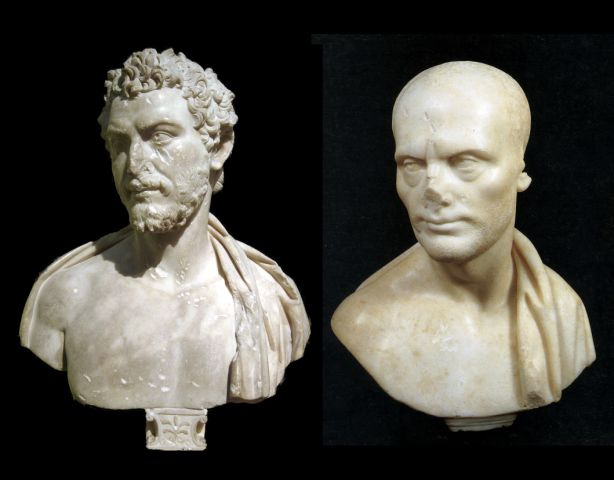
The portrait head has been re-cut. The size of the bust and shape of the original beard and moustache indicate that the original portrait probably dated after the middle of the second century. A bearded portrait in the British Museum (inv. no. 1910) shows the same basic bust type and provides an example of the hair and beard style which were removed in this case.
The sensitive modelling of the face and the careful engraving of the hair have led most recent scholars (Cesarano and Nista) to place it the late Severan period, c. 230-240 and led Faccena to compare it to works of the Gallienic renaissance of c. 260 (Faccena, NSc 1948, 276) and place it just prior to such examples (Faccena, BullCom 1946-48, pp.81-2). These authors, however, fail to note that the portrait has been re-cut.
Unlike works of the first eight decades of the third century, this hair is not in relief; it has no volume. It moreover does not follow the a penna technique but is simply engraved straight slashes. The beard is also carefully trimmed and does not extend onto the neck. But, most importantly, the head was found within a context that suggests a late third or early fourth century use.
HONORAND
The man portrayed shows himself in a mode of dress that was associated with intellectuals. The portrait furthermore comes from the main room of a luxurious villa. It likely represented the owner or an important family member who wished to emphasize his more cerebral aspect in the privacy of his own home.
Discussion references
- Anderson, M. and L. Nista , Roman Portraits in Context. Imperial and Private Likenesses from the Museo Nazionale Romano, Roma 1988, 58, no. 11
- Faccena, D. 'Busto virile dalla via Cassia', Bullettino della commissione archeologica comunale di Roma, Rome 1946-48, 79-82, pl.1
Cite: Last Statues of Antiquity, LSA-2135 (J. Lenaghan).