
LSA-2136
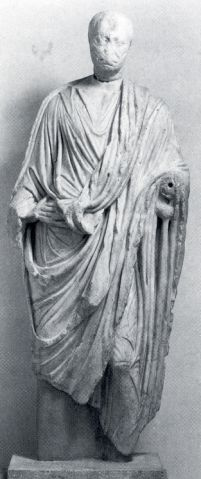
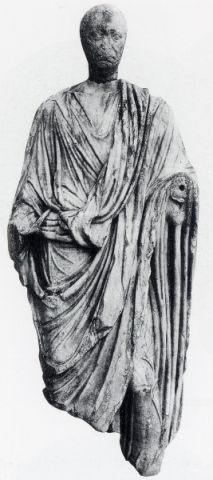
Togate statue of C. Valerius Vibianus signo Obsequius, governor of Tripolitania (see LSA-2178). Lepcis Magna (Tripolitania). circa 303.
Record details
Photographs
Bibliography
- Bianchi, L. 'Ritratti di Leptis Magna fra III e IV secolo', Archeologia Classica 56, Rome 2005, 278-280, 298 figs. 13-16 (later third to Tetrarchic style)
- Tantillo, I. and F. Bigi (eds.), Leptis Magna. Una città e le sue iscrizioni in epoca tardoromana, Cassino 2010, 269-270, fig. 8.15 (identification of statue with base)
Discussion
DESCRIPTION (Object)
Over life-size statue. H: 177 cm; H (of head): 28 cm. Fine-grained white marble.
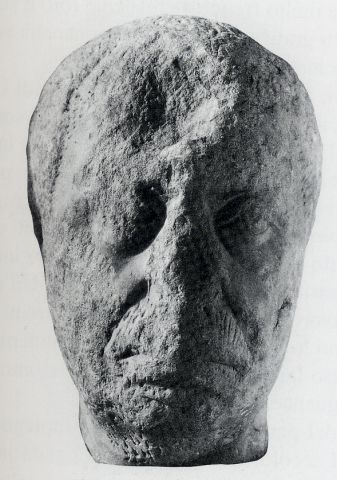
The head and body were made in one piece but broke at the neck and have been reassembled in the twentieth century. The left wrist and hand were worked separately and are missing. The right wrist and hand, the right lower leg, and both feet and the plinth are missing. (The lack of preservation of the feet and plinth may relate to the re-use of the base LSA-2178 which has a deep channel cut in the top surface.) The head is badly battered and has a large chip in the forehead and is missing its nose.
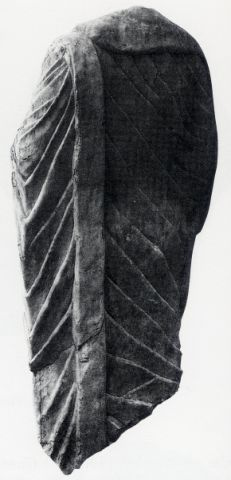
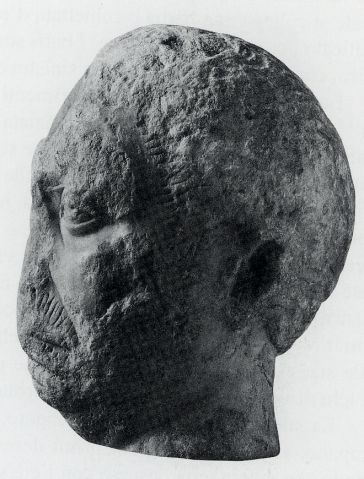
The back is flatly and schematically worked; it was never intended to be seen. The head has been re-cut from an earlier portrait. The hair on the head has been worked down to a flat raised cap, though traces of some locks seem to remain at the top. The fringe on the brow and the facial hair have been engraved into the surface with long strokes of a flat chisel. The irises are engraved and larger than semi-circular; the pupils are U-shaped. On the body the sleeve of the tunic may have been adjusted.
PROVENANCE
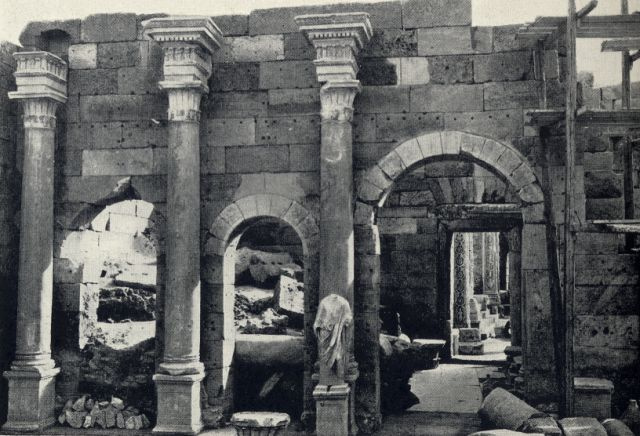
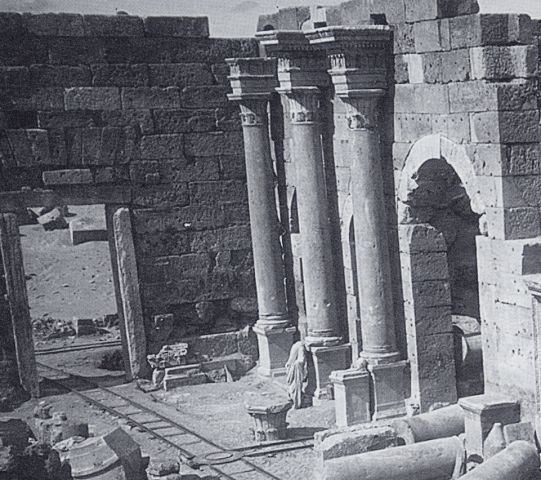
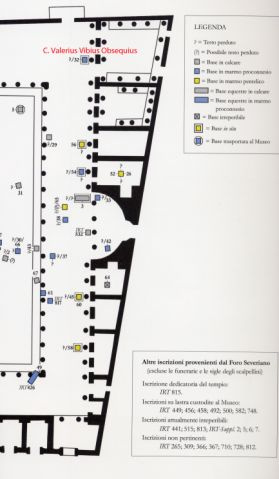
Found in the Severan Forum in the campaign of 1927-28. It was found with its base, LSA-2178 which remains in situ in the eastern portico in front of the third column from north of the inner colonnade.
DESCRIPTION
The portrait statue shows an elderly man in a toga and tunic. His weight rests over his right leg (next to which there was once probably a support), and his left arm extended forward. The toga has a sinus which reaches to the knee and an umbo that is low and centrally located on the abdomen. The sleeve of the tunic, visible on the right arm, has been given unusual folds that follow the projection of the arm.
The man looks to his left. He has short receding hair that is comes forward on to the brow and a short beard. His physiognomy indicates mature age. He has deep naso-labial folds, a broad and down-turned mouth, a small chin, and loose skin below the chin (a double chin). His eyes are large.
HONORAND AND DATE
As Bigi has shown, this portrait statue can be identified. It was found with its base LSA-2178 which honoured the governor of Tripolitania, C. Valerius Vibianus signo Obsequius (PLRE I, 956, C. Valerius VIBIANUS 3). Valerius Vibianus was a governor around 303.
Previously the togate statue has been discussed by scholars without knowledge of the base. It is reassuring to note that Bergmann cited it as an example of Tetrarchic style, and Bianchi placed in an iconographic typology that began with Claudius Gothicus and Probus but was still visible in some Tetrarchic portraits.
Goette’s discussed the toga as an example of c. 230s-240s. This may reflect the date of the original statue.
Discussion references
- Bartoncini, R. 'Il foro imperiale di Lepcis (Leptis Magna). Scavi di 1927-1928', Africa Italiana 2, Bergamo 1928-1929, 40 (figure shows statue on base)
- Bergmann, M., Studien zum römischen Porträt des 3. Jahrhunderts n. Chr., Bonn 1977, 155, fn. 620 (Tetrarchic)
- Goette, H.R., Studien zu römischen Togadarstellungen, Mainz 1990, 139, no. Bb 170, pl. 26.3
Cite: Last Statues of Antiquity, LSA-2136 (J. Lenaghan).