
LSA-2144
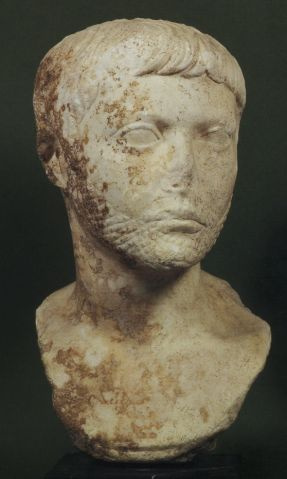
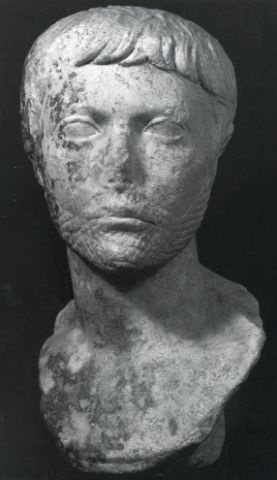
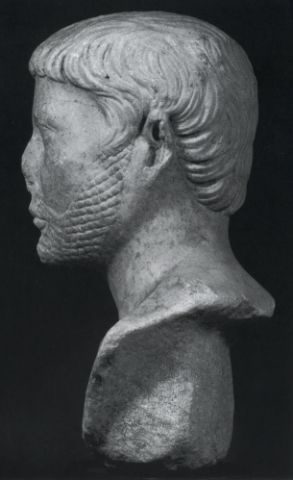
Portrait bust of Julio-Claudian youth with added beard. From Acerra. Late third century?
Record details
Photographs
Bibliography
- Strocka, V. (ed.), Römische Bildnisse : Porträts der Berliner Antikensammlung in Freiburg , Munich 2000, 55-62, no. 5, figs. 30-34
Discussion
DESCRIPTION (Object)
Bust. H: 38.5, H (chin to crown): 20.7, W (shoulder to shoulder) 20.8 cm. Large-grained marble.
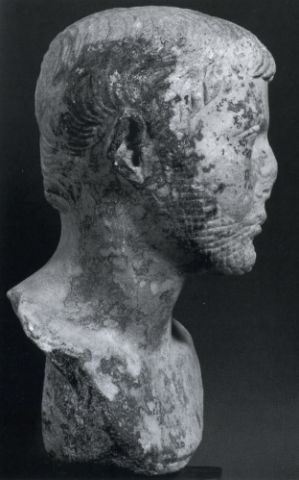
The tip of the nose and the rims of both ears have broken off. There are chips in the edge of the bust at both shoulders. The surface features burial accretions.
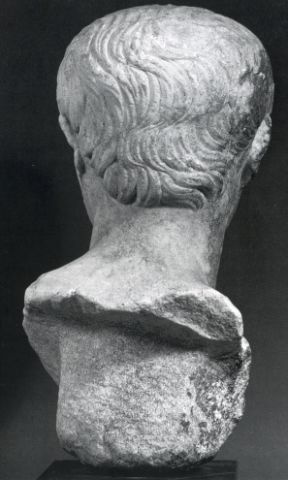
The bust was made in one piece from the mid-sternum to the top of the head. The underside of the bust and the back and sides of the rectangular spine are worked over with a fine claw chisel. A small area of the spine appears at the front of the bust beneath the edge of the chest.
The hair of the head is rendered with a flat chisel; no eyebrow hair is defined. The beard and moustache are engraved into the surface in a fish-net pattern with a flat chisel. The eyeballs are unmarked.
PROVENANCE
The bust was acquired by the Berlin Museum in 1965. It is said to have come from Acerra where it was found with another Julio-Claudian bust (a re-cut Caligula or Claudius) as well as a head of Nero and one of Germanicus.
DESCRIPTION (Subject)
The bust portrays a nude youth who turns to his left. He has casually arranged lank hair of medium length and a schematically rendered beard with awkward moustache.
The chest area extends laterally from the inside of one shoulder to the inside of the other and vertically from the middle of the sternum to the top of the head. The clavicles are softly modelled.
The face has an oval shape which tapers slightly at the chin and is generally rendered in a neo-classical style which conceals the skeletal structure. There are no lines or creases. The brow is broad and flat. The eyes, nose, and mouth are all regularly-shaped.
The hair over the brow is brushed to the sides, forming a small parting over the inside of the left eye. On the sides of the head it falls in two tiers; the upper of which turns backwards and the lower of which comes forward. At the back it falls in tiers which curve gently in alternate directions.
The singular and incongruous detail of the portrait is the beard and moustache. The beard has sharply defined inner and outer edges. The outer edge does not even reach the outer edge of the cheek on the left side. Within these edges regular diagonal hashes in both directions create a series of raised diamond shapes. Over the upper lip the upper perimeter line of the moustache is sharply defined but below it the moustache is not rendered with the regularity of the beard. In fact, the rendering here as destroyed the shape of the upper lip.
DATE
With the exception of the beard and moustache, the portrait bust is typical of the production of the Julio-Claudian period. The shape and size of the bust, the fashion of the hair, and the rendering are all standard to that period. It may even have been intended to be one of the Julio-Claudian princes, particularly if it is true that all other portraits found with it are of imperial family members.
The portrait has been used again to show a bearded young man. Although beards became popular amongst the Romans in the second quarter of the second century, the schematic rendering and the short style of this beard make it most likely that the honorand was a man of the later third century. In addition, the second half of the third century was, unlike the second century, a period of rampant re-use of extant portraiture. It is difficult to place this bust any more specifically because of the limited intervention of the re-use. That the unmarked eyes were left untouched is, however, not without parallels. Paestum, again in Campania, provides another example of a re-used Julio-Claudian portrait, LSA-1203, to which only a schematically rendered beard was added.
Cite: Last Statues of Antiquity, LSA-2144 (J. Lenaghan).