
LSA-2145
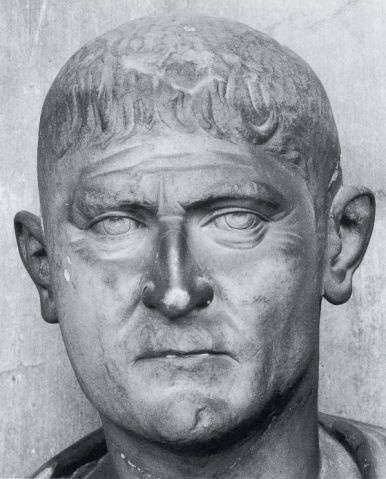
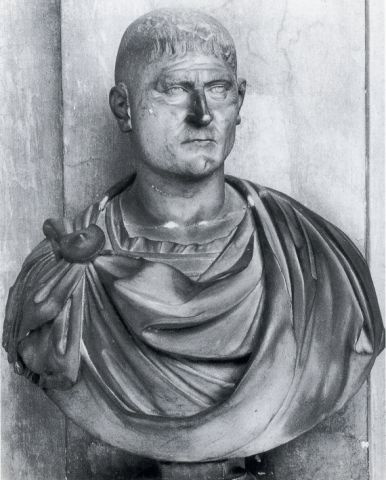
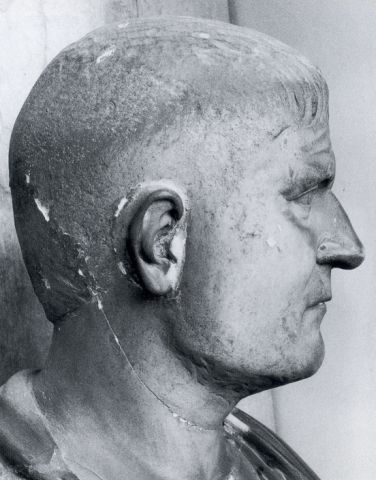
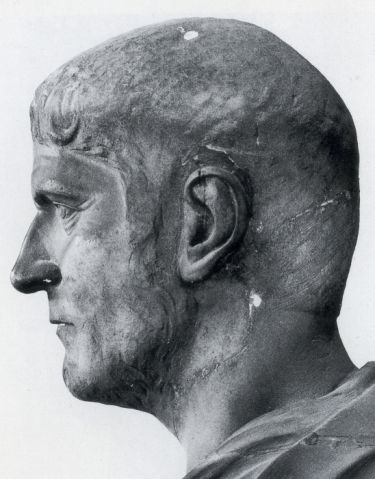
Portrait head of man with fringe and light beard. From Italy. Later fourth century?
Record details
Photographs
Bibliography
- Bol, P. (ed.), Forschungen zur Villa Albani. Katalog der antiken Bildwerke IV. Bildwerke im Kaffeehaus, Berlin 1994, 142, no. 436, pls. 70-71 (Amedick)
Discussion
DESCRIPTION (Object)
Over life-size head set on modern bust. H (with bust): 84.5, H (from chin to crown) 26.5 cm. Marble.
The head has broken off its original bust or statue. The break runs through the front part of the neck and rises to include some of the back of the head. A restored neck now attaches the head to a modern bust. The ears and nose are restored. The surface has been washed with acid.
The head has been re-carved. The hair of the head and beard has mainly been removed. Only some naturalistic locks at the brow and engraved strands below the jaw line are still preserved. Ridges created by a broad chisel on the top of the head give the illusion of hair brushed forward. The eyebrows have been picked over, and the lips, with the probably removal of a moustache, are extremely thin. The irises are engraved lines, just greater than semi-circular. The pupils are ‘heart-shaped’, made of two contiguous drill holes.
PROVENANCE
No provenance is recorded.
DESCRIPTION (Subject)
The portrait head has been re-cut from an earlier portrait and the re-cutting may never have been finished (Amedick). In its second use, it portrays a mature, almost clean-shaven man who has short hair that comes forward.
The hair on the top of the head comes forward. Over the brow it falls in medium length locks. They part in the centre and curve gently away from the parting. Near the left temple the locks are shorter, straighter, and less naturalistic.
The face is rectangular and features prominent cheekbones and a strong jaw. The brow is traversed by three creases and has one vertical line at the root of the nose. The root of the nose also has a strong horizontal fold. The eyebrows have been partially removed as if to make them seem higher. The eyes are close-set, long and narrow. At the outer corners are wrinkles and below the eyes are a series of parallel folds. The mouth is broad but with extremely thin lips. Both the naso-labial folds and the curving folds around the outer corners of the mouth are indicated.
Random traces of beard hair remain below the left ear and on the underside of the jaw line. The engraved hairs are long and curving .
DATE
Amedick considers this portrait to be an early second century work which is in the process of being re-cut. She believes that the eye markings and the hair removal are all part of an unfinished re-working which could not be earlier than the third century, precisely because of the eye-markings.
The original portrait clearly had a full beard, moustache, and medium-length hair. The carefully marked eyes are stylistically and technically of the same period as the shape of the eye and rendering of the eyelid. Thus, this author believes that the original portrait might have dated either to the Antonine to Severan period or to the Gallienic period.
This author believes that the re-working was probably considered finished. The light remains of the beard and the sideburn on the left side were probably desired. In its second use the portrait was to show a mature man with brushed forward hair, a short fringe with parting locks, sideburns, and perhaps even a light stubble beard. These are fashion details which appear variously in other fourth-century portraits; see for example LSA-1074, LSA-2116, LSA-2134, LSA-879 .
Cite: Last Statues of Antiquity, LSA-2145 (J. Lenaghan).