
LSA-2148
Base for statue of Constantius I, emperor. Lepcis Magna (Tripolitania). 293-305
Record details
Photographs
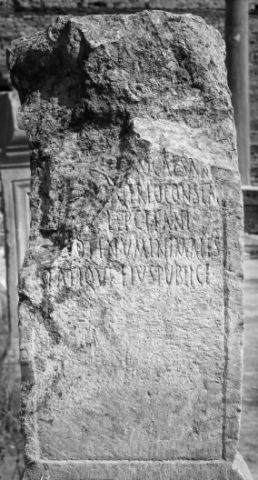
Inscription
[Fortissimo ac?] / [nobilissi]mo Caesari, / [Flavio V]alerio Constan/[tio], Lepcitani, /(5) [de]voti numini maies/tatique eius, publice.
Inscription translation
To the most powerful and most noble Caesar, Flavius Valerius Constantius; the people of Lepcis (Lepcitani), devoted to his divine spirit and majesty, [set this up] with public funds
Bibliography
- Lepelley, C., Les cités de l’Afrique romaine au Bas-Empire, I-II, Paris 1979-1981, vol. II p. 342 with n. 30
- Reynolds, J. M. & J. B. Ward-Perkins, The Inscriptions of Roman Tripolitania. In collaboration with S. Aurigemma, R. Bartoccini, G. Caputo, R. Goodchild, P. Romanelli, Roma 1952, no. 466
- Tantillo, I. and F. Bigi (eds.), Leptis Magna. Una città e le sue iscrizioni in epoca tardoromana, Cassino 2010, 316-317, no. 2, figs. 7.22, 10.2, pl. IV
Discussion
INSCRIPTION
In six lines of which five are partly preserved:
[Fortissimo ac?] / [nobilissi]mo Caesari, / [Flavio V]alerio Constan/[tio], Lepcitani, /(5) [de]voti numini maies/tatique eius, publice.
'To the most powerful and most noble Caesar, Flavius Valerius Constantius; the people of Lepcis (Lepcitani), devoted to his divine spirit and majesty, [set this up] with public funds.'
Letter height 4 cm.
DESCRIPTION
Limestone block, with mouldings at top and bottom: H 135, W 60, D 60 cm. The upper half of the front face is broken off destroying the opening of the inscription. The right and the back faces are only roughly finished. On the top face there are traces of five holes for the fixing of the statue, two at the front and three at the back; one of the holes at the back still contains remnants of a metal dowel.
Our inscription is carved over an erased earlier one. A third use of the base, at an undetermined time, is possibly indicated by a rectangular cavity towards the bottom of its left face, which may once have contained an inscribed panel fixed with a single dowel (Tantillo & Bigi 2010, 227-8).
PROVENANCE AND CURRENT LOCATION
Found on the eastern side of the Severan Forum, where it remains today.
HONORAND AND DATE
The editors of The Inscriptions of Roman Tripolitania were uncertain whether to attribute the inscription to Constantine I or to his father Constantius I, with an implicit preference for the former. In our view, however, there are good reasons to attribute it to Costantius, Caesar 293-305. Firstly, in inscriptions to Constantine, the nomen Valerius (line 3) is mostly abbreviated to 'Val(erius)', whereas in inscriptons to Constantius it is normally given in its extended form (as here). Secondly, in inscriptions to Constantine, the title of 'nobilissimus Caesar' (line 2) always follows the imperial name, whereas in tetrarchic inscriptions it precedes it (in keeping with the ideological goal of enhancing the status of the Caesars). Thirdly, the epithet 'nobilissimus' in its extended form (as here, line 2) is rare in inscriptions to Constantine, but frequently used for his father.
FURTHER DISCUSSION
The shape and working of the mouldings are similar to those on a base of very similar dimension, dedicated to Severus (LSA-2150). The two bases perhaps came from the same workshop.
Cite: Last Statues of Antiquity, LSA-2148 (Ignazio Tantillo & Francesca Bigi).