
LSA-215
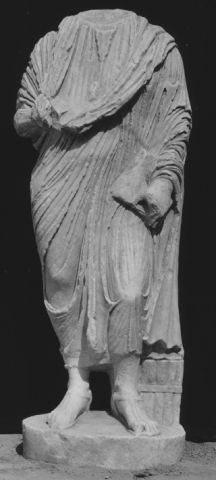
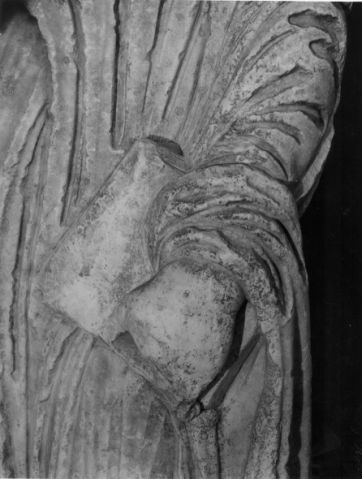
Himation statue (headless) holding codex. Aphrodisias (Caria). Fourth century.
Record details
Photographs
Bibliography
- Smith, R.R.R. 'Late antique portraits in a public context: Honorific statuary at Aphrodisias in Caria, AD 300-600' , Journal of Roman Studies, 89 (1999), 155-89, pl. 5.1
Discussion
DESCRIPTION (Object)
Over life-size statue. H: 192, W: 70, D: 48 cm. H (of plinth): 15 cm. Medium to fine-grained white marble.
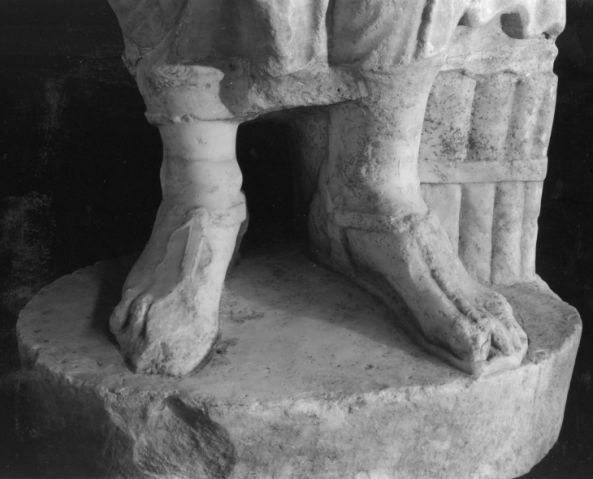
The statue was worked in one piece with the head (missing) and the tall plain plinth. Preserved in two main pieces: (1) body and (2) plinth with feet, ankles, and support.
PROVENANCE
Excavated at the street south of the Tetrapylon in 1983 and 1987.
DESCRIPTION (Subject)
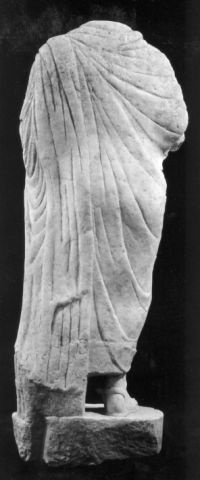
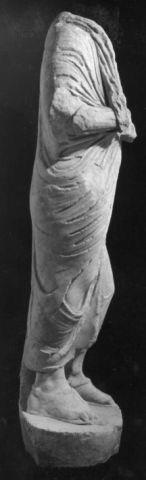
The subject wears a tunic, himation, and open sandals. He holds a codex in his left hand and is supported by a strapped bundle of scrolls. The figure has a strange, ungainly, top-heavy composition—massive, sloping shoulders, broad hips, small arms, feet close together with both knees looking as if bent, and an exceptionally tall plinth. The drapery traces unusual, ‘irrational’ contour lines across the figure.
The himation is worn in the ‘arm-sling’ posture, and the right hand was open in a gesture of address. Its attachment point is present in the middle of the chest. The prominent codex (unusual in late antique statues) has its pages modelled, engraved, and visible on its two ‘open’ sides which are treated in kind of perspective foreshortening.
DATE
The technical handling (the awkward figural composition, drapery style, rendering) and the codex all indicate a late antique date, which given its large scale, should probably still be in the fourth century.
ANOTHER VERSION
The same unusual statue composition is reproduced closely in a statue from Ephesus (LSA-737). They are close in both posture and unusual details of drapery composition and are probably replicas of a common design. The main difference is that the Ephesus statue is better controlled and carried an unidentified object in his left hand instead of a codex.
Cite: Last Statues of Antiquity, LSA-215 (R.R.R. Smith).