
LSA-2150
Base for statue of Severus, emperor. Lepcis Magna (Tripolitania). 305-306.
Record details
Photographs
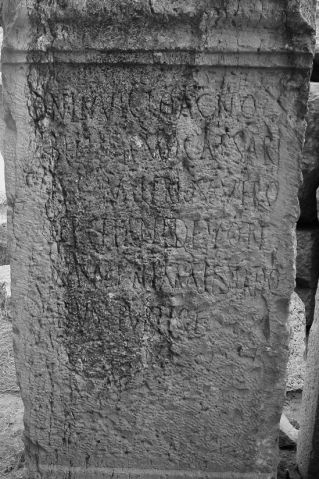
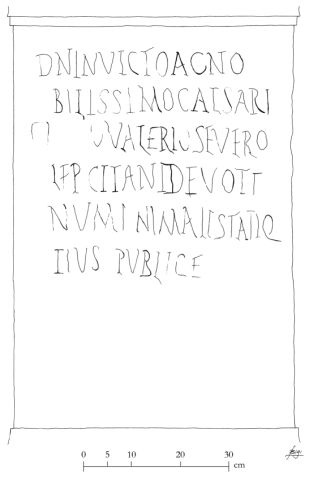
Inscription
D(omino) n(ostro) invicto ac no/bilissimo Caesari, / Fl[avi]o Valerio Severo, / Lepcitani, devoti / numini maiestatiq(ue) / eius, publice.
Inscription translation
To our lord, the unconquered and most noble Caesar, Flavius Valerius Severus; the people of Lepcis (Lepcitani), devoted to his divine spirit and majesty, [set this up] with public funds.
Bibliography
- Lepelley, C., Les cités de l’Afrique romaine au Bas-Empire, I-II, Paris 1979-1981, vol. II p. 341 with note 27
- Reynolds, J. M. & J. B. Ward-Perkins, The Inscriptions of Roman Tripolitania. In collaboration with S. Aurigemma, R. Bartoccini, G. Caputo, R. Goodchild, P. Romanelli, Roma 1952, no. 463
- Tantillo, I. and F. Bigi (eds.), Leptis Magna. Una città e le sue iscrizioni in epoca tardoromana, Cassino 2010, 320-321, no. 4, figs. 7.22, 10.5-6, pl. IV
Discussion
INSCRIPTION
In six lines:
D(omino) n(ostro) invicto ac no/bilissimo Caesari, / Fḷ[avi]o Valerio Severo, / Lepcitani, devoti /(5) numini maiestatiq(ue) / eius, publice.
‘To our lord, the unconquered and most noble Caesar, Flavius Valerius Severus; the people of Lepcis (Lepcitani), devoted to his divine spirit and majesty, [set this up] with public funds.’
Letter height 5 - 5.5 cm.
DESCRIPTION
Rectangular limestone base, with mouldings at top and bottom: H 144, W 60, D 62 cm. Our inscription marks the third or even fourth use of the base. On the left side (the original front) a dedication to Gordian III (AD 238-44; Reynolds and Ward-Perkins 1952 no. 454) is carved over an erased earlier inscription. On this same face there are also evident changes to the upper and lower mouldings, and to the framing of the epigraphic field, which may have been caused by a third use (the fixing of a marble plaque, bearing a new inscription).
PROVENANCE AND CURRENT LOCATION
The base is standing in the southern portico of the Severan forum in Lepcis, close to the central exedra. Its original position on the forum is unknown.
HONORAND, AWARDER AND DATE
Severus, the honorand, was Caesar 305-6 and proclaimed Augustus after Constantius I’s death in 306; this dates our inscription to 305-6.
The inscription was set up by the people of Lepcis, from public funds.
FURTHER DISCUSSION
Our inscription was possibly accompanied by similar dedications to the other emperors of the second tetrarchy (Constantius I, Galerius, and Maximinus Daia). In its dimensions and the details of its carving it resembles a dedication to Constantius I (LSA-2148), which, however, is not directly contemporary.
Cite: Last Statues of Antiquity, LSA-2150 (Ignazio Tantillo & Francesca Bigi).