
LSA-2151
Base for statue of Maxentius, emperor. Lepcis Magna (Tripolitania). 307-308
Record details
Photographs
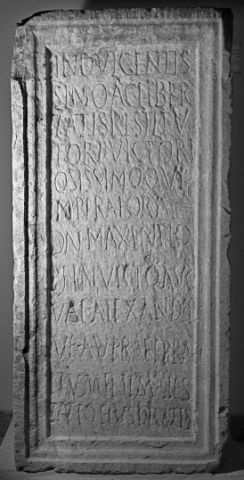
Inscription
Indulgentis/simo ac liber/tatis restitu/tori, victori/osissimoque /(6) imperatori, / d(omino) n(ostro) Maxentio, / p(io), f(elici), invicto Aug(usto), / Val(erius) Alexander, /(10) v(ir) p(erfectissimus), a(gens) v(ices) praef(ecti) praet(orio), / numini maies/tatiq(ue) eius dicatiss(imus).
Inscription translation
To the most indulgent and restorer of freedom, and most victorious emperor, our lord Maxentius, pious, fortunate, unconquered Augustus. Valerius Alexander, of perfectissimus rank, acting as vicar for the praetorian prefect, most dedicated to his divine spirit and majesty, [set this up].
Bibliography
- Lepelley, C., Les cités de l’Afrique romaine au Bas-Empire, I-II, Paris 1979-1981, vol. II, p. 341 with n. 28
- Reynolds, J. M. and J. B. Ward-Perkins, Inscriptions of Roman Tripolitania, enhanced electronic reissue by Gabriel Bodard and Charlotte Roueché (available at http://irt.kcl.ac.uk/irt2009/index.html), London 2009, no. 464
- Tantillo, I. and F. Bigi (eds.), Leptis Magna. Una città e le sue iscrizioni in epoca tardoromana, Cassino 2010, 321-3, no. 5, fig. 10.7
Discussion
INSCRIPTION
In twelve lines:
Indulgentis/simo ac liber/tatis restitu/tori, victori/osissimoque /(6) imperatori, / d(omino) n(ostro) Maxentio, / p(io), f(elici), invicto Aug(usto), / Val(erius) Alexander, /(10) v(ir) p(erfectissimus), a(gens) v(ices) praef(ecti) praet(orio), / numini maies/tatiq(ue) eius dicatiss(imus).
'To the most indulgent and restorer of freedom, and most victorious emperor, our lord Maxentius, pious, fortunate, unconquered Augustus. Valerius Alexander, of perfectissimus rank, acting as vicar for the praetorian prefect, most dedicated to his divine spirit and majesty, [set this up].'
Letter height 4-5 cm.
DESCRIPTION
Rectangular brown limestone shaft of a base: H 95, W 50, D 53 cm. The plinth and the crowning element were worked separately and are today lost; the epigraphic field is framed on all four sides. The surface of the epigraphic field is somewhat irregular, perhaps a sign of the erasure of an earlier inscription; but there is also damage to some of the letters of our inscription, so the roughness may have been caused by an attempted partial erasure of our text, or by a roughening of the surface in order to cover it in a layer of plaster (Tantillo & Bigi 2010, 323 no. 5).
PROVENANCE AND CURRENT LOCATION
The base comes from the Severan forum of Lepcis where it was probably set up at the north-east corner, together with a similar base, likewise to Maxentius (LSA-2152; map Tantillo & Bigi 2010 pl. 1 no. 6). It is today in the Lepcis Museum (without published inv. no.).
HONORAND, AWARDER AND DATE
Maxentius, the honorand, was Augustus 307-12, though recognized only in Italy and the African provinces.The praise for him as ‘the most kindly restorer of freedom and most victorious emperor’ (in lines 1-5) must refer to his victory over Galerius in 307 (Tantillo & Bigi 2010, 43).
Valerius Alexander, the awarder, was vicar of the African diocese (line 10; PLRE I, 44, Val. Alexander 20). He is to be identified with the usurper Lucius Domitius Alexander, who held power in Africa in 308-10 (PLRE I, 43, L. Domitius Alexander 17; for the justification of this identification on historical and prosopographical grounds, see Porena in Tantillo & Bigi 2010, 41-3); this provides a terminus ante quem of 308 for our inscription.
FURTHER DISCUSSION
Another base to Maxentius, similar in size and shape, and with identical formula, was set up in the Severan forum by the governor (praeses) of Tripolitania, Volusius Donatianus (LSA-2152; see above, ‘Provenance and Location’).
Our inscription, like its pendant LSA-2152, surprisingly survives without Maxentius' name being erased after his defeat by Constantine in 312. However, a careful examination of the inscription shows that it may well have been plastered over (see above, ‘Description’), probably at the time of Domitius Alexander's usurpation (Tantillo & Bigi 2010, 44).
Cite: Last Statues of Antiquity, LSA-2151 (Ignazio Tantillo & Francesca Bigi).