
LSA-2152
Base for statue of Maxentius, emperor. Lepcis Magna (Tripolitania). 307-308.
Record details
Photographs
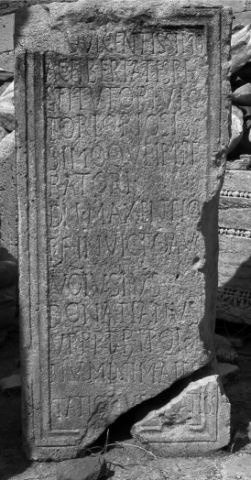
Inscription
[In]dulgentissimo / ac libertatis re/stitutori, vic/torioriosis/simoque (sic) impe/ratori, /(7) d(omino) n(ostro) Maxentio, / p(io), f(elici), invicto Aug(usto), / Volusius / (10) Donatianus, / v(ir) p(erfectissimus), p(raeses) p(rovinciae) / Tripol(itanae), / numini maies/tatiq(ue) [e]ius dicatiss(imus).
Inscription translation
To the most indulgent, and restorer of freedom, and most victorious emperor, our lord Maxentius, pious, fortunate, unconquered Augustus. Volusius Donatianus, of perfectissimus rank, governor (praeses) of the province of Tripolitania, most dedicated to his divine spirit and majesty, [set this up].
Bibliography
- Lepelley, C., Les cités de l’Afrique romaine au Bas-Empire, I-II, Paris 1979-1981, vol. II, pp. 241-342 with n. 29.
- Reynolds, J. M. & J. B. Ward-Perkins, The Inscriptions of Roman Tripolitania. In collaboration with S. Aurigemma, R. Bartoccini, G. Caputo, R. Goodchild, P. Romanelli, Roma 1952, no. 465
- Tantillo, I. and F. Bigi (eds.), Leptis Magna. Una città e le sue iscrizioni in epoca tardoromana, Cassino 2010, 323-5, no. 6, fig. 10.8
Discussion
INSCRIPTION
In 13 lines:
[In]dulgentissimo / ac libertatis re/stitutori, vic/torioriosis/simoque (sic) impe/ratori, /(7) d(omino) n(ostro) Maxentio, / p(io), f(elici), invicto Aug(usto), / Volusius / (10) Donatianus, / v(ir) p(erfectissimus), p(raeses) p(rovinciae) / Tripol(itanae), / numini maies/tatiq(ue) [e]ius dicatiss(imus).
‘To the most indulgent, and restorer of freedom, and most victorious emperor, our lord Maxentius, pious, fortunate, unconquered Augustus. Volusius Donatianus, of perfectissimus rank, governor (praeses) of the province of Tripolitania, most dedicated to his divine spirit and majesty, [set this up].’
Letter height 5 cm.
DESCRIPTION
Rectangular shaft of a base, of brown limestone: H 105, W 48, D 50 cm. Plinth and crowning element were worked separately and are today lost. The lower right corner is broken but not lost; a portion of the right margin, and the upper left corner are chipped. The surface of the epigraphic field shows numerous traces of chisel work; these indicate either that our inscription is carved over an erased earlier one, or, more likely, that it was dressed to be covered with plaster at a later date.
PROVENANCE AND CURRENT LOCATION
The base is standing in the northwest corner of the Severan forum of Lepcis Magna, where it was found.
HONORAND, AWARDER AND DATE
Maxentius, the honorand, was Augustus 307-12, though recognized only in Italy and in the African provinces.
Volusius Donatianus, the awarder, was governor (praeses) of the province of Tripolitania (PLRE I, 268, Donatianus 7).
The formula of the inscription, as well as the shape and dimensions of the base, and, last but not least, the appearance of the surface with the traces of chisel work, are very similar to a second dedication to Maxentius in Lepcis, set up by the vicar Valerius Alexander (LSA-2151) which can be narrowly dated to 307/8. The close resemblance of the two bases makes it highly probable that they were erected contemporaneously.
FURTHER DISCUSSION
Our inscription, like its pendant LSA-2151, surprisingly survives without Maxentius' name being erased after his defeat by Constantine in 312. However, this may well be because they were plastered over (see above, ‘Description’), probably at the time of Domitius Alexander's usurpation (Tantillo & Bigi 2010, 44).
Cite: Last Statues of Antiquity, LSA-2152 (Ignazio Tantillo & Francesca Bigi).