
LSA-2153
Base for statues of Constantius II and Constantius Gallus, emperors. Lepcis Magna (Tripolitania). 352-354.
Record details
Photographs
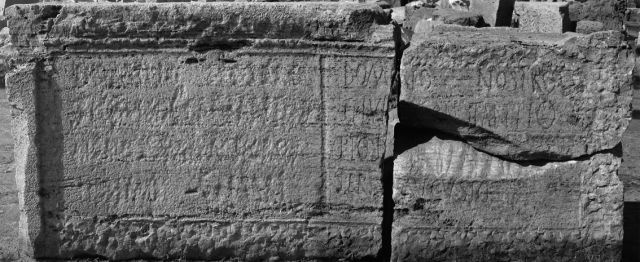
Inscription
column 1
[[Domino nostro]] / [[Fl(avio) Claudio Constantio]],
/[[nobilissimo ac floren]]/[[tissimo Caesari]].
column 2
Domino nostro / Fl(avio) Iul(io) Constantio, / pio, f[elici], sem/per Augusto.
Inscription translation
column 1
To our lord Flavius Claudius Constantius, most noble and prosperous Caesar.
column 2
To our lord Flavius Iulius Constantius, pious, fortunate, eternal Augustus.
Bibliography
- Lepelley, C., Les cités de l’Afrique romaine au Bas-Empire, I-II, Paris 1979-1981, vol. II, p. 342 with n. 32
- Reynolds, J. M. & J. B. Ward-Perkins, The Inscriptions of Roman Tripolitania. In collaboration with S. Aurigemma, R. Bartoccini, G. Caputo, R. Goodchild, P. Romanelli, Roma 1952, no. 469
- Tantillo, I. and F. Bigi (eds.), Leptis Magna. Una città e le sue iscrizioni in epoca tardoromana, Cassino 2010, 325-7, no. 7, figs. 7.23, 10.9, pl. IV
Discussion
INSCRIPTION
Text laid out in two separate columns, separated by a vertical line. Each column consists of four lines of text, and each presumably stood under the respective statues of the two emperors honoured:
Column 1:
[[Domino nostro]] / [[Fl(avio) Claudio Constantio]], / [[nobilissimo ac floren]]/[[tissimo Caesari]].
‘To our lord Flavius Claudius Constantius, most noble and most prosperous Caesar.'
This text has been deliberately erased, but its traces are still legible in part.
Column 2:
Domino nostro / Fl(avio) Iul(io) Constantio, / pio, f[elici], sem/per Augusto.
‘To our lord Flavius Iulius Constantius, pious, fortunate, eternal Augustus.’
Letter height 5.5 - 6 cm.
Below these texts, we assume that the awarder, almost certainly the people of Lepcis, was named, as on other dedications; this line may have been carved on the frame, which was cut back at a later time (for an example of this, see LSA-2174).
In column 1, Reynolds read Constantino instead of Constantio (see below, 'Honorands, Awarder and Date')
DESCRIPTION
Shaft of a large base of grey limestone: H 108, W 212, D 92 cm. Plinth and crowning element were worked separately. The plinth survives, separated from this shaft (see below, ‘Provenance and Current Location’); the crowning element is lost. The frame which once surrounded the epigraphic field has been worked back with a point. The right third of the block has been sawn off and reduced in height. This right-hand end is horizontally broken in two, the break destroying a portion of lines 2 and 3 of the inscription. This damage was presumably caused by a later use of the block as building material.
Our dedication is the third use of this base, which in its first two uses was for an equestrian statue, with the dedicatory inscription on one of the short ends (the right end relative to our inscription). The first use can be dated, by the shape of the base's mouldings, to the late 2nd/early 3rd century (Tantillo & Bigi 2010, 245 ch. 7.3.11). In the reign of Gallienus (253-68), the original dedication was erased and an inscription to this empror added (Reynolds & Ward Perkins no. 457). Finally, our inscription documents the third use of the base, to support statues of Constantius II and Constantius Gallus, standing side by side.
PROVENANCE AND CURRENT LOCATION
Our block stands in the eastern part of the Severan forum of Leptis, where it was found by the Italian excavators of the earlier 20th century. Its plinth, however, survives some distance away, behind the columns of the eastern portico of the forum. Our monument was probably set up as a counterpart to the very similar double dedication to Constantius I and Galerius (305/6), at the entrance of the large exedra leading to the basilica (LSA-2149, map Tantillo & Bigi 2010, pl. I)
HONORANDS, AWARDER AND DATE
The name of one honorand, Constantius II, is clearly legible (on column 2), honoured here during his rule as Augustus (337-61).
The other column of inscription has been deliberately erased, and is very difficult to read: of the imperial name, only the final O can be read with any confidence, and this does not help with its identification. Earlier editors attributed the dedication to Constantius II's brother, Constantine II (Augustus 337-40, whose name was often erased after his fall from power), and read an 'N' before the final O. However this N is no longer legible, nor does there seem to be sufficient space for it before the final O, whereas in line 4 the title 'Caesari' can be read with confidence. This title excludes Constantine II as the honorand, since, for all the time that Constantius II was an Augustus, so too was Constantine II (indeed, as Constantius' elder brother, he was the senior figure) (Tantillo & Bigi 2010, 326). In our view, therefore, this inscription has to be attributed to Constantius Gallus, Caesar under Constantius II between 351 and 354, whose name too, after his execution, was often removed from inscriptions.
The common reign of Constantius II and Constantius Gallus is 351-4, but it is very unlikely that our inscription was set up during the time that the usurper Magnentius (350-3) ruled over Africa (between 350 and 352). It is indeed likely to have been erected after the successes of Constantius II's generals over Magnentius in late 352, to celebrate these successes and mark the loyalty of the citizens of Lepcis to the newly triumphant Augustus, Constantius II, and his Caesar, Constantius Gallus.
Cite: Last Statues of Antiquity, LSA-2153 (Ignazio Tantillo & Francesca Bigi).