
LSA-2154
Base for statue of Constantius II, emperor. Lepcis Magna (Tripolitania). 352-361.
Record details
Photographs
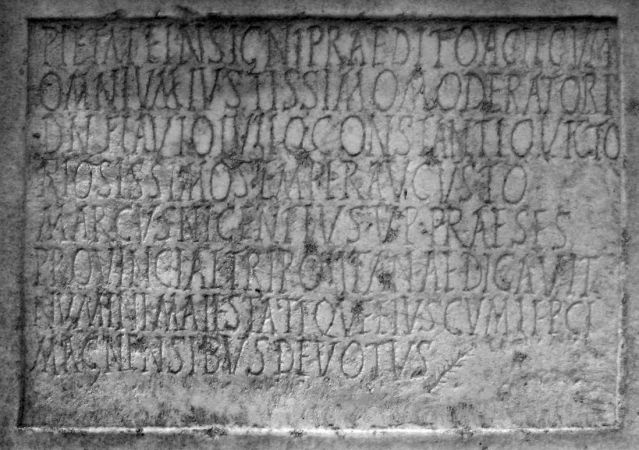
Inscription
Pietate insigni praedito ac legum / omnium iustissimo moderatori / d(omino) n(ostro) Flavio Iulio Constantio victo/riosissimo semper Augusto / Marcus Nicentius v(ir) p(erfectissimus) praeses / provinciae Tripolitanae dicavit / numini maiestatique eius cum Lepci/magnensibus devotus
Inscription translation
To one gifted with exceptional piety, and a most just moderator of all laws, our lord Flavius Iulius Constantius, most victorious, forever Augustus. Marcus Nicentius, of perfectissimus rank, governor (praeses) of the province of Tripolitania dedicated [this statue], devoted, with the people of Lepcis Magna, to his divine spirit and majesty.
Bibliography
- Reynolds, J. M. & J. B. Ward-Perkins, The Inscriptions of Roman Tripolitania. In collaboration with S. Aurigemma, R. Bartoccini, G. Caputo, R. Goodchild, P. Romanelli, Roma 1952, no. 471
- Tantillo, I. and F. Bigi (eds.), Leptis Magna. Una città e le sue iscrizioni in epoca tardoromana, Cassino 2010, 327-9, no. 8, figs. 7.14, 10.10, pl. V
Discussion
INSCRIPTION
In eight lines:
Pietate insigni praedito ac legum / omnium iustissimo moderatori / d(omino) n(ostro) Flavio Iulio Constantio victo/riosissimo semper Augusto /(5) Marcus Nicentius v(ir) p(erfectissimus) praeses / provinciae Tripolitanae dicavit / numini maiestatique eius cum Lepci/magnensibus devotus.
'To one gifted with exceptional piety, and a most just moderator of all laws, our lord Flavius Iulius Constantius, most victorious, forever Augustus. Marcus Nicentius, of perfectissimus rank, governor (praeses) of the province of Tripolitania dedicated [this statue], devoted, with the people of Lepcis Magna, to his divine spirit and majesty.'
Letter height 3.5 cm.
DESCRIPTION
Monolithic base of Proconnesian marble, moulded at top and bottom; H 110, W 90, D 55 cm. The mouldings are carelessly worked at the sides. The epigraphic field is set back and surrounded by a plain frame. The sides are smoothly finished, the back only roughly. On the back face there is a deep cut running lengthwise across the entire lower part of the base. This was probably made in order to set the base in front of an architectural element with a protruding part moulding. The top face is finished with a chisel; it has a single large cylindrical hole somewhat off centre to the front left; this was probably to fix the dowel of a statue plinth.
The anomalous proportions of the base (of limited height and almost square) suggest that it may originally have been an architectural block. Its width and the mouldings are similar, if slightly deviant in size, to the Ionic pedestals of the Severan Baslica. The block was possibly originally a discarded building block.
Our inscription is carved over an earlier one that has thoroughly been erased; traces of it remain visible, however, at various points of the surface.
PROVENANCE AND CURRENT LOCATION
The inscription was first recorded in 1945 on the northern side of the square of the Severan Forum, where it remains.
HONORAND, AWARDER AND DATE
Constantius II, the honorand (full name Flavius Iulius Constantius, as in our inscription) was Augustus 337-61. Particularities of the epigraphic formula suggest that the inscription was probably set up after the defeat of Magnentius in 352 (see below, ‘Further Discussion’).
Marcus Nicentius, the awarder, was governor (praeses) of the province of Tripolitania. He is not attested elsewhere; however, he is possibly identical with a Nicentius who was a correspondent of Libanius and held several high administrative posts. This Nicentius was governor of Syria in 358 (Tantillo & Bigi 2010, 329 with references), a higher-ranking office which would then provide a terminus ante quem for our inscription.
Exceptionally, the citizens of Lepcis are included in the governor's expression of loyalty towards the emperor.
FURTHER DISCUSSION
The epigraphic formula is unusual: notably the phrase legum omnium iustissimo moderatori (lines 1-2) is unparalleled. This role as ‘moderator of the laws’ highlights the mildness of the emperor; a motif which occurs in encomiastic speeches addressed to Constantius II by Themistius (Oration I 14d – 15c) and Julian (Oration 1, 48, a-b), after his defeat of Magnentius.
Cite: Last Statues of Antiquity, LSA-2154 (Ignazio Tantillo & Francesca Bigi).