
LSA-2155
Base for statue of Valentinian I or Valens, emperors (with LSA-2156). Lepcis Magna (Tripolitania). 364-367.
Record details
Photographs
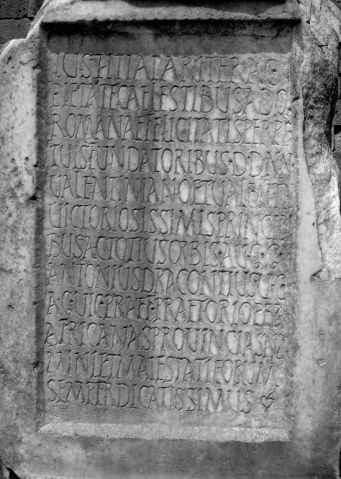
Inscription
Iustitia pariter ac / pietate caelestibus adq(ue) /Romanae felicitatis perpe/tuis fundatoribus, dd(ominis) nn(ostris) /(5) Valentiniano et Valenti / victoriosissimis principi/bus ac totius orbis Augg(ustis), / Antonius Dracontius v(ir) c(larissimus), / ag(ens) vic(es) praef(ectorum) praetorio per /(10) Africanas provincias, ni/mini (sic, for 'numini') et maiestati eorum / semper dicatissimus. (ivy leaf)
Inscription translation
'To [rulers] equally celestial in justice as in piety, and perpetual founders of Roman happiness, our lords Valentinianus and Valens, most victorious princes and Augusti of the entire world. Antonius Draconius, of clarissimus rank, acting as vicar of the praetorian prefect for the provinces of Africa, always most dedicated to their divine spirit and majesty, [set this up].'
Bibliography
- Reynolds, J. M. & J. B. Ward-Perkins, The Inscriptions of Roman Tripolitania. In collaboration with S. Aurigemma, R. Bartoccini, G. Caputo, R. Goodchild, P. Romanelli, Roma 1952, 472
- Tantillo, I. and F. Bigi (eds.), Leptis Magna. Una città e le sue iscrizioni in epoca tardoromana, Cassino 2010, 329-331, no. 9, figs. 7.19, 10.11, pl. XXV
Discussion
INSCRIPTION
In twelve lines:
Iustitia pariter ac / pietate caelestibus adq(ue) / Romanae felicitatis perpe/tuis fundatoribus, dd(ominis) nn(ostris) /(5) Valentiniano et Valenti / victoriosissimis principi/bus ac totius orbis Augg(ustis), / Antonius Dracontius v(ir) c(larissimus), / ag(ens) vic(es) praef(ectorum) praetorio per /(10) Africanas provincias, ni/mini (sic, for numini) et maiestati eorum / semper dicatissimus. (ivy leaf)
'To [rulers] equally celestial in justice as in piety, and perpetual founders of Roman happiness, our lords Valentinianus and Valens, most victorious princes and Augusti of the entire world. Antonius Draconius, of clarissimus rank, acting as vicar of the praetorian prefect for the provinces of Africa, always most dedicated to their divine spirit and majesty, [set this up].'
Letter height 4 - 5 cm.
DESCRIPTION
Monolithic base of Proconnesian marble (with prominent vertical veining), with mouldings at top and bottom: H 155, W 47, D 76 cm. The upper moulding is broken on all sides; at the bottom, the left front and the back right corners are broken; part of the front right corner is lost. Only a small area of the surface of the top face is preserved, which is smoothly finished. Both sides are smoothly finished and have a moulded frame in the centre. The back face is finished with a point. The epigraphic field is deeply indented and surrounded by a broad and plain frame.
At the upper left corner, on the frame, are the remaining traces of an incised small wreath of leaves over a ribbon; this is probably a remnant of an earier use of the base (see next pragraph).
Our inscription is the third use of the base. The form of the lower moulding, the frames on the lateral faces of the block, the marble quality (with the vertical veins careful set to make them visible at the sides but not on the front face), and the measurements of the block (and of its single parts) have an exact correspondence in a set of three bases set up by Aemilia Victrix to her sons in the Antonine period. Our base most probably once formed a part of this ensemble. The extant bases show that the original epigraphic field was surrounded by a moulded frame. This must still have been in use when the base was re-used for the first time, as shown by the small wreath on the upper left corner; such an element is usually incised above the frame of the epigraphic field. This is where a signum was usually carved, a feature of inscriptions that began to spread towards the middle of the 3rd century. The wreath therefore indicates a second use of the base in the later 3rd century. Our Inscription of the 360s is a third use, for which the epigraphic field was extended and the frame and upper bar (with signum) removed.
PROVENANCE AND CURENT LOCATION
The inscription was first recorded in 1928 in the north-eastern part of the Severan forum, where it remains today.
HONORAND, AWARDER AND DATE
Valentinian I, the first honorand, was Augustus 364-75; his brother Valens, the second honorand, Augustus 364-78. A terminus ante quem is provided by the elevation of Valentinian’s son Gratian to the rank of Augustus in 367, because Gratian is not recorded in the inscription. Our base supported the statue of one of the two emperors, probably the senior Augustus, Valentinian (see below, ‘Further Discussion’).
Antonius Dracontius, the awarder, was certainly vicar of the African provinces in 364-7 (but possibly as early as 363; PLRE I, 271-2 Antonius Dracontius 3), at a time when Tripolitania was in turmoil because of the incursions of the Austuriani (Tantillo & Bigi 2010, 22-4 ch. 1.1.5). He set up on a similar base in Lepcis an almost identical inscription to the two emperors (LSA-2156), and further inscriptions to Valentinian and Valens in Sabratha (LSA-2562, LSA-2563), and Furnos Minus (LSA-1823), as well as one to Gratian the father of the two emperors in Cirta (LSA-2320). He was himself probably honoured with a statue in Lepcis Magna (LSA-2172).
FURTHER DISCUSSION
The two bases set up by Dracontius in Lepcis to Valentinian I and Valens (our base, and LSA-2156), will each have carried a statue of one of the emperors. Since our base is slightly the larger, it was probably the one for the senior Augustus, Valentinian I.
Discussion references
- Jones, A. H. M. et al., The Prosopography of the Later Roman Empire. Vol. I 260-395, Cambridge et al. 1971 (1975)
Cite: Last Statues of Antiquity, LSA-2155 (Ignazio Tantillo & Francesca Bigi).