
LSA-216
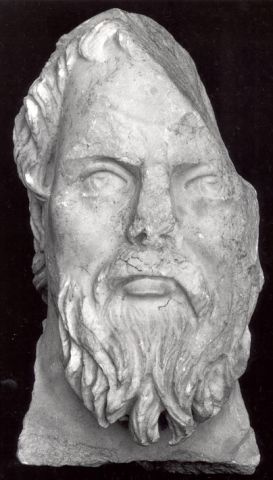
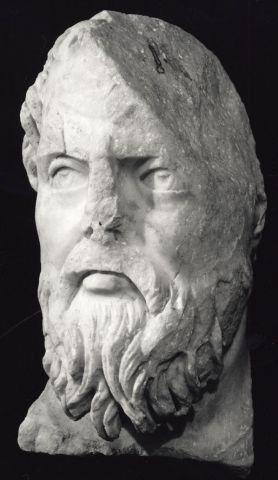
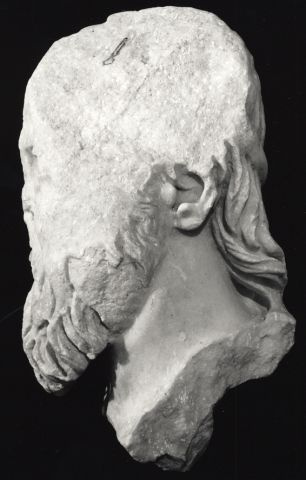
Bust of bearded male with long hair. Aphrodisias (Caria). Fourth century.
Record details
Photographs
Bibliography
- Erim, K.T., "De Aphrodisiade'", AJA 71 (1967), 238, figs. 17-18
Discussion
DESCRIPTION (Object)
Life-size head preserved with small portion of bust around the neck. H: 36, W: 18, D: 22 cm. Medium-grained white marble.
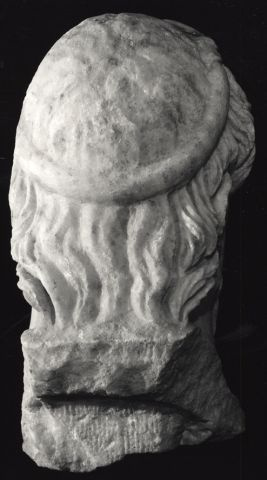
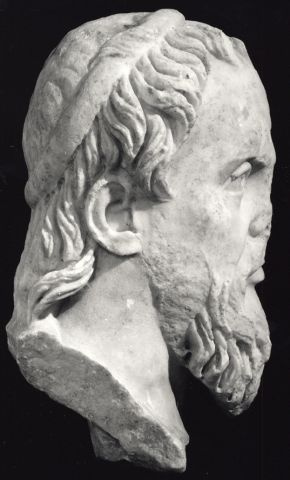
The bust is broken on the sides of the neck and across the front of the body at the point of convergence of the sternocleidomastoids. A diagonal break also runs from the the hairline above the right eye down to the top of the left ear.
The chest area of the bust is missing. A section of the top left of the head as well as the top of the left ear; the front part of the upper rim of the right ear; most of the moustache over the lip; and the nose are also missing. The top left corner of the spine has chipped off. The ends of some locks in the front right sector of the beard are broken. There are chips in the left cheek in the area of the beard and in the right eyebrow.
The flesh is smoothly finished, and there is a trace of high polish on the lower lip. The pupils have a large and unusual U shaped perimeter. The ends of the beard locks are connected by 'bridges' of marble on the right and front sides. The flat chisel has been used for engraved lines; for example, the lines that denote the irises, the origin of the locks high on the cheeks, and the individual strands within locks of hair. The top and upper back are not fully worked. The lower part of the hair at the back, however, is worked.
The hollowed bust is supported behind by a flat spine. Its surface is evenly worked with a broad claw chisel over a pointed area. The hollowed area of the bust is roughly picked.
PROVENANCE
The fragmentary bust was discovered in 1961 before the official New York University Excavations began. It was found at the 'Water Channel', located in the NE part of site at the city wall.
DESCRIPTION (Subject)
The bust portrays a mature bearded man whose long hair is held by a band and who turns sharply to his right. The turn of the head, the deep drillwork (mainly in the hair), and the crisp edges of the eyes and eyebrows animate the bust. The long hair and beard in conjunction with the costume, a himation over a bare chest, give the sitter the aspect and attributes of a philosopher.
DATE
The drilling of the eye suggests a date in the fourth century AD.
Cite: Last Statues of Antiquity, LSA-216 (J. Lenaghan).