
LSA-2163
Small fragment of dedication to unknown emperor, possibly from base for statue. Lepcis Magna (Tripolitania). Fourth century.
Record details
Photographs
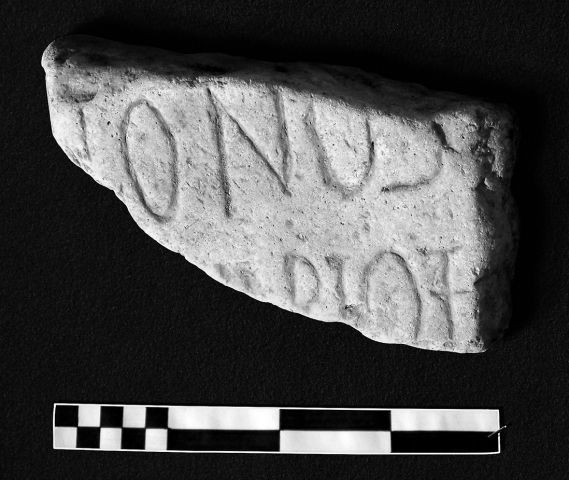
Inscription
- - - - - -? / [- - - domi]no nos[tro - - -] / [- - -]++ pio f[elici - - -] / - - - - - -
Inscription translation
...to our lord...pious, fortunate....
Bibliography
- Reynolds, J. M. & J. B. Ward-Perkins, The Inscriptions of Roman Tripolitania. In collaboration with S. Aurigemma, R. Bartoccini, G. Caputo, R. Goodchild, P. Romanelli, Roma 1952, no. 513
- Tantillo, I. and F. Bigi (eds.), Leptis Magna. Una città e le sue iscrizioni in epoca tardoromana, Cassino 2010, 340-341, no. 17, fig. 10.19
Discussion
Two lines preserved:
- - - - - -? / [- - - domi]no nos[tro - - -] / [- - -]++ pio f[elici - - -] / - - - - - -
'...to our lord...pious, fortunate....'.
Letter height 4.5 - 5 cm.
DESCRIPTION
Small fragment of a white marble plaque: H 12.3, W 22, D 2.2 cm. The fragment is without original edges and contains parts of two lines of an inscription. This plaque is possibly from a statue base (see below, ‘Further Discussion’).
PROVENANCE AND CURRENT LOCATION
The inscription was found in 1931 in the Macellum. It is today kept in the store rooms of the museum (without published inventory number).
HONORAND AND DATE
The inscription is certainly to an emperor. The formula pio felici is often not abbreviated in the epigraphic record of Lepcis Magna from Caracalla to Arcadius and Honorius. However, the formula domino nostro without abbreviation, as in our inscription, occurs only rarely and suggests a late-antique date: its only occurrences in honorific inscriptions are the double dedication to Constantius II and Gallus (LSA-2150) and the one to Gratian (LSA-2157). Our inscription is therefore likely to be 4th-century in date.
FURTHER DISCUSSION
It is uncertain whether the inscription was set up at the Macellum, where it was found, because no other dedications to late-antique emperors are known from this structure. It was perhaps set up to one of the emperors who had the Macellum rebuilt, Constantine I or one of his sons (cf. Tantillo & Bigi 2010, no. 73).
Cite: Last Statues of Antiquity, LSA-2163 (Ignazio Tantillo & Francesca Bigi).