
LSA-2164
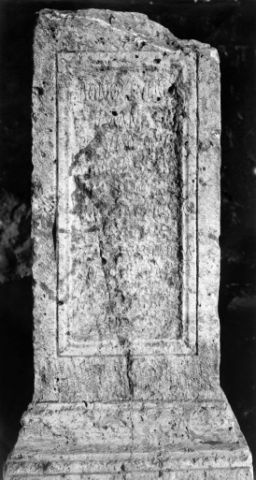
Base for statue of unknown emperor. Lepcis Magna (Tripolitania). Late third to early fourth century.
Record details
Photographs
Inscription
Bono generis / humani / pr[o]viso fortis/simo [principi] /(5) [d(omino) n(ostro) - - -] / [- 5? -]+L++[.]O/ [- - - A]ug(usto) / A[- 8? -]us Rogati[n]us / ṿ(ir) c̣(larissimus) ẠP̣LL d(evotus) n(umini) / m(aiestati)q(ue) /(10) e[ius cum Lepcimagne-] / n[sib]u[s? - - -] / [posuit?]
Inscription translation
To one provided for the good of human kind, the most powerful emperor … Augustus. A ...us Rogatinus, of clarissimus rank, … devoted to his divine spirit and majesty, with the people of Lepcis Magna … set this up.
Bibliography
- Reynolds, J. M. & J. B. Ward-Perkins, The Inscriptions of Roman Tripolitania. In collaboration with S. Aurigemma, R. Bartoccini, G. Caputo, R. Goodchild, P. Romanelli, Roma 1952, no. 539
- Tantillo, I. and F. Bigi (eds.), Leptis Magna. Una città e le sue iscrizioni in epoca tardoromana, Cassino 2010, 341-3, no. 18, figs. 7.23, 10.20-21
Discussion
INSCRIPTION
Partly preserved in eleven visible lines:
Bono generis / humani / pr[o]viso fortis/simo [principi] /(5) [d(omino) n(ostro) - - -] / [- 5? -]+L++[.]O/ [- - - A]ug(usto) / A[- 8? -]us Rogati[n]us / ṿ(ir) c̣(larissimus) ẠP̣LL d(evotus) n(umini) / m(aiestati)q(ue) /(10) e[ius cum Lepcimagne-] / n[sib]u[s? - - -] / [posuit?]
'To one provided for the good of human kind, the most powerful emperor … Augustus. A ...us Rogatinus, of clarissimus rank, … devoted to his divine spirit and majesty, with the people of Lepcis Magna … set this up.'
Letter height 2 - 4 cm.
DESCRIPTION
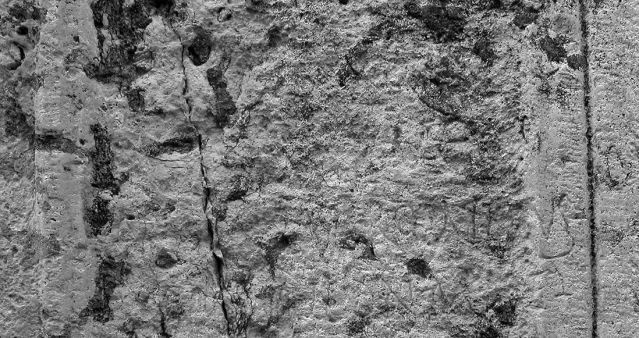
Monolithic rectangular statue base of porous limestone, with moulding at bottom: H 150, W 70, D 55 cm. The top is broken and lost, and the edges chipped. The surface is worn and the inscription partly illegible, in particular in lines 4-7.
The epigraphic field is indented and surrounded by a moulded frame; the inscription extends onto the frame. The sides are smoothly finished, the back only very roughly. On the top face there are two round holes at the right front and back corners, possibly to fix a bronze statue.
The epigraphic field is low and its surface uneven, particularly in the upper part. This suggets that our inscription was carved over an erased earlier one. The date of the first use is hard to determine; however, the flat forms of the mouldings, the scanty decoration, and the choice of limestone suggest that it was at a comparatively late date, perhaps not long before its re-use for our inscription.
PROVENANCE AND CURRENT LOCATION
The base was first recorded in 1954 in the southern colonnade of the Severan forum, where it is still standing.
HONORAND, AWARDER AND DATE
The dedication is certainly to an emperor; what is left of the name in line 6 is, however, insufficient to identify him. The introductory formula bono generis humani proviso (lines 1-3) is a variant of a formula found particularly in the Constantinian period, though it also occurs in the tetrarchic period (Tantillo & Bigi 2010, 342).
The awarder, A…us Rogatinus (line 8) is otherwise unknown (PLRE I, 767 Rogati(an)us 2). He bears a typical African name, was of senatorial (clarissimus) rank (line 9), and possibly held an office in the imperial administration, though this cannot be certain from the extant letters APLL in line 9. His senatorial rank excludes a governor (praeses) of Tripolitana, since these were of equestrian rank into the later 4th century. Possible solutions are: a proconsul of Africa (or a proconsular legate before 303); a vicar of the African provinces after 325; a praetorian prefect in the early 4th century or later; a comes rei militaris Africae of c. 330 or later; a comes et dux Tripolitanae from the late 4th century. A local notable of senatorial rank is also possible; or a military man with a special command, before Gallienus or after Constantine (in the intermediate period one would expect such a person to hold equestrian rank).
The inscription was perhaps set up by Rogatinus together with the people of Lepcis Magna (lines 10-11), a formula found on the base to Constantius II (LSA-2154).
The introductory formula of the inscription points to a late-antique date, the letter-forms suggesting a date in the first decades of the 4th century.
Cite: Last Statues of Antiquity, LSA-2164 (Ignazio Tantillo & Francesca Bigi).