
LSA-2165
Base for statue of unknown emperor. Lepcis Magna (Tripolitania). First half of fourth century.
Record details
Photographs
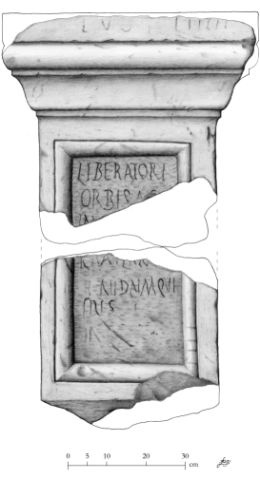
Inscription
Fragment A:
(on the top moulding) +VS+++++++ //
(in the epigraphic field) Liberatori / orbis ac / ++[- - -] / - - - - - - ca.2 lines.
Fragment B:
R++++++[- - - Lepci]/tani, d(evoti) n(umini) m(aiestati)que / eius.
Inscription translation
Fragment A:
... to the liberator of the world and ...
Fragment B:
The people of Lepcis (Lepcitani), devoted to his divine spirit and majesty, [set this up] .
Bibliography
- Reynolds, J. M. & J. B. Ward-Perkins, The Inscriptions of Roman Tripolitania. In collaboration with S. Aurigemma, R. Bartoccini, G. Caputo, R. Goodchild, P. Romanelli, Roma 1952, no. 514
- Tantillo, I. and F. Bigi (eds.), Leptis Magna. Una città e le sue iscrizioni in epoca tardoromana, Cassino 2010, 343-5, no. 19, figs. 7.23, 10.22, pl. VII
Discussion
INSCRIPTION
Fragmentarily preserved in five lines:
Fragment A
(on the top moulding) +VS+++++++ //
(in the epigraphic field) Liberatori / orbis ac / ++[- - -] / - - - - - - ca. 2 lines.
'... to the liberator of the world and ...
Fragment B
R++++++[- - - Lepci]/tani, d(evoti) n(umini) m(aiestati)que / eius.
'The people of Lepcis (Lepcitani). devoted to his divine spirit and majesty, [set this up] .'
Letter height 3 -4 cm.
DESCRIPTION
Two non-adjacent fragments of a brown limestone base with moulding at top: H 100, W 65, D 65 cm. The bottom moulding is broken off and lost, the top moulding chipped at its edges. The epigraphic field is indented, uneven, and surrounded by a moulded frame. The sides are finished with a claw, the back not visible. On the top face a layer of the stone is chipped off, so that nothing of the original surface is preserved.
Our inscription represents a third use of this base. Of the original inscription nothing is left. It was probably carved into the current epigraphic field, but with a more elaborate frame. At that time, the base stood the other way up, with what is now the top moulding being the original bottom. In a first phase of re-use, the epigraphic field was cut back, but not smoothly finished; it was probably filled with a plaque bearing the inscription. In the same phase, the base was turned upside-down and a signum carved on the (now) upper moulding, traces of which are still visible. This first re-use presumably occurred after the middle of the 3rd century (when the signum is first documented at Lepcis). For the second re-use (our inscription) the signum was erased and a new inscription carved directly on the epigraphic field.
PROVENANCE AND CURRENT LOCATION
The inscription was first recorded in the southern colonnade of the Severan forum, where it remains.
HONORAND, AWARDER AND DATE
The honorand of our inscription was certainly an emperor, but cannot be identified more precisely. The epithet liberator orbis was used for several emperors from the 3rd century through to the 5th, but is most frequent in the epigraphic record of the period between Constantine and Julian. A date in the earlier to mid-4th century for our inscription is further supported by the chronology of the various phases of use of the base, since the signum of the preceding use suggests a dating for our inscription not earlier than the late 3rd century.
The inscription was almost certainly set up by the people of Lepcis Magna (Fragment B).
Cite: Last Statues of Antiquity, LSA-2165 (Ignazio Tantillo & Francesca Bigi).