
LSA-2173
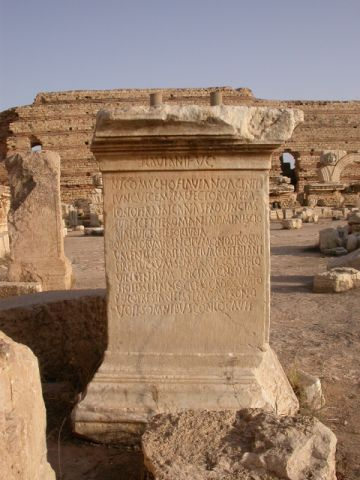
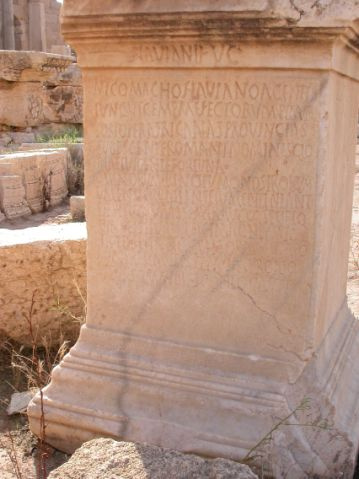
Base for statue of Nicomachus Flavianus, vicar. Lepcis Magna (Tripolitania). 377-378
Record details
Photographs
Inscription
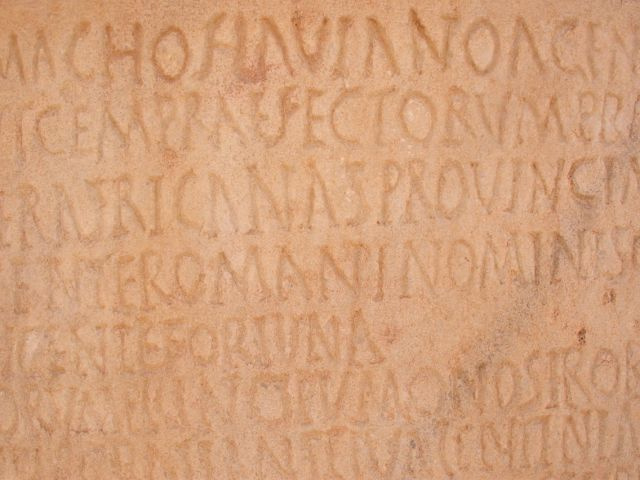
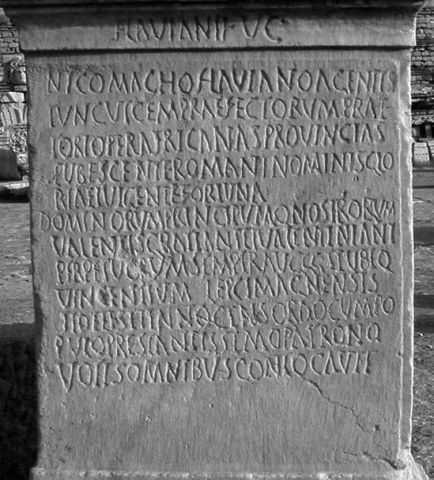
Flavianii v(iri) c(larissimi). /Nicomacho Flaviano, agenti{s} / tunc vicem praefectorum prae/torio per Africanas provincias, /(5) pubescente Romani nominis glo/ria et vigente fortuna / dominorum principumq(ue) nostrorum / Valentis, Gratiani et Valentiniani, / perpetuorum semper Auggg(ustorum) et ubiq(ue) /(10) vincentium (vac. c. 2), Lepcimagnensis / fidelis et innocens ordo cum po/pulo pr(a)estantissimo patrono / votis omnibus conlocavit.
Inscription translation
(Statue of) Flavianus, of clarissimus rank. To Nicomachus Flavianus, then acting in the role of the praetorian prefects for the African provinces, in the first bloom of the glory of the Roman name, and in the full vigour of the fortune of our lords Valens, Gratian and Valentinian, perpetually eternal Augusti and everywhere victorious; the loyal and blameless order of Lepcis Magna with the people set this up with the consent of all to their most outstanding patron.
Bibliography
- Reynolds, J. M. & J. B. Ward-Perkins, The Inscriptions of Roman Tripolitania. In collaboration with S. Aurigemma, R. Bartoccini, G. Caputo, R. Goodchild, P. Romanelli, Roma 1952, no. 475
- Tantillo, I. and F. Bigi (eds.), Leptis Magna. Una città e le sue iscrizioni in epoca tardoromana, Cassino 2010, 358-360, no. 27, figs. 8.6, 10.30, pl. IX
Discussion
INSCRIPTION
In 13 lines:
Flavianii v(iri) c(larissimi). / Nicomacho Flaviano, agenti{s} / tunc vicem praefectorum prae/torio per Africanas provincias, /(5) pubescente Romani nominis glo/ria et vigente fortuna / dominorum principumq(ue) nostrorum / Valentis, Gratiani et Valentiniani, / perpetuorum semper Auggg(ustorum) et ubiq(ue) /(10) vincentium (vac. c.2), Lepcimagnensis / fidelis et innocens ordo cum po/pulo pr(a)estantissimo patrono / votis omnibus conlocavit.
'(Statue of) Flavianus, of clarissimus rank. To Nicomachus Flavianus, then acting in the role of the praetorian prefects for the African provinces, in the first bloom of the glory of the Roman name, and in the full vigour of the fortune of our lords Valens, Gratian and Valentinian, perpetually eternal Augusti and everywhere victorious; the loyal and blameless order of Lepcis Magna with the people set this up with the consent of all to their most outstanding patron.'
Letter height 3–3.5 cm.
DESCRIPTION
Monolithic base of Proconnesian marble, moulded at top and bottom; H 115, W 80, D 80 cm. The left side and both corners on the right side of the upper moulding are broken; of the bottom moulding, the right front corner is broken. The upper face is finished with a point and has a single rectangular hole, slightly off centre. This is probably a dowel hole to fix the plinth of a marble statue.
The dimensions and the outline of the base are similar to the pedestals from the Severan Nymphaeum; our base belongs to the architectural blocks of the Severan period that were reused for inscriptions in Late Antiquity.
Our inscription was the third use of the base. Only two decades earlier, the inscription to the comes et praeses Flavius Archontius Nilus LSA-2186 was carved on the opposite side of our inscription; for this an earlier inscription, the original one, had been erased.
PROVENANCE AND CURRENT LOCATION
The base was first recorded in 1950 on the eastern part of the square of the Severan forum (map I in Tantillo & Bigi 2010). There it is still standing today.
HONORAND, AWARDER AND DATE
Virius Nicomachus Flavianus, the honorand (Nicomachus Flavianus in our inscription) was of a noble senatorial family and an ardent pagan (PLRE I, 347-9 Virius Nicomachus Flavianus 15). He was vicar of the African provinces in 377 (line 3); our inscription explicitly records that it was set up after Flavianus had quit this office (tunc, line 3). He is still recorded in that office in October 377 while his successor Alypius is recorded on January 1st, 378. Our inscription was most probably set up after October 377, but before August 9 when Valens died in the battle of Hadrianopolis.
Nicomachus Flavianus, together with the former proconsul of Africa Hesperius (LSA-2169), was appointed by the emperor Gratian to settle the case of the provincials against the comes Romanus; the special court gave justice to the provincials. The inscription was possibly set up on this occasion, together with a series of further bases: our inscription; one to Hesperius LSA-2169; one to the comes rei militaris Victorianus LSA-2175; and, in connection with these, also the inscription to Valentinian II LSA-2162, and just possibly the one to Gratian LSA-2161). However, unlike the inscriptions to Hesperius and to Victorianus, our inscription to Flavianus does not make reference to these events (on the case see Tantillo & Bigi 2010, 22-24). Nicomachus Flavianus was patron of Lepcis Magna; he is styled ‘most outstanding patron’ (praestantissimo patron), an apparent mark of his honour set against that of Hesperius who was likewise patron, but - despite his higher rank - styled only praestans, 'outstanding'.
The inscription was set up by the council and the people of Lepcis (lines 10-13).
FURTHER DISCUSSION
The inscription to Nicomachus Flavianus is not erased in our inscription; this is remarkable since the zealous pagan supported the usurper Eugenius in 394; after Eugenius’ defeat, Flavianus suffered damnatio memoriae. It is possible that the Lepcitani deliberately ignored the advice to cancel their patron’s name (Lepelley II, 359). However, it is also possible that, as in other cases, the inscription was plastered over (and perhaps made visible again after Flavianus’ rehabilitation in the early 5th century); it is less probable that the base was removed and later redeployed.
The inscription contains a remarkable and apparently unparalleled reference to the emperors Valentinian II, Gratian and Valens (lines 5-8). The formula pubescente Romani nominis gloria, ‘in the first bloom of the glory of the Roman name’ probably alludes to the youth of the emperors Valentinian II and Gratian.
Cite: Last Statues of Antiquity, LSA-2173 (Ignazio Tantillo & Francesca Bigi).