
LSA-2174
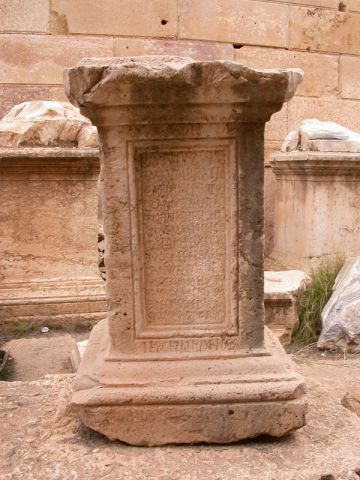
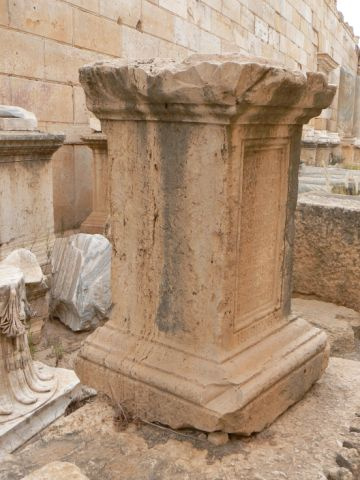
Base for statue of Caecilius Severus Elpidius, vicar. Lepcis Magna (Tripolitania). Late fourth to early fifth century.
Record details
Photographs
Inscription
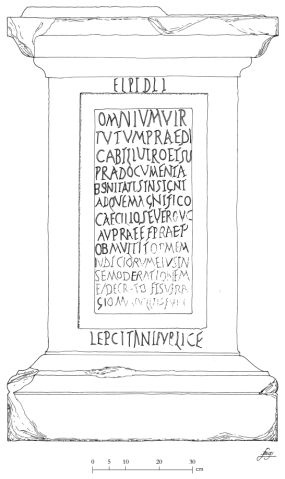
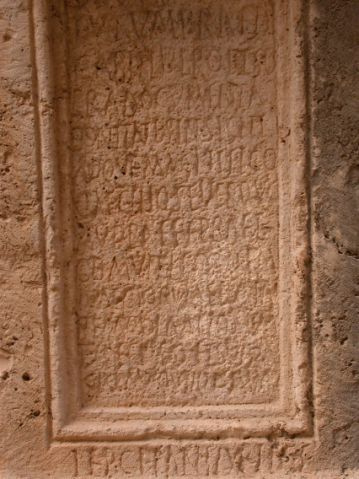
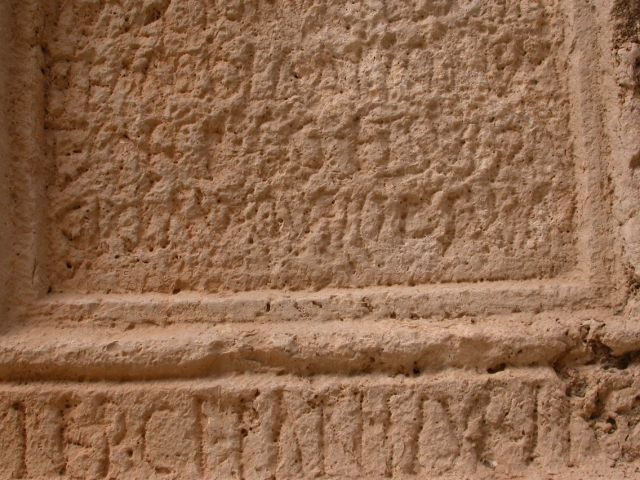
Elpidii. / omnium vir/tutum praedi/cabili viro et su/pra documenta /(6) bonitatis insigni / adque magnifico, / Caecilio Severo, v(iro) c(larissimo), / a(genti) v(ices) praeff(ectorum) praet(orio), /(10) ob multiformem / iudiciorum eius in / se moderationem, / ex decreto et sufra/gio M++++++++++++ ,/(15) Lepcitani publice.
Inscription translation
(Statue of) Elpidius. To the man praiseworthy of all virtues, outstanding and magnificent beyond the documented proofs of his goodness, Caecilius Severus, of clarissimus rank, acting in the role of the praetorian prefects; on account of the multiform moderation of his judgements concerning themselves, by decree and vote … the people of Lepcis Magna [set this up] from public funds.
Bibliography
- Reynolds, J. M. & J. B. Ward-Perkins, The Inscriptions of Roman Tripolitania. In collaboration with S. Aurigemma, R. Bartoccini, G. Caputo, R. Goodchild, P. Romanelli, Roma 1952, no. 519
- Tantillo, I. and F. Bigi (eds.), Leptis Magna. Una città e le sue iscrizioni in epoca tardoromana, Cassino 2010, 361-4, no. 28, figs. 7.14, 10.31-32, pl. IX
Discussion
INSCRIPTION
In 15 lines :
Elpidii. / omnium vir/tutum praedi/cabili viro et su/pra documenta /(6) bonitatis insigni / adque magnifico, / Caecilio Severo, v(iro) c(larissimo), / a(genti) v(ices) praeff(ectorum) praet(orio), /(10) ob multiformem / iudiciorum eius in / se moderationem, / ex decreto et sufra/gio M++++++++++++ ,/(15) Lepcitani publice.
'Statue of) Elpidius. To the man praiseworthy of all virtues, outstanding and magnificent beyond the documented proofs of his goodness, Caecilius Severus, of clarissimus rank, acting in the role of the praetorian prefects; on account of the multiform moderation of his judgements concerning themselves, by decree and vote … the people of Lepcis Magna [set this up] from public funds.'
Letter height 3-4 cm.
DESCRIPTION
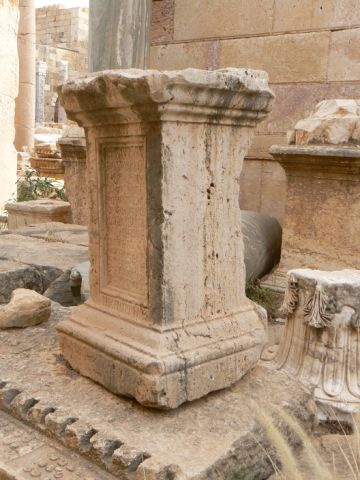
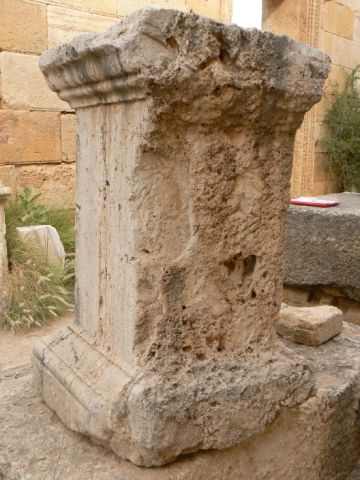
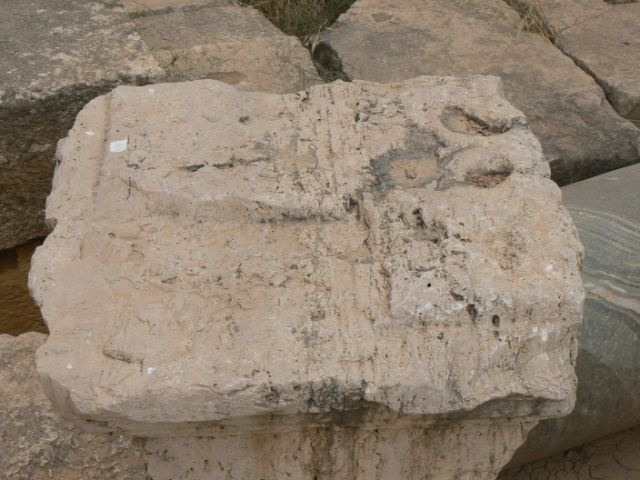
Monolithic base of compact grey limestone, moulded at top and bottom; H 130, W 81, D 75 cm. Both mouldings are chipped. The front face is decorated by a moulded frame, the lateral faces are smoothly finished and without decoration, and the back face is only roughly finished, and badly worn. On the top face there is a rectangular cavity close to the front but slightly off-centre, and a pair of irregular small holes at the back edge. The function of these settings is not clear; they could have been associated with a single marble statue on a plinth, or with two distinct statues, one in marble, one in bronze. Given the off-centre position of the rectangular cavity, it is also possible that it does not belong to the fittings for a statue and that there was only one statue, in bronze.
The inscription is carved over an erased earlier one, traces of which are visible in the inner part of the text and along the right margin of the epigraphic field. The form of the base and its mouldings date its creation and original use to the first half of the 2nd century.
PROVENANCE AND CURRENT LOCATION
The inscription was first recorded in 1954 in the eastern vestibule of the Severan Basilica, where it still stands today.
HONORAND, AWARDER AND DATE
Caecilius Severus signo Elpidius, the honorand, was of senatorial rank (clarissimus, line 8) and vicar of the African provinces (line 9). The office of vicar was elevated to senatorial rank only in c.325; in Africa a senatorial vicar is attested as early as 318.
The letter forms suggest a date in the later 4th or early 5th century for our inscription; this is supported by the dropping of the aspiration in the signum (H)elpidius. This chronological horizon suggests a tentative identification of our honorand with Helpidius the correspondent of Symmachus. This Helpidius was concerned with extraordinary food supply from Africa for Rome when the city suffered famine in 402 during the war against Alaric. He has traditionally been seen as a provincial governor (proconsul) of Africa, but a vicar could pool the burden of taxation on many provinces. Moreover, the fasti of the vicars of Africa have a gap between 399 and 403, whereas those of the proconsuls of Africa are complete (for references see Tantillo & Bigi 2010, 67).
The inscription was set up by the people of Lepcis who style themselves in a traditional manner, Lepcitani. This is remarkable because this traditional term is otherwise restricted to imperial dedications in our period (Tantillo & Bigi 2010, 195).
Cite: Last Statues of Antiquity, LSA-2174 (Ignazio Tantillo & Francesca Bigi).