
LSA-2175
Base for statue of Flavius Victorianus, military commander (comes) of Africa. Lepcis Magna (Tripolitania). 378
Record details
Photographs
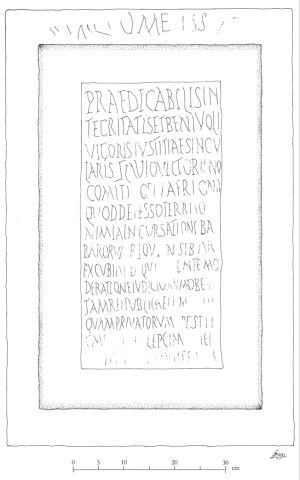
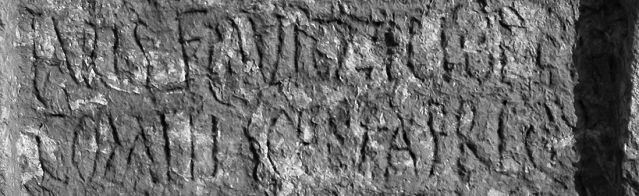
Inscription
[- - -?]+L+OME++SS++ / praedicabilis in/tegritatis et benivoli /(4) vigoris, iustitiae singu/laris, Flavio Victoriano / comiti [.]+ per Africam / quod defesso territo[rio] / nimia incursatione ba[r]/barorum P+QV[..]NS+B+++ /(10) excubiae [.]d[.]que [- 3? -]ente mo/deratione iudiciorum ob e[ius?] / tam rei publicae [ - 8? -] / quam privatorum (vac. 1) restit[- --- ?] / ++[- 8? -] Lepcim[agnens] /(15) [es? - 20? -]
Inscription translation
(To) ... of laudible integrity and vigour for good ends, of singular justice. To Flavius Victorianus, military commander (comes) ... for Africa, because when the territory was worn out by too great an incusion of barbarians...by his vigilance ... and with the moderation of his judgements he restored as much for the community (rei publicae) … as for private citizens. The … of Lepcis Magna [set this up].
Bibliography
- Reynolds, J. M. & J. B. Ward-Perkins, The Inscriptions of Roman Tripolitania. In collaboration with S. Aurigemma, R. Bartoccini, G. Caputo, R. Goodchild, P. Romanelli, Roma 1952, no. 570
- Tantillo, I. and F. Bigi (eds.), Leptis Magna. Una città e le sue iscrizioni in epoca tardoromana, Cassino 2010, 365-7, no. 29, figs.10.33-34, pl. X
Discussion
INSCRIPTON
In 15 lines:
[- - -?]+L+OME++SS++ / praedicabilis in/tegritatis et benivoli /(4) vigoris, iustitiae singu/laris, Flavio Victoriano / comiti [.]+ per Africam / quod defesso territo[rio] / nimia incursatione ba[r]/barorum P+QV[..]NS+B+++ /(10) excubiae [.]d[.]que [- 3? -]ente mo/deratione iudiciorum ob e[ius?] / tam rei publicae [ - 8? -] / quam privatorum (vac. 1) restit[- --- ?] / ++[- 8? -] Lepcim[agnens] /(15) [es? - 20? -]
'(To) ... of laudible integrity and vigour for good ends, of singular justice. To Flavius Victorianus, military commander (comes) ... for Africa, because when the territory was worn out by too great an incursion of barbarians...by his vigilance ... and with the moderation of his judgements he restored as much for the community (rei publicae) … as for private citizens. The … of Lepcis Magna [set this up].'
Letter height 3-4 cm.
In line 1 the signum of the honorand, and possibly his senatorial rank and court office was recorded (see below, ‘Honorand, Awarder and Date’); it is today illegible.
DESCRIPTION
Rectangular shaft of a brown limestone base; H 85, W 56, D 50 cm. The upper and lower mouldings were worked separately and are today lost. The front face is decorated with a moulded frame that surrounds the greater part of the inscription (lines 2-15). The surface is worn and the inscription is difficult to read.
The inscription is carved over an erased earlier one. The first use can perhaps be dated before the Gallienic period (mid-3rd century), when this type of base ceased to be produced.
PROVENANCE AND CURRENT LOCATION
The inscription was found in the eastern colonnade of the Severan forum, where it is still standing today.
HONORAND, AWARDER AND DATE
Flavius Victorianus, the honorand, was military commander in Africa ( comiti … per Africam, line 6). From another inscription from Cellae (on the border of the provinces of Sitifensis and Numidia), it is known that he was of senatorial (clarissimus) rank, and that he held the title of comes primi ordinis (PLRE I, 962 Fla. Victorianus 2). In our inscription Victorianus is praised for his military achievements against the barbarian tribe of the Austuriani that had pillaged the territory of Lepcis in the 360s (lines 7-10; on the barbarian incursion and the comes Romanus who refused to help the city, Tantillo & Bigi 2010, 22-24).
Victorianus held the office of comes Africae in 375-8 (perhaps as early as 373). As usual, his statue will have been set up after his time in office; our inscription was probably set up together with those to the other high-ranking persons who gave justice to the Lepcitans and restored the city after the barbarian incursions and the lawsuit against the comes Romanus in 378 (Hesperius LSA-2169; Nicomachus Flavianus LSA-2173; and Benedictus LSA-2188).
Victorianus is additionally praised for his integrity (praedicabilis integritatis, lines 2-3), his goodwill (benivoli vigoris, lines 3-4), his justice (iustitiae singularis, lines 4-5), and the moderation of his judgements ( moderatione iudiciorum, lines 10-11) by which he restored the wellbeing of the city and of individuals. These epithets are appropriate for high civilian office holders; it is possible that the comes held extraordinary juridical and administrative power similar to the later duces of Tripolitania.
The inscription was probably set up by a civic body of Lepcis Magna (line 14).
Cite: Last Statues of Antiquity, LSA-2175 (Ignazio Tantillo & Francesca Bigi).