
LSA-2179
Base for statue of Laenatius Romulus, governor of Tripolitania. Lepcis Magna (Tripolitania). 324-326.
Record details
Photographs
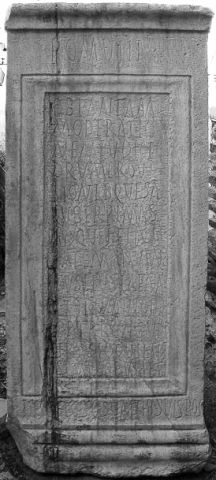
Inscription
Romulii. / Ob tantam /(3) moderatio/nem iudici/orum, provi/sionesque sa/luberrimas, /(8) adque felici/tatem adven/tus eius, Laena/tio Romulo v(iro) p(erfectissimo), /(12) p(raesidi) p(rovinciae) Tripol(itanae), su/fragio quietis/simi populi et /(15) decreto s(plendissimi) o(rdinis) sum(p)tib(us) suis pos(uit).
Inscription translation
(Statue of) Romulus. On account of such great moderation of judgements, and the soundest provisions, and the felicity of his arrival. To Laenatius Romulus, of perfectissimus rank, governor (praeses) of the province of Tripolitania; by vote of the most peaceful people and by decree of the most splendid ordo; he set this up at his own expense.
Bibliography
- Tantillo, I. and F. Bigi (eds.), Leptis Magna. Una città e le sue iscrizioni in epoca tardoromana, Cassino 2010, 374-6, no. 33, figs. 7.15, 10.38, pl. IX
Discussion
INSCRIPTION
In 15 lines :
Romulii. / Ob tantam /(3) moderatio/nem iudici/orum, provi/sionesque sa/luberrimas, /(8) adque felici/tatem adven/tus eius, Laena/tio Romulo v(iro) p(erfectissimo), /(12) p(raesidi) p(rovinciae) Tripol(itanae), su/fragio quietis/simi populi et /(15) decreto s(plendissimi) o(rdinis) sum(p)tib(us) suis pos(uit).
'(Statue of) Romulus. On account of such great moderation of judgements, and the soundest provisions, and the felicity of his arrival. To Laenatius Romulus, of perfectissimus rank, governor (praeses) of the province of Tripolitania; by vote of the most peaceful people and by decree of the most splendid ordo; he set this up at his own expense.'
Letter height 5-7 cm.
DESCRIPTION
Monolithic base of Proconnesian marble, moulded at top and bottom; H 150, W 58.5, D 57 cm. The front and the lateral faces are decorated with a moulded frame. The back face is only roughly finished with a point; at the top it has a large and deep offset. In the centre of the top face, there is a rectangular hole to which a small cast channel is leading. This is for a dowel with which the plinth of a marble statue was fixed. The greater part of the inscription is carved inside the frame; however, line 1 (the signum) and line 15 are carved on the upper and lower mouldings.
This tall base is distinct for its mouldings which are scarcely projecting and have an unusually low number of articulations. This is the result of a reworking of the base. The dimensions and the extant decoration of the base are similar to those of the base that was re-used in the mid-4th century for the comes et praeses Nepotianus (LSA-2187); the two were probably set up as twin bases in their original use.
Our inscription is carved over an erased earlier one; like ours this earlier inscription was apparently extended onto the mouldings. This makes it likely that it contained a signum and was therefore not earlier than the mid-3rd century. The alterations of the base (see previous paragraph) can hardly be connected with its first use, hence were executed when it was re-used for Romulus. The offset at the back side indicates that the base was probably removed from its original position at that time and had to be adapted to its new position.
PROVENANCE AND CURRENT LOCATION
The base was first recorded in the Severan forum, in the apse that connects with the Severan basilica (Tantillo & Bigi 2010 map I). It is still standing where it was found; however, it has been turned around c.90 degrees in order to place the inscribed face towards the centre of the apse.
HONORAND, AWARDER AND DATE
Laenatius Romulus, the honorand, was governor (praeses) of the province of Tripolitania (line 12). He is recorded in a building inscription in Lepcis Magna (Tantillo & Bigi 2010 no. 73) that was set up under Constantine I and the Caesars Crispus (died 326), Constantine II, and Constantius II (elevated 324); Romulus’ governorship was therefore between 324 and 326 (see also below, ‘Further Discussion’).
The statue was decreed by the civic bodies of Lepcis Magna ( sufragio quietissimi populi et decreto splendissimi ordinis, lines 12-15). However, the formula sumptibus suis (line 15) is usually applied to record a personal expense, not a public one (which would be indicated by sumptu publico). It is likely that Romulus paid himself for the statue; we therefore prefer the extension posuit (line 15), first proposed by Aurigemma 1939, 113) to the alternative posuerunt (which was preferred by IRT and Lepelley II, 344 with n. 44).
FURTHER DISCUSSION
Laenatius Romulus probably received another statue at Lepcis Magna; however, his name is mutilated on that base (LSA-2180). Beyond the building inscription from the macellum mentioned above (Tantillo & Bigi 2010 no. 73), his name is recorded in a building inscription recording repair work at the tripertita porticus (no. 71; this inscription records also that the governor set up a statue to Constantine I). A further, mutilated building inscription from the same tripertita porticus was probably also set up under Romulus’ governorship (Tantillo & Bigi 2010 no. 72; however, his name does not survive on this inscription). Finally, the statue to the local notable Marcus Vibius Annianus Geminus Amelius, probably originally set up at the macellum, probably contains an allusion to Romulus’ repair work (though his name is not recorded in the extant inscription, LSA-2204).
Cite: Last Statues of Antiquity, LSA-2179 (Ignazio Tantillo & Francesca Bigi).