
LSA-218
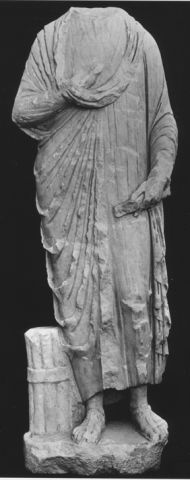
Himation statue (headless) with scroll. Aphrodisias (Caria). Fourth century.
Record details
Photographs
Bibliography
- Smith, R.R.R. 'Late antique portraits in a public context: Honorific statuary at Aphrodisias in Caria, AD 300-600' , Journal of Roman Studies, 89 (1999), 155-89, pl.5.2
- Smith, R.R.R., 'Archaeological research at Aphrodisias 1989-1992', C. Roueché and R.R.R. Smith (eds.), Aphrodisias Papers 3. The setting and quarries, mythological and other sculptural decoration, architectural development, Portico of Tiberius and tetrapylon, JRA Suppl. Series 20, Ann Arbor 1996, 38, fig. 35
Discussion
DESCRIPTION (Object)
Over life-size statue. H: 172 cm. White marble.
The statue was worked in one piece with its tall plain plinth and the head which is now missing. The right hand is broken. The plinth and feet of the statue are chipped and scraped by a modern plow.
PROVENANCE
Recovered in 1989 from north of the modern village of Geyre, on the north side of the main road which runs from Karacasu to Tavas.
DESCRIPTION (Subject)
The figure wears a tunic, himation, and sandals and holds a scroll in his left hand. It is supported by a belted bundle of scrolls. The himation is worn in the arm-sling pose, and the broken right hand raised and open in a gesture of address.
DATE
A fourth century date is suggested by a series of technical details: full statue scale, sloping shoulders, broad neck base, small right arm and feet, unusually tall statue support for a himation statue, and adjusted, rather formless, overall proportions.
COSTUME: THE HIMATION IN LATE ANTIQUITY
The use of the traditional Greek himation appears throughout late antiquity in the more private genre of busts and tondi which often feature great thinkers of the past. In full-scale portraits in the eastern part of the Empire it was probably more common than we can trace since earlier statues may have been re-used. This is suggested by four secure examples of re-use: LSA-152 (Aphrodisias: fourth century for a governor), LSA-728 (Ephesus: used for two governors, the second of which is fourth to mid-fifth century), LSA-736 (Ephesus: for a doctor of the fourth century), and LSA-2361 (Corinth: with a head undergoing re-cutting).
Seven examples (in addition to this one) of late full-scale statues shown wearing a himation and made ex-novo also exist. They seem mainly to belong in the late third or fourth century but are difficult to date. These include two seated statues LSA-155 (context in workshop: fourth century) and LSA-172 (style: fourth to fifth century) and one standing statue LSA-215 (codex: fourth century) from Aphrodisias, a statue from Ephesus LSA-737 (same type as Aphrodisias codex-holder), a late third-century priest from Pompeiopolis LSA-2112, a statue from Constantia,LSA-847 (portrait style: late third or fourth century), and portrait statue of a young man from Alexandria LSA-2101 (portrait style: fourth century).
Cite: Last Statues of Antiquity, LSA-218 (R.R.R. Smith and J. Lenaghan).