
LSA-2182
Lower part of base for statue of unknown governor of Tripolitania, patron of Lepcis (used later, in 379/95, for LSA-2159 and earlier, in 290/94, for LSA-2168). Lepcis Magna (Tripolitania). Fourth century.
Record details
Photographs
Inscription
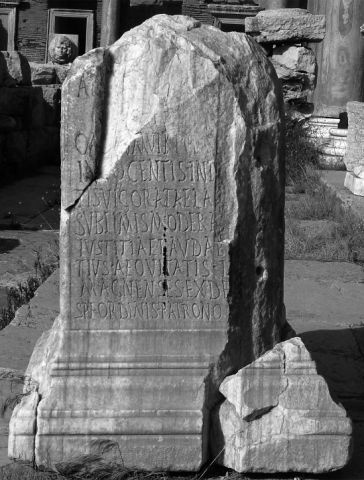
[- - -]+POR[- - -] / AE[- 14? -] v(iro) p(erfectissimo), / prae[sidi provinc(iae) Tr]ip(olitanae), / omnium virtut[um vi]ro, /(5) innocentis inte[g]rita/tis, vigoratae laenitatis (sic, for 'lenitatis')), / sublimis moderat[i]onis, / iustitiae laudab[i]lis, to/tius aequitatis, L[e]pci/magnenses ex decreto /(11) spl(endidissimi) ordinis patrono benign(o).
Inscription translation
Statue of …por… . To Ae … , of perfectissimus rank, governor (praeses) of the province of Tripolitania, a man of all virtues, of blameless integrity, vigorous mildness, sublime moderation, laudable justice, of total fairness. The people of Lepcis Magna (Lepcimagnenses), by decree of the most splendid council (ordo) [set this up] to their benign patron.
Bibliography
- Reynolds, J. M. & J. B. Ward-Perkins, The Inscriptions of Roman Tripolitania. In collaboration with S. Aurigemma, R. Bartoccini, G. Caputo, R. Goodchild, P. Romanelli, Roma 1952, no. 610
- Tantillo, I. and F. Bigi (eds.), Leptis Magna. Una città e le sue iscrizioni in epoca tardoromana, Cassino 2010, 381-3, no. 36, figs. 8.6, 10.41-42, pl. VI
Discussion
INSCRIPTION
In eleven lines:
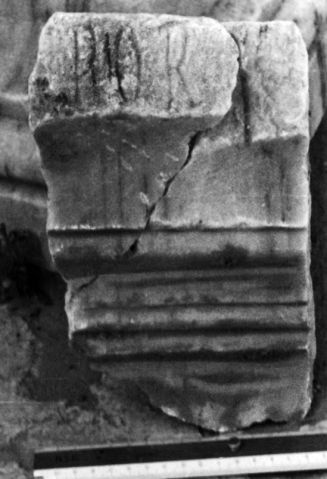
[- - -]+POR[- - -] / AE[- 14? -] v(iro) p(erfectissimo), / prae[sidi provinc(iae) Tr]ip(olitanae), / omnium virtut[um vi]ro, /(5) innocentis inte[g]rita/tis, vigoratae laenitatis(sic), / sublimis moderat[i]onis, / iustitiae laudab[i]lis, to/tius aequitatis, L[e]pci/magnenses ex decreto /(11) spl(endidissimi) ordinis patrono benign(o).
'Statue of …por… . To Ae … , of perfectissimus rank, governor (praeses) of the province of Tripolitania, a man of all virtues, of blameless integrity, vigorous mildness, sublime moderation, laudable justice, of total fairness. The people of Lepcis Magna (Lepcimagnenses), by decree of the most splendid council (ordo) [set this up] to their benign patron.'
Letter height 4–4.5 cm.
The text as recorded by the editors of IRT is today only partially preserved. A fragment that contains the beginnings of lines 2-6 is broken off but still lying at the base. The fragment from the right margin was lost already at the time when IRT was compiled, but the editors knew the text from archive photos (to which, however, they did not leave any bibliographic reference). The fragment of the crown moulding on which the extant remains of line 1 (probably the signum of the honorand) were carved, was untraceable in 2010. The letter forms of this fragment differ from those of the main body of the inscription, suggesting that the two are not associated (see below, ‘Description’ and ‘Honorand, Awarder and Date’).
DESCRIPTION
Lower portion of a monolithic base of Proconnesian marble with mouldings; H 110, W 82, D 82 cm. The top of the base, a portion of the left side and the entire right margin are broken off. The base belongs to the architectural pieces of the Severan period that were used as statue supports (see LSA-2159). Our inscription is the third of four uses of the base: the first use was in the Severan period; the second one, an inscription to the proconsul of Africa Titus Claudius Aurelius Aristobulus, was carved onto the right side of the original inscription (LSA-2168) in the late 3rd century; our inscription, on the back side of the original one was engraved in the mid-4th century (see below ‘Honorand, Awarder and Date’); finally an inscription to the emperor Theodosius I (379-95), was carved on the original front face over the erased first-use inscription (LSA-2159).
Reynolds 1955, 131 assigned a separate fragment of an upper moulding to our inscription, on which line 1 of the inscription (as given above) is carved. The formal properties of this fragment show that it is from an architectural block of the Severan period and therefore could have belonged to our base (though not necessarily to our inscription); however, this cannot be confirmed and the fragment might have come from another base of the same type.
PROVENANCE AND CURRENT LOCATION
The inscription was first recorded on the Severan forum, in front of the southern colonnade, where it is still standing today.
HONORAND, AWARDER AND DATE
The honorand was a governor (praeses) of Tripolitania of equestrian (perfectissimus) rank. Of the his name, only the two initial letters AE have survived. Line 1, as given above, just possibly preserves a portion of his signum; however there are severe doubts over the association of this line with our inscription (see above, ‘Inscription’ and ‘Description’).
The statue was set up by the people of Lepcis Magna, by decree of the council (ordo) (cf. Tantillo & Bigi 2010, 195).
Our man's governorship has, of course, to be dated after the foundation of the province in 303, and a secure terminus ante quem is given by the later inscription to Theodosius I (379-95) on the same base (LSA-2159); however, we think that the time frame for our inscription can be lowered. The eulogy that praises the administrative virtues of our governor is strikingly similar to the earlier inscription on this same base to the proconsul Aristobulus from 290/4 (<l<2168">LSA-2168); however, this is not unparalleled and does not necessarily point to a close chronological link. The average rhythm of re-use makes it probable that our inscription was set up approximately a generation after the one to Aristobulus and one generation earlier than the subsequent one to Theodosius I (LSA-2159), suggesting a time-frame of c.320-60. The similarity of the palaeography to inscriptions of the Constantinian period (Tantillo & Bigi 2010, ch. 6.2, part. p. 213), and the formula that records the decree by the splendidissimus ordo (Tantillo & Bigi 2010, ch. 5.7.1) suggest a date early within that time-frame.
Cite: Last Statues of Antiquity, LSA-2182 (Ignazio Tantillo & Francesca Bigi).