
LSA-2185
Base for statue of Flavius Archontius Nilus, military commander and governor (comes et praeses) of Tripolitania, patron of Lepcis. Lepcis Magna (Tripolitania). 355-361.
Record details
Photographs
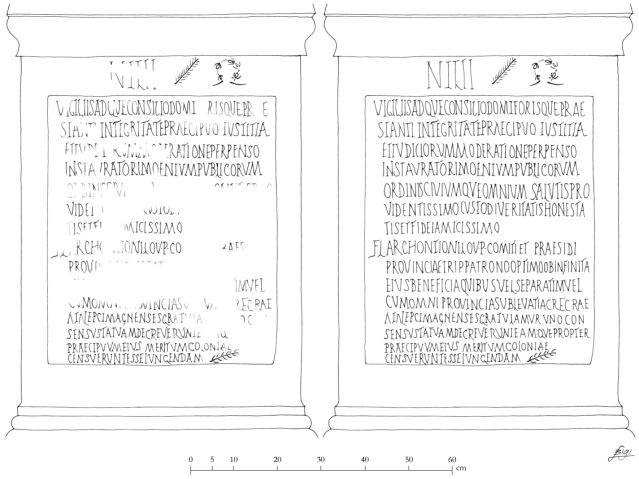
Inscription
Nilii. / vigiliis adque consilio domi [fo]risque pr[a]e/stanti, integritate praecipuo, iustitia / et iud[ic]i[o]rum mo[d]eratione perpenso, /(5) instauratori moenium publicorum, / ordinis civi[umq]u[e omnium] salut[is pr]o/vide[ntissimo], custodi [veritatis, honesta]/tis et fi[dei a]micissimo, / Fl(avio) Archontio Nilo v(iro) p(erfectissimo), com[iti et p]raes[idi] /(10) provi[nciae Trip(olitanae), patrono optimo, ob infinita] / [eius beneficia, quibus vel separat]im vel / cum omn[i pr]ovincia su[ble]va[ti ac] recrae/ati (sic for recreati) Lepcimagnenses gratula[mur, un]o c[on]/sensu statuam decreverunt e[am]q[ue propter] /(15) praecipuum eius meritum coloniae [ornatui] / censuerunt esse iungendam.
Inscription translation
(Statue of) Nilus. To a man outstanding in vigilance and advice at home and abroad (= in peace and war), foremost by integrity, measured by justice and the moderation of his judgements, the restorer of public buildings, a most far-seeing guardian of the safety of the council (ordo) and of all citizens, safeguarder of truth and the greatest friend of honesty and loyalty, Flavius Archontius Nilus, of perfectissimus rank, military commander (comes) and governor (praeses) of the province of Tripolitania. To ther best patron, on account of his infinite good deeds by which both separately and with the entire province they have been raised and reborn, the people of Lepcis Magna (Lepcimagnenses) show their joy; unanimously they decreed a statue and because of his exceptional merit they decided that it should be added to the décor of the city.
Bibliography
- Reynolds, J. M. & J. B. Ward-Perkins, The Inscriptions of Roman Tripolitania. In collaboration with S. Aurigemma, R. Bartoccini, G. Caputo, R. Goodchild, P. Romanelli, Roma 1952, no. 563
- Tantillo, I. and F. Bigi (eds.), Leptis Magna. Una città e le sue iscrizioni in epoca tardoromana, Cassino 2010, 387-9, no. 39, figs. 7.14, 10.46, pl. XIII
Discussion
INSCRIPTION
In 16 lines:
Nilii. / vigiliis adque consilio domi [fo]risque pr[a]e/stanti, integritate praecipuo, iustitia / et iud[ic]i[o]rum mo[d]eratione perpenso, /(5) instauratori moenium publicorum, / ordinis civi[umq]u[e omnium] salut[is pr]o/vide[ntissimo], custodi [veritatis, honesta]/tis et fi[dei a]micissimo, / Fl(avio) Archontio Nilo v(iro) p(erfectissimo), com[iti et p]raes[idi] /(10) provi[nciae Trip(olitanae), patrono optimo, ob infinita] / [eius beneficia, quibus vel separat]im vel / cum omn[i pr]ovincia su[ble]va[ti ac] recrae/ati (sic, for 'recreati') Lepcimagnenses gratula[mur, un]o c[on]/sensu statuam decreverunt e[am]q[ue propter] /(15) praecipuum eius meritum coloniae [ornatui] / censuerunt esse iungendam.
'(Statue of) Nilus. To a man outstanding in vigilance and advice at home and abroad (= in peace and war), foremost by integrity, measured by justice and the moderation of his judgements, the restorer of public buildings, a most far-seeing guardian of the safety of the council (ordo) and of all citizens, safeguarder of truth and the greatest friend of honesty and loyalty, Flavius Archontius Nilus, of perfectissimus rank, military commander (comes) and governor (praeses) of the province of Tripolitania. To ther best patron, on account of his infinite good deeds by which both separately and with the entire province they have been raised and reborn, the people of Lepcis Magna (Lepcimagnenses) show their joy; unanimously they decreed a statue and because of his exceptional merit they decided that it should be added to the décor of the city.'
Letter height 2.5–6.5 cm.
The signum that is carved on the frame is accompanied by a palm branch and a wreath incised to its right.
The inscription is partly illegible (see below, ‘Description’) and has been completed from another, similar inscription to the same man (LSA-2186) in lines 1-12; line 15 requires the completion of a substantive like ornatui, which is justified by the space after coloniae.
DESCRIPTION
Monolithic base of heavily veined Pentelic marble, moulded at top and bottom; H 157, W 80, D 56 cm. There are chips scattered over the surface and along the margins, and heavy cracking of the marble has rendered lines 6 and 11 and portions of lines 7-10 and 12-15 mostly illegible. The front face is decorated by a flat frame; the lateral faces are smooth, and the back face is only roughly finished with a point. On the top face there is a small circular hole in the centre, surrounded by various cavities worked with a point (irregularly round at the left margin and rectangular at the rear).
Where the surface of the base has survived, it is polished and free of traces of an earlier use. It cannot be excluded, however, that this base was worked at a time prior to our inscription and discarded because of the marble’s poor quality.
PROVENANCE AND CURRENT LOCATION
The inscription was first recorded in 1931 on the Old forum where it was built into the apse of the church. It had been removed from that wall by 1953, when it is described as ‘standing loose in the apse’ by Ward-Perkins & Goodchild 1953, 27. It is still standing there today.
HONORAND, AWARDER AND DATE
Flavius Archontius Nilus, the honorand, was honoured with another inscription in Lepcis Magna (LSA-2186); moreover, he is probably recorded in a building inscription that records the Hadrianic baths (Tantillo & Bigi 2010 no. 75; PLRE I, 632 Nilus 1). He was military commander (comes, line 9) and provincial governor (praeses, line 9) of Tripolitania, and he was of equestrian (perfectissimus) rank.
The inscription was set up by the people of Lepcis Magna (Lepcimagnenses, lines 13-14).
The date for Nilus’ time in office is provided by two inscriptions from the castellum of Talalati (ILAfr 11 = CIL VIII 22766 + 22767) which date from the joint reigns of Constantius II Augustus and Julian Caesar. The terminus post quem is therefore the elevation of Julian to the rank of Caesar in 355, the terminus ante quem Constantius’ death in 361.
FURTHER DISCUSSION
The conjunction of civic and military office documented for Nilus is also found in Lepcis Magna in the comes et praeses Nepotianus (LSA-2187). It appears to be a phenomenon of the reign of Constantius II that some governors of endangered provinces were also invested with military powers.
Discussion references
- Corpus Inscriptionum Latinarum; , VIII
- Jones, A. H. M. et al., The Prosopography of the Later Roman Empire. Vol. I 260-395, Cambridge et al. 1971 (1975)
Cite: Last Statues of Antiquity, LSA-2185 (Ignazio Tantillo & Francesca Bigi).