
LSA-2187
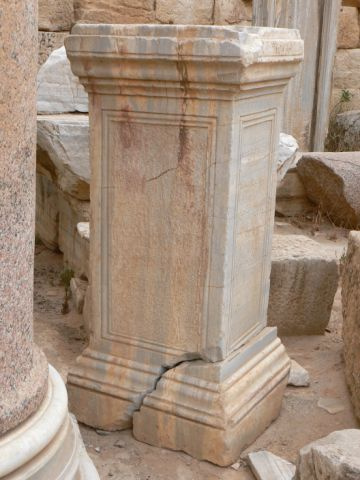
Base for marble statue of Flavius Nepotianus, military commander and governor (comes et praeses) of Tripolitania. Lepcis Magna (Tripolitania). 350-360.
Record details
Photographs
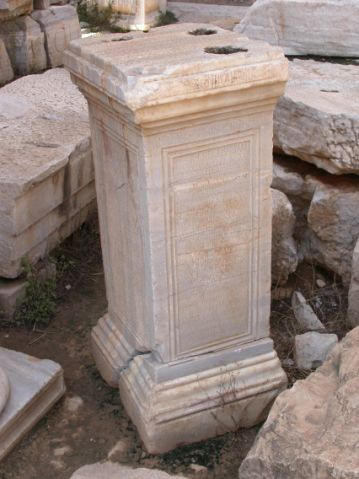
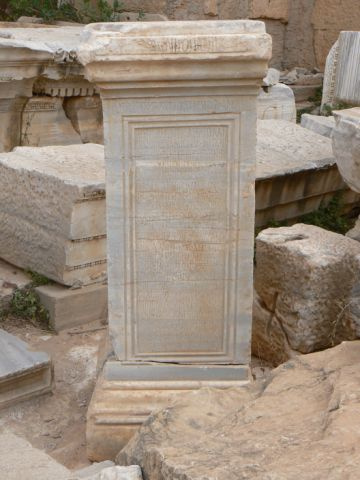
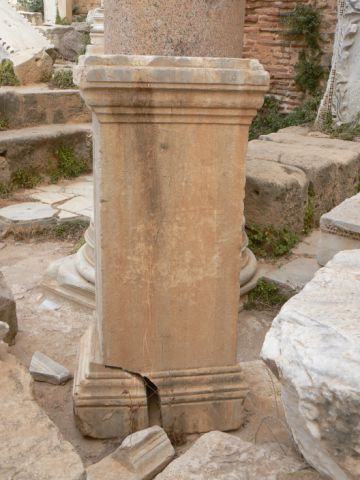
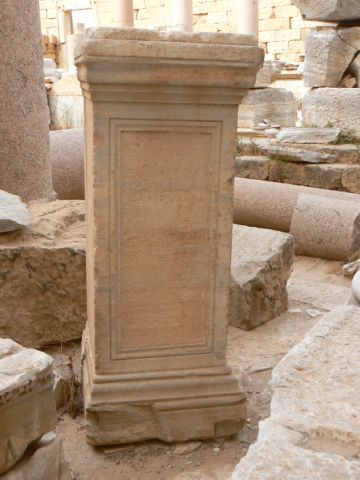
Inscription
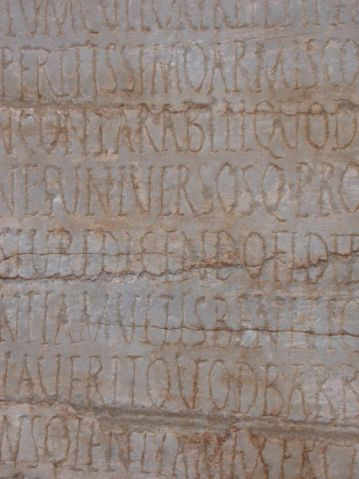
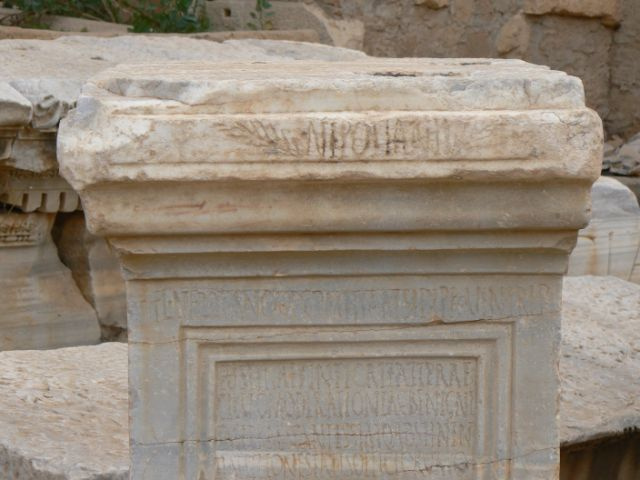
Nepotianii. / Fl(avio) Nepotiano v(iro) p(erfectissimo), com(iti) et praesidi provin(ciae) Trip(olitanae), /(3) iustitia et integritati (sic, for 'integritate') prae/cipuo, moderatione ac benigni/tate praestantissimo, abstinen/tiae et honestatis officiorumq(ue) /(7) omnium cultori, rei etiam mili/taris peritissimo, armis consi/li(i)sq(ue) inconparabili, quod idem /(10) ordines universosq(ue) provin/ciales iuridicendo fide beni/volentia multis beneficiis /cumulaverit, quod barbaro/rum insolentiam exercitio /(15) scientiae militaris adtriberit, / quod limitis defensionem tui/tionemq(ue) perpetuam futuris etia(m) / temporibus munitam securamq(ue) /(19) ab omni hostile incursione prae/stiterit, quod civitatum moenia ope/rum instauratione vel novitate de/coraverit, ordo civitatis Lepcimag(nensis) / cum populo statuam marmoream / ob haec merita decretis et sufragiis / concinnentibus (sic, for 'concinentibus') conlocavit.
Inscription translation
(Statue of) Nepotianus. To Flavius Nepotianus, of perfectissimus rank, military commander and governor (comes et praeses) of the province of Tripolitania. Exceptional in justice and integrity, outstanding in moderation and benignity, a cultivator of abstinence and honesty and of all duties, very experienced also in military affairs, incomparable in arms and in counsel. Because he increased the councils (ordines) and all the provincials with many benefits by administrating with benevolent loyalty; because he crushed the insolence of the barbarians with the use of military science; because he established defence and permanent protection for the borders, also for future times, fortified and secure from any hostile incursion; because he adorned the buildings of the cities both by restoration and by new building. The council (ordo) of the city of Lepcis Magna with the people (populus) set up a marble statue on account of these merits, with all decrees (= of the ordo) and votes (= of the people) in unison.
Bibliography
- Reynolds, J. M. & J. B. Ward-Perkins, The Inscriptions of Roman Tripolitania. In collaboration with S. Aurigemma, R. Bartoccini, G. Caputo, R. Goodchild, P. Romanelli, Roma 1952, no. 565
- Tantillo, I. and F. Bigi (eds.), Leptis Magna. Una città e le sue iscrizioni in epoca tardoromana, Cassino 2010, 392-4, no. 41, fig. 7.15, pl. XIV
Discussion
INSCRIPTION
In 25 lines:
Nepotianii. / Fl(avio) Nepotiano v(iro) p(erfectissimo), com(iti) et praesidi provin(ciae) Trip(olitanae), /(3) iustitia et integritati (sic, for 'integritate') prae/cipuo, moderatione ac benigni/tate praestantissimo, abstinen/tiae et honestatis officiorumq(ue) /(7) omnium cultori, rei etiam mili/taris peritissimo, armis consi/li(i)sq(ue) inconparabili, quod idem /(10) ordines universosq(ue) provin/ciales iuridicendo fide beni/volentia multis beneficiis /cumulaverit, quod barbaro/rum insolentiam exercitio /(15) scientiae militaris adtriberit, / quod limitis defensionem tui/tionemq(ue) perpetuam futuris etia(m) / temporibus munitam securamq(ue) /(19) ab omni hostile incursione prae/stiterit, quod civitatum moenia ope/rum instauratione vel novitate de/coraverit, ordo civitatis Lepcimag(nensis) / cum populo statuam marmoream / ob haec merita decretis et sufragiis / concinnentibus (sic, for 'concinentibus') conlocavit.
'(Statue of) Nepotianus. To Flavius Nepotianus, of perfectissimus rank, military commander and governor (comes et praeses) of the province of Tripolitania. Exceptional in justice and integrity, outstanding in moderation and benignity, a cultivator of abstinence and honesty and of all duties, very experienced also in military affairs, incomparable in arms and in counsel. Because he increased the councils (ordines) and all the provincials with many benefits by administrating with benevolent loyalty; because he crushed the insolence of the barbarians with the use of military science; because he established defence and permanent protection for the borders, also for future times, fortified and secure from any hostile incursion; because he adorned the buildings of the cities both by restoration and by new building. The council (ordo) of the city of Lepcis Magna with the people (populus) set up a marble statue on account of these merits, with all decrees (= of the ordo) and votes (= of the people) in unison.'
Letter height 2.5 -5 cm.
The signum is carved on the upper moulding, and the first line, with the honorand’s name and title, above the frame that surrounds the epigraphic field.
DESCRIPTION
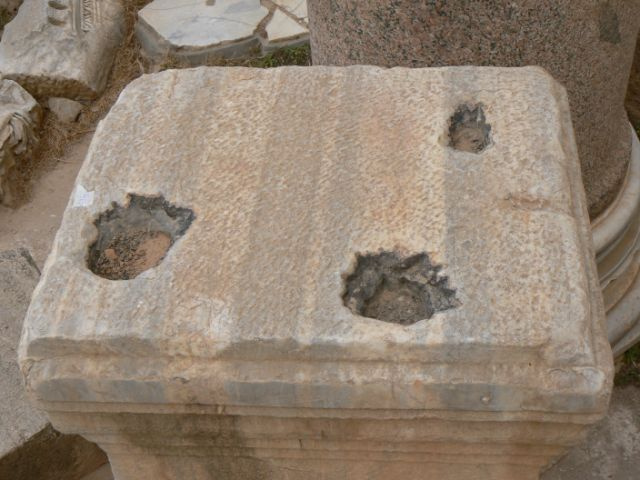
Monolithic base of proconnesian marble, moulded at top and bottom; H 153, W 62, D 70 cm. At the front, the lower moulding is broken, but still present. Three sides of the shaft are decorated with a fine moulded frame while the fourth, originally the back face, is smooth. On the top face, there are two irregular circular cavities at the back margin and another one, slightly smaller, at the front. These are traces of a bronze statue that was oriented towards the front. As our inscription explicitly states (line 23), the bronze statue was later replaced by a marble one.
Our inscription which is carved on the right side of the block, is the last of three uses of the base. Both the front and the left faces carry traces of earlier inscriptions that were later erased. The formal properties of the base suggest a date in the earlier 3rd century for the first-use inscription (on the original front face). The base is similar in form to the one that carries the inscription to the governor Laenatius Romulus from the Constantinian period (LSA-2179, dated 324/6); it is possible that both were set up as a pair in their original use.
PROVENANCE AND CURRENT LOCATION
The inscription was first recorded in 1951 in the Severan Basilica, at the southern end of the western colonnade (Caputo 1951, 233), where it is still standing today. Caputo, the first editor, thought that it had been set up in the upper floor of the basilica and fallen down from there. However, its good state of preservation does not support this theory.
HONORAND, AWARDER AND DATE
Flavius Nepotianus, the honorand, was military commander and at the same time provincial governor (comes et praeses) of Tripolitania; he was of equestrian (perfectissimus) rank (line 2). He is only known from this inscription (PLRE I, 624 Fl. Nepotianus 4; see also below, ‘Further Discussion’).
The inscription praises Nepotianus' administrative and his military virtues alike; in this it is similar to the ones set up to the comes et praeses Nilus (LSA-2185, LSA-2186) which can be dated to 355/61. A terminus post quem of 352 for our inscription is provided by the time in office of the governor Marcus Nicentius who set up a dedication to Constantius II in 352/61 and was still only a civilian office holder (LSA-2154). The phenomenon that office holders with combined military and civilian competences were installed in some particularly threatened areas of the empire is typical for the reign of Constantius II (337-61); in fact all such dignitaries known so far can be dated to 340/60. Our dedication is almost certainly from this same period.
FURTHER DISCUSSION
The honorand Flavius Nepotianus was identified by Caputo 1951, 240-2 with Nepotianus the friend of Ausonius, who was a grammaticus and professor of rhetoric, who held office as a provincial governor at an unknown date in an unknown province. However, it is improbable that this scholarly man would have been entrusted with a duty that so decidedly called for military experience as the governorship of Tripolitania in the mid-4th century.
Our base was erroneously considered to have been for an equestrian statue by Bergemann 1990, 145 cat. No. E 83, followed in this by Zelazowski 1999, 886 and by v. Stylow 2000, 433 with note 32.
Cite: Last Statues of Antiquity, LSA-2187 (Ignazio Tantillo & Francesca Bigi).