
LSA-2188
Fragmentary base for statue of Flavius Vivius Benedictus, governor of Tripolitania. Lepcis Magna (Tripolitania). 378.
Record details
Photographs
Inscription
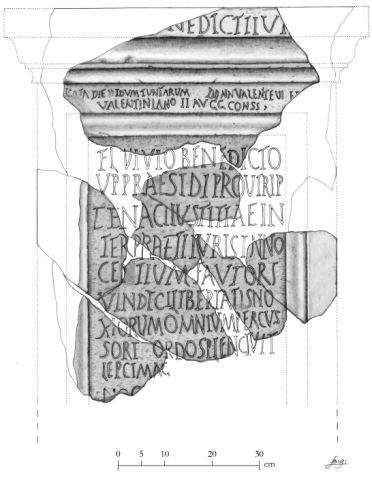
[Be]nedictii v(iri) p(erfectissimi), / [ded]icata die VI(?) Idum Iuniarum (vac. c.4) dd(ominis) nn(ostris) Valente VI et / Valentiniano II Augg(ustis) conss(ulibus). / [Fl(avio)] Vivi[o Be]nedi[cto] /(5) [v(iro) p(erfectissimo), p]raesidi pro[v(inciae) Trip(olitanae)], / te[n]aci iustitia[e, in]/terpraeti (sic, for 'interpreti') iur[is, i]nno/centium [f]autori, /(9) vindici liber[t]atis, no/xiorum omniu[m] percus/sori, (vac. c. 2) ordo splen(didissimus) [ci]vit(atis) / Lepcimag[nensium - - -] / no +[- - -] / [- - -]PO+GAV[- - -] /(15) [- - -]DIGNETPATR+++[- - -].
Inscription translation
'Statue of) Benedictus, of perfectissimus rank. Dedicated on the sixth(?) day of the Ides of June in the consulship of our lords the Augusti, Valens for the sixth time and Valentinian for the second time. To Flavius Benedictus, of perfectissimus rank, governor (praeses) of the province of Tripolitania; steady in justice, interpreter of the law, supporter of the innocent, vindicator of freedom, punisher of all evils. The most splendid council (ordo) of the city of Lepcis Magna … to the patron(?) … .
Bibliography
- Reynolds, J. M. & J. B. Ward-Perkins, The Inscriptions of Roman Tripolitania. In collaboration with S. Aurigemma, R. Bartoccini, G. Caputo, R. Goodchild, P. Romanelli, Roma 1952, no. 571
- Tantillo, I. and F. Bigi (eds.), Leptis Magna. Una città e le sue iscrizioni in epoca tardoromana, Cassino 2010, 395-7, no. 42, figs. 7.15, 10.49, pl. XV
Discussion
INSCRIPTION
Partly preserved in 15 lines:
[Be]nedictii v(iri) p(erfectissimi), / [ded]icata die VI(?) Idum Iuniarum (vac. c.4) dd(ominis) nn(ostris) Valente VI et / Valentiniano II Augg(ustis) conss(ulibus). / [Fl(avio)] Vivi[o Be]nedi[cto] /(5) [v(iro) p(erfectissimo), p]raesidi pro[v(inciae) Trip(olitanae)], / te[n]aci iustitia[e, in]/terpraeti (sic, for 'interpreti') iur[is, i]nno/centium [f]autori, /(9) vindici liber[t]atis, no/xiorum omniu[m] percus/sori, (vac. c. 2) ordo splen(didissimus) [ci]vit(atis) / Lepcimag[nensium - - -] / no +[- - -] / [- - -]PO+GAV[- - -] /(15) [- - -]DIGNETPATR+++[- - -].
'(Statue of) Benedictus, of perfectissimus rank. Dedicated on the sixth(?) day of the Ides of June in the consulship of our lords the Augusti, Valens for the sixth time and Valentinian for the second time. To Flavius Benedictus, of perfectissimus rank, governor (praeses) of the province of Tripolitania; steady in justice, interpreter of the law, supporter of the innocent, vindicator of freedom, punisher of all evils. The most splendid council (ordo) of the city of Lepcis Magna … to the patron(?) … .'
Letter height 2.5 – 5.5 cm.
Line 1 which contains the honorand’s signum and rank predicate is carved on the upper moulding; lines 2-3 which contain the date of the dedication are carved above the frame that surrounds the epigraphic field.
DESCRIPTION
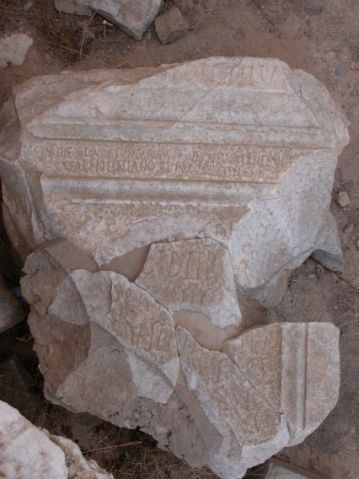
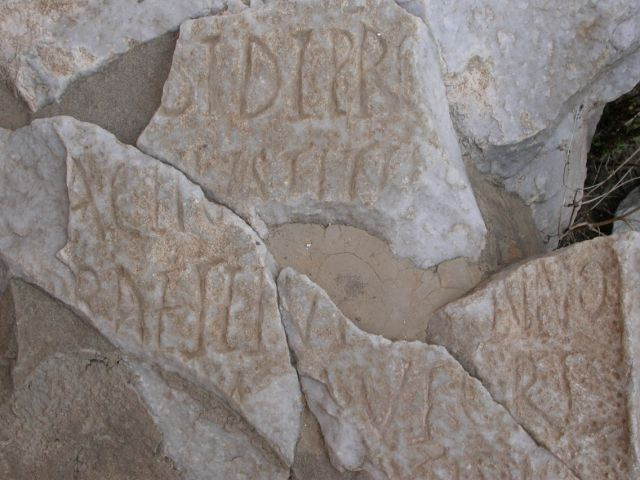
Monolithic base of Proconnesian marble with mouldings at top; H 82.3, W 63 cm. The lower portion is missing, and the extant remains are broken into many pieces; some portions of the text are missing, notably at the bottom. The front is the only face of which some portions of the surface are extant. It is decorated with a moulded frame. The moulding is remarkably shallow.
Our inscription is carved over an erased earlier one; above the frame there are clear traces of an erasure, which suggest that, like ours, also the earlier inscription extended beyond the epigraphic field.
PROVENANCE AND CURRENT LOCATION
The inscription was first recorded on the Severan forum, in the apse that connects the forum with the Severan Basilica (Tantillo & Bigi 2010 map I).
HONORAND, AWARDER AND DATE
Flavius Vivius Benedictus, the honorand, was provincial governor (praeses) of Tripolitania (line lines 5-6); the inscription praises his administrative virtues. His name 'Benedictus' possibly indicates that he was a Christian.
He is one of the dignitaries that were honoured in Lepcis after the city was vindicated in its suit against the comes Romanus (LSA-2169, LSA-2173, LSA-2175; see also LSA-2157, LSA-2158). He is possibly identical with the Benedictus who was unjustly stripped of his honours in 379/83 (Symmachus ep. 4, 53; PLRE I, 160 Benedictus 1), an appealing hypothesis first suggested by Willmanns (CIL VIII, 2). If so, this would show how ,even after the vindication of Lepcis by Hesperius (LSA-2169) and Nicomachus Flavianus (LSA-2173), less powerful officials could experience problems at the hands of the influential friends of the comes Romanus.
The inscription was set up by the city council (ordo) of Lepcis Magna (lines 11-12)
The inscription was set up on 8 or 9 June, 378; our review of the text revealed that in line 2 the word idum (‘of the Ides’) is preceded by a numeral, probably V or VI. The specification of the consular year (lines 2-3) is unique in the honorific inscriptions of Lepcis Magna.
.
Cite: Last Statues of Antiquity, LSA-2188 (Ignazio Tantillo & Francesca Bigi).