
LSA-2192
Base for statue of Lucius Volusius Bassus Caerealis, curator (later re-used for LSA-2216). Lepcis Magna (Tripolitania). 295-305
Record details
Photographs
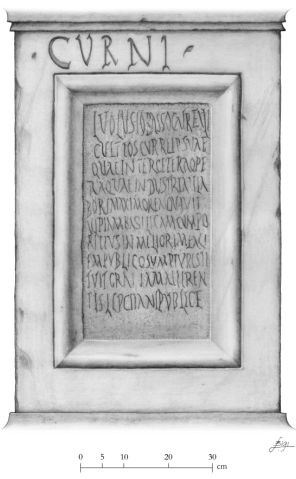
Inscription
Curni. /L(ucio) Volusio Basso Caereali, / c(larissimo) v(iro) et co(n)s(ulari), cur(atori) rei p(ublicae) suae, /(4) quae (sic, for 'quod') inter cetera ope/ra quae industria et la/bore maximo renovavit /(7) Ulpiam basilicam cum +O/R+++VS in meliorem faci/em publico sumptu resti/tuit, gratiam afferen/tes Lepcitani publice.
Inscription translation
(Statue of) Curnius. To Lucius Volusius Bassus Caerealis, of clarissimus and consular rank, curator of his home city; for, among other works that he renovated with industry and the greatest labour, he restored the Ulpian basilica with … to a better appearance, at public expense. Offering thanks, the people of Lepcis (Lepcitani) [set this up] from public funds.
Bibliography
- Reynolds, J. M. & J. B. Ward-Perkins, The Inscriptions of Roman Tripolitania. In collaboration with S. Aurigemma, R. Bartoccini, G. Caputo, R. Goodchild, P. Romanelli, Roma 1952, no. 543
- Tantillo, I. and F. Bigi (eds.), Leptis Magna. Una città e le sue iscrizioni in epoca tardoromana, Cassino 2010, 401-404, no. 46, figs. 7.16, 10.53, pl. XXII
Discussion
INSCRIPTION
In eleven lines :
Curni. /L(ucio) Volusio Basso Caereali, / c(larissimo) v(iro) et co(n)s(ulari), cur(atori) rei p(ublicae) suae, /(4) quae (sic, for 'quod') inter cetera ope/ra quae industria et la/bore maximo renovavit /(7) Ulpiam basilicam cum +O/R+++VS in meliorem faci/em publico sumptu resti/tuit, gratiam afferen/tes Lepcitani publice.
'(Statue of) Curnius. To Lucius Volusius Bassus Caerealis, of clarissimus and consular rank, curator of his home city; for, among other works that he renovated with industry and the greatest labour, he restored the Ulpian basilica with … to a better appearance, at public expense. Offering thanks, the people of Lepcis (Lepcitani) [set this up] from public funds.'
Letter height 4.5–7 cm.
In line 4, quae is an error for quod rather than qui, as earlier scholarship had suggested.
DESCRIPTION
Monolithic base of Proconnesian marble, moulded at top and bottom; H 155, W 90, D 90 cm. All sides of the shaft are decorated with a moulded frame. On the right side there is a lituus, on the left side an urceus standing proud in the centre of the frame. On the back face a later inscription to the Genius of the colony is carved. On the top face there are the traces of multiple use. Next to the front edge there are the imprints of two bronze statues, probably belonging to the first two phases of use. A circular hole in the centre of the surface and two smaller circular holes in line with this central one are probably dowel holes to fix the plinth of a marble statue in the third phase of use.
Our inscription is the second of three phases of use of the base. It is carved over an erased earlier one, from the original use, on the front face; the formal properties of the base suggest a date for its original creation and use in the 2nd century. Later (probably in the late Constantinian period), a dedication to the ‘Genius of the colony’ (LSA-2216) was carved onto the back side.
PROVENANCE AND CURRENT LOCATION
The inscription was first recorded in the south-western sector of the Severan forum, at the feet of the stairs leading to the temple, where it is still standing (Tantillo & Bigi 2010 map I). This is probably the location of the last use of the base in the 4th century (see above, ‘Description’). When it was used for our inscription, the base was probably located in or at the Basilica Ulpia the restoration of which was the reason to set up this honour to Cerealis. The location of that basilica remains unknown, but it was probably outside the Severan forum (perhaps in the Old forum). It is unlikely our inscription was set up next to the other inscription to Caerealis set up some year earlier in the Severan forum (LSA-2170, see below, 'Honorand, Awarder and Date').
HONORAND, AWARDER AND DATE
Lucius Volusius Bassus Caerealis signo Curnius, the honorand, was a local man (line 4). He held the imperial office of curator rei publicae in Lepcis, an overseer of the public finance and municipal administration who was usually chosen from the local aristocracy but reported to the imperial administration. He was of elevated senatorial rank (viro clarissimo et consulari, line 3).
The inscription was set up by the civic bodies of Lepcis Magna (line 11).
Cerealis was honoured with another statue at Lepcis Magna some year earlier when he served in the imperial administration as legate of the governor (proconsul) of Africa (to which Lepcis belonged before the province of Tripolitania was established in 303) (LSA-2170); this inscription is securely dated to 290/4. The absence of the title of consularis in LSA-2170 suggests that our text (which records this rank) is later. A date in the late 3rd/ early 4th century appears secure; it is possible that Cerealis held the office of curator in the first years after the new province of Tripolitania was founded.
Cite: Last Statues of Antiquity, LSA-2192 (Ignazio Tantillo & Francesca Bigi).