
LSA-2193
Small fragment of plaque with honorific inscription. Lepcis Magna (Tripolitania). Late third to early fourth century.
Record details
Photographs
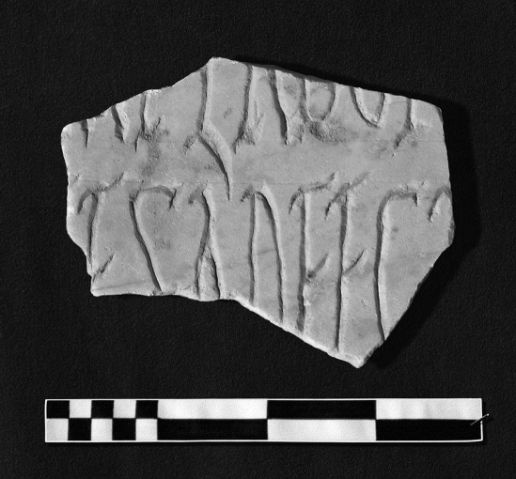
Inscription
- - - - - - / [- - -]++ labor[- - -] / [- - - erga civ]es adfect[ionem - - -] / - - - - - -.
Inscription translation
... labour ... affection to the citizens...
Bibliography
- Tantillo, I. and F. Bigi (eds.), Leptis Magna. Una città e le sue iscrizioni in epoca tardoromana, Cassino 2010, 404-405, no. 47, fig. 10.54
Discussion
INSCRIPTION
Fragmentarily preserved in two lines:
- - - - - - / [- - -]++ labor[- - -] / [- - - erga civ]es adfect[ionem - - -] / - - - - - -.
'...labour ... affection to the citizens...'
Letter height 5.5 cm.
DESCRIPTION
Fragment of a Proconnesian marble plaque broken on all sides with no margin preserved; H 18, W 13, D 2 cm. The fragment contains a portion of two lines of an inscription.
PROVENANCE AND CURRENT LOCATION
The find spot of the inscription is unknown; it is today in the storerooms of the Lepcis museum.
HONORAND AND DATE
The preserved text of line 2 can possibly be completed to a formula referring to care and labour for the common weal. If so, our inscription is possibly from an honorific monument to a local benefactor.
The letter forms suggest a date in the later 3rd or early 4th century.
Cite: Last Statues of Antiquity, LSA-2193 (Ignazio Tantillo & Francesca Bigi).