
LSA-2194
Base for statue of Aemilia Lychnis Clementilla, set up by her husband. Lepcis Magna (Tripolitania). Later third century.
Record details
Photographs
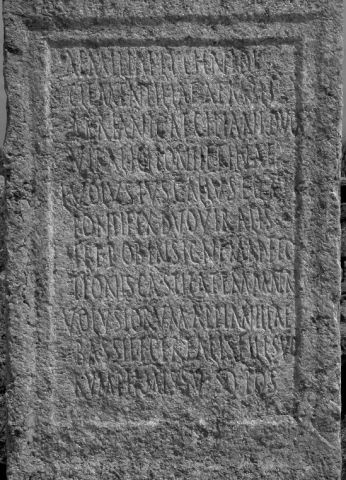
Inscription
Aemiliae Lychnidi / Clementillae, Aemili / Arriani Caeciliani, duo/viralici, pontif(icis) filiae, /(5) L(ucius) Volusius Gallus, eq(ues) R(omanus), / pontifex, duoviralis, / fl(amen) p(er)p(etuus), ob insignem adfec/tionis castitatem matri / Volusiorum Appianillae /(10) Bassi et Cerealis fill(iorum) suo/rum permissu s(plendidissimi) o(rdinis) pos(uit).
Inscription translation
To Aemilia Lychnis Clementilla, daughter of Aemilius Arrianus Caecilianus, former duovir, pontifex. L(ucius) Volusius Gallus, Roman knight, former duovir, pontifex, perpetual flamen, on account of the remarkable chasteness of her disposition, to the mother of the Volusii, Appianilla, Bassus and Cerealis, his children, set this up by permission of the most splendid council (ordo).
Bibliography
- Reynolds, J. M. & J. B. Ward-Perkins, The Inscriptions of Roman Tripolitania. In collaboration with S. Aurigemma, R. Bartoccini, G. Caputo, R. Goodchild, P. Romanelli, Roma 1952, no. 579
- Tantillo, I. and F. Bigi (eds.), Leptis Magna. Una città e le sue iscrizioni in epoca tardoromana, Cassino 2010, 405-406, no. 48, figs. 7.15, 10.55, pl. XV
Discussion
INSCRIPTION
In eleven lines:
Aemiliae Lychnidi / Clementillae, Aemili / Arriani Caeciliani, duo/viralici, pontif(icis) filiae, /(5) L(ucius) Volusius Gallus, eq(ues) R(omanus), / pontifex, duoviralis, / fl(amen) p(er)p(etuus), ob insignem adfec/tionis castitatem matri / Volusiorum Appianillae /(10) Bassi et Cerealis fill(iorum) suo/rum permissu s(plendidissimi) o(rdinis) pos(uit).
'To Aemilia Lychnis Clementilla, daughter of Aemilius Arrianus Caecilianus, former duovir, pontifex. L(ucius) Volusius Gallus, Roman knight, former duovir, pontifex, perpetual flamen, on account of the remarkable chasteness of her disposition, to the mother of the Volusii, Appianilla, Bassus and Cerealis, his children, set this up by permission of the most splendid council (ordo).'
Letter height 3 cm.
To Aemilia Lychnis Clementilla, daughter of Aemilius Arrianus Caecilianus, former duovir, pontifex. L(ucius) Volusius Gallus, Roman knight, former duovir, pontifex, perpetual flamen, on account of the remarkable chasteness of her disposition, to the mother of the Volusii, Appianilla, Bassus and Cerealis, his children, set this up by permission of the most splendid council (ordo).
DESCRIPTION
Monolithic brown limestone base with mouldings at top and bottom; H 181, W 58, D 61 cm. There are slight chips along the margins of the crown moulding. The base has strikingly slender proportions, underlined by the considerable height and reduced extent of the mouldings. The crowning is a high bend with acroteria on both sides. The front face is decorated by a frame that surrounds the epigraphic field, the lateral faces are smooth, and the back face is finished with a claw. On the top face there are two small circular holes at the centre of the front and rear edges. These are dowel holes to fix the plinth of a marble statue. Two rectangular offsets at the lateral edges are additional provisions to fix the plinth with clamps.
PROVENANCE AND CURRENT LOCATION
The inscription was found at the Macellum, east of the northern Tholos, where it is still standing today.
If the inscription was set up in the Macellum (and was not transferred there at a later date), it is remarkable that it survived the extensive restoration work of the Constantinian period which led to the destruction of many earlier inscriptions. Our inscription was possibly saved because it honoured the ancestor of noble families that were still influential at the time of these interventions.
HONORAND, AWARDER AND DATE
Aemilia Lychnis Clementilla, the honorand, was a lady of the local aristocracy, daughter, wife and mother of local notables. She is honoured for her chastity (line 8), and, implicitly, as the mother of the awarder’s children (lines 8-11).
The base was erected, with permission of the council, by Lucius Volusius Gallus, Clementilla's husband.
We suggest that one of Clementilla’s children, Cerealis (line 10) is identical with Volusius Bassus Cerealis, legate of the proconsul of Africa in 290/4 and curator of Lepcis Magna some year later, who received two honorific statues in the city (LSA-2170; LSA-2192). If so, our base to Clementilla will date from the later 3rd century, somewhat earlier than the first one to her son, which is of 290/4 (LSA-2170), perhaps in the 3rd quarter of the 4th century. We cannot exclude, however, that Volusius Bassus Cerealis was a more distant descendant; our inscription would then date from a generation or two earlier.
Cite: Last Statues of Antiquity, LSA-2194 (Ignazio Tantillo & Francesca Bigi).