
LSA-2195
Base for equestrian statue of patron. Lepcis Magna (Tripolitania). Later third century.
Record details
Photographs
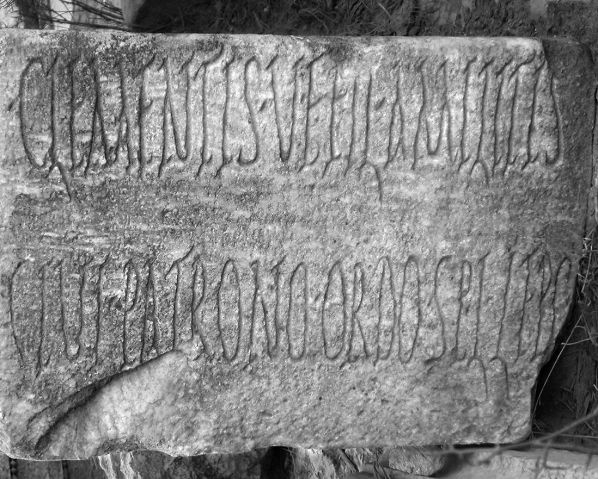
Inscription
------ / Clementis v(iri) e(gregi) fil(io), a militi(i)s, / civi, patrono, ordo spl(endidissimus) Lepc(imagnensium ?)
Inscription translation
To ... , son of Clemens of egregius rank, equestrian officer, citizen, patron. The most splendid council (ordo) of Lepcis Magna [set this up].
Bibliography
- Reynolds, J. M. & J. B. Ward-Perkins, The Inscriptions of Roman Tripolitania. In collaboration with S. Aurigemma, R. Bartoccini, G. Caputo, R. Goodchild, P. Romanelli, Roma 1952, no. 591
- Tantillo, I. and F. Bigi (eds.), Leptis Magna. Una città e le sue iscrizioni in epoca tardoromana, Cassino 2010, 406-408, no. 49, fig. 10.56, pl. XVI
Discussion
INSCRIPTION
Partly preserved in two lines:
------ / Clementis v(iri) e(gregi) fil(io), a militi(i)s, / civi, patrono, ordo spl(endidissimus) Lepc(imagnensium ?)
'To ... , son of Clemens of egregius rank, equestrian officer, citizen, patron. The most splendid council (ordo) of Lepcis Magna [set this up].'
Letter height 9 cm.
DESCRIPTION
Rectangular block of Proconnesian marble; H 34, W 51, D 142 cm. There are chips along the margins of the block. All sides are smooth. The inscription is carved on one of the narrow sides; the first line is missing and was probably carved on a moulding that was separately worked.
Our inscription is the second use of the block. The inscription is carved on the side opposite to the original front face which carries an inscription to Geta or Caracalla from the early 3rd century (IRT 426); the first line of this earlier inscription is also missing.
The proportions of the block indicate that this was the base of an equestrian statue.
PROVENANCE AND CURRENT LOCATION
The inscription was found on the Severan forum, at the south-eastern angle of the colonnade, where it is still standing today (Tantillo & Bigi 2010 map I).
HONORAND, AWARDER AND DATE
The name of the honorand is lost; he was the son of a Clemens who was of equestrian (egregius, line 1) rank. The honorand himself was a high ranking military man in the imperial service (a militiis, line 1). He was a citizen of Lepcis; however, the sole onomastic element of his father left in the inscription (Clementis, line 1) does not allow for an attribution of our honorand to one of the known families of the city.
The inscription was set up by the council (ordo) of Lepcis Magna (line 2).
The fact that a base to a son of Septimius Severus was redeployed for our inscription suggests a date in the later 3rd century. The formula a militiis is in use already in the later 2nd century, but has its main usage in the 3rd century after Caracalla (211-18). The letter forms also suggest a date in the mid-later 3rd century.
Cite: Last Statues of Antiquity, LSA-2195 (Ignazio Tantillo & Francesca Bigi).