
LSA-2197
Two fragments of plaque with honorific inscription, probably from base for statue. Lepcis Magna (Tripolitania). Later third century.
Record details
Photographs
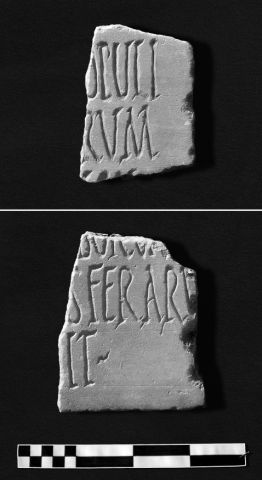
Inscription
A
- - - - - - / [- - - p]opuli / [- - -]rum / [- - -]+++ / - - - - - -
B
- - - - - - / [- - - ?la]borum[- - -] / [- - - ?munu]s feraru[m - - -] / [- - - ?posu]it.
Inscription translation
Fragment A
… of the people …
Fragment B:
… of labours … beast hunt … set up …
Bibliography
- Reynolds, J. M. & J. B. Ward-Perkins, The Inscriptions of Roman Tripolitania. In collaboration with S. Aurigemma, R. Bartoccini, G. Caputo, R. Goodchild, P. Romanelli, Roma 1952, no. 786 + 623
- Tantillo, I. and F. Bigi (eds.), Leptis Magna. Una città e le sue iscrizioni in epoca tardoromana, Cassino 2010, 412-413, no. 51, fig. 10.58
Discussion
INSCRIPTION
Fragmentarily preserved in two (Fragment A) and three lines (Fragment B):
A
- - - - - - / [- - - p]opuli / [- - -]rum / [- - -]+++ / - - - - - -
'… of the people …'.
B
- - - - - - / [- - - ?la]borum[- - -] / [- - - ?munu]s feraru[m - - -] / [- - - ?posu]it
'… of labours … beast hunt … set up …'.
Letter height 4–4.5 cm.
DESCRIPTION
Two fragments (A and B) of a white marble plaque with greyish veins: H (Fragment A) 12, W, 9.6, D 2.5 cm; H (Fragment B) 15, W 12.2, D 2.3 cm. Fragment A preserves a portion of the right margin, fragment B of the lower one. The surface is smooth, without moulded frame.
The fragments that were published separately by IRT certainly form part of the same inscription. They preserve some portions of what was probably an honorific inscription (see below, ‘Honorand and Date’). The plaque was originally mounted on a base in a different material (Tantillo & Bigi 2010 ch. 7.2.3-4).
PROVENANCE AND CURRENT LOCATION
Fragment A was found on the Old Forum; Fragment B on the cardo west of the Hadrianic baths. Both fragments are now stored in the Lepcis museum.
HONORAND AND DATE
The honorand, whose name is lost; was apparently a benefactor who organized beast hunts (Fragment B, line 2), similar to Porphyrius (LSA-2196) in the later 3rd, and Titus Flavius Vibianus (LSA-2202) in the earlier/mid-4th century. The letter forms suggest a date in the later 3rd century for our inscription.
Cite: Last Statues of Antiquity, LSA-2197 (Ignazio Tantillo & Francesca Bigi).