
LSA-2198
Base for statue of Aurelius Sempronius Serenus Dulcitius, intellectual and benefactor. Lepcis Magna (Tripolitania). Late third to early fourth century.
Record details
Photographs
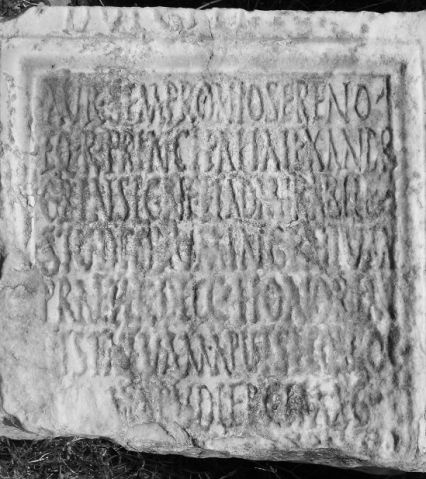
Inscription
Dulciti. / Aur(elio) Sempronio Sereno / eq(uiti) R(omano), principali Alexandr(iae), / ob insigne et admirabile /(5) studiorum ingenium, / praeter decc(urionatuum) honorem, / [e]t statuam apud se conloc(atam) / [e]tiam apud Lepcimag/[nenses - 4?-]++++++ / - - - - - -
Inscription translation
(Statue of) Dulcitius. To Aurelius Sempronius Serenus, Roman knight, principalis of Alexandria, on account of the distinguished and admirable genius in studies, in addition to the honour of the decurionates and the statue that was set up among themselves, also at Lepcis Magna...
Bibliography
- Reynolds, J. M. & J. B. Ward-Perkins, The Inscriptions of Roman Tripolitania. In collaboration with S. Aurigemma, R. Bartoccini, G. Caputo, R. Goodchild, P. Romanelli, Roma 1952, no. 559
- Tantillo, I. and F. Bigi (eds.), Leptis Magna. Una città e le sue iscrizioni in epoca tardoromana, Cassino 2010, 413-415, no. 52, fig. 10.59, pl. VIII
Discussion
INSCRIPTON
Partly preserved in eight lines:
Dulciti. / Aur(elio) Sempronio Sereno / eq(uiti) R(omano), principali Alexandr(iae), / ob insigne et admirabile /(5) studiorum ingenium, / praeter decc(urionatuum) honorem, / [e]t statuam apud se conloc(atam) / [e]tiam apud Lepcimag/[nenses - 4?-]++++++ / - - - - - -
'(Statue of) Dulcitius. To Aur(elius) Sempronius Serenus, Roman knight, principalis of Alexandria, on account of the distinguished and admirable brilliance of his studies, in addition to the honour of the decurionates and the statue that was set up among themselves, (and) also at Lepcis Magna ...'
Letter height 3 cm.
The signum (line 1) is carved above the frame that surrounds the epigraphic field.
DESCRIPTION
Upper part of a rectangular base of Pentelic marble; H 40, W 46, D 43 cm. The base and crown mouldings were worked separately and are now lost. The top face is finished with a point.
All four sides of the base carry inscriptions. All sides were once decorated with moulded frames; the frame has been worked back on the back face to enlarge the epigraphic field for the latest inscription (of the mid-4th century, (LSA-2172). Our inscription is the third of four uses of this base. Both lateral faces show remnants of erased earlier inscriptions, one of them probably the original one. The date of the first use can only be approximately dated, to the first decades of the 3rd century (see LSA-2172). After the middle of the 3rd century this type of base was not produced any more.
PROVENANCE AND CURRENT LOCATION
The inscription was found on the Severan forum, in the first taberna north of the apse that connects the forum with the Severan basilica (Tantillo & Bigi 2010 map I), where it is standing still.
HONORAND, AWARDER AND DATE
Aurelius Sempronius Serenus signo Dulcitius is honoured for his intellectual achievements (lines 4-5). He was a Roman knight and a native of Alexandria (line 3); he belonged to the highest stratum of the municipal aristocracy of his native city (principali Alexandriae, line 3). He was a member of the council of at least one, perhaps two further cities, which set up this statue to him in Lepcis Magna (praeter deccurionatum honorem, line 6; the double 'C' could suggest two decurionates). Dulcitius had chosen Lepcis as his residence; his name appears in the amphitheatre where a section of the seats is reserved to his family. He was awarded a second, bronze, statue by the people of Lepcis themselves (LSA-2199); this second inscription was found at the temple of Serapis and praises Dulcitius as a poet. Moreover, his name is composed by the initial letters of an acrostichic hymn to Serapis, likewise found in the temple of Serapis (Tantillo & Bigi 2010 no. 86). The intellectual brilliance of Dulcitius earned him statues in other cities, as well as at Lepcis (lines 7-8). He probably used his poetic talents to achieve benefits from the emperor or the imperial administration, through writing panegyrical works; or he composed poems that celebrated the glorious past of these cities (however, it appears less likely that such poems would justify honours of this type).
The statue was awarded by at least one city, the name of which is lost; this was perhaps Oea or Sabratha, where a man named Dulcitius is recorded in mutilated inscriptions from the 3rd/4th century.
The use of the signum indicates a date not earlier than the mid-3rd century. Its ending in -i (instead of -ii as used later) points to a date not later than the era of Diocletian; the same is suggested by the title of eques Romanus (line 3). Some indicators suggest a later date within that period: the inscription in the amphitheatre of Lepcis (see above) places Dulcitius’ name next to the family of the Heraclii, a family of local notables the known members of which can be dated to the Constantinian period; moreover, the principalate is understood here as an effective municipal function rather than just a generic indication of social status.
FURTHER DISCUSSION
Dulcitius’ membership in ‘foreign’ city councils (line 6) was probably honorary and without the costly duties that were usually associated with this dignity.
The honours to Dulcitius which were not for the usual benefactions but for intellectual and poetic achievements (see also LSA-2199) are exceptional; he appears to be an antecedent of the Egyptian ‘wandering poets’ who flourished in the later 4th century.
Cite: Last Statues of Antiquity, LSA-2198 (Ignazio Tantillo & Francesca Bigi).