
LSA-2199
Base for bronze statue of Aurelius Sempronius Serenus Dulcitius, poet. Lepcis Magna (Tripolitania). Late third to early fourth century.
Record details
Photographs
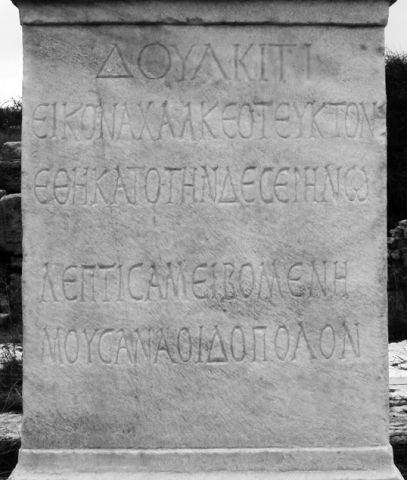
Inscription
Δουλκῖτι. / Εἰκόνα χαλκεότευκτον / ἐθήκατο τὴνδε Σερήνῳ / Λέπτις ἀμειβομένη /(5) Μοῦσαν ἀοιδοπόλον.
Inscription translation
Dulcitius. This bronze statue Lepcis set up to Serenus, rewarding his verse-making Muse.
Bibliography
- Tantillo, I. and F. Bigi (eds.), Leptis Magna. Una città e le sue iscrizioni in epoca tardoromana, Cassino 2010, 415-416, no. 53, figs. 8.6-7, 10.60
Discussion
INSCRIPTION
Verse inscripton of one elegiac distich laid out in four lines and introduced by a signum, in total five lines:
Δουλκῖτι. /
Εἰκόνα χαλκεότευκτον / ἐθήκατο τὴνδε Σερήνῳ /
Λέπτις ἀμειβομένη /(5) Μοῦσαν ἀοιδοπόλον.
'Dulcitius. This bronze statue Lepcis set up to Serenus, rewarding his verse-making Muse.'
Letter height not recorded.
Pugliese Caratelli 2003 believed that ἀμειβομένη (line 5) was constructed with a double accusative and translated ‘Dulcitius, this image in bronze dedicated Lepcis to Serenus, responding with (the statue of) a Muse to (the song of) the poet’.
In line 2, χαλκεότευκτον, a variant of χαλκότευκτον, was preferred here for metrical reasons.
DESCRIPTION
Monolithic base of Proconnesian marble moulded at top and bottom; H 117, W 81.5, D 81.5 cm. The base is a re-used architectural element of the Severan period, in dimensions and form similar to the pedestals of the Severan nymphaeum (Tantillo & Bigi 2010 ch. 7.3.12 and 8.2.1.2).
All sides are smoothly finished and without decoration. On the top face there are four circular holes, two at the front edge, the other two lined up with these but further back. As the inscription explicitly states, the base was crowned with a bronze statue; the two holes at the front must be dowel holes for the feet of that statue, while the two others were for further supports. At the rear there is a T-shaped offset; this is for a clamp to repair the crown moulding which had been damaged in Antiquity.
Remarkably our inscription is the first use of this block (see also below, ‘Further Discussion’).
PROVENANCE AND CURRENT LOCATION
The inscription was found in the temple of Serapis, where it is still standing (see also below, ‘Further Discussion’). Dulcitius as a native of Alexandria (as we know from LSA-2198) was a member of the important and manifestly rich Egyptian community in Lepcis, which had their point of reference in the luxurious temple of Serapis.
HONORAND, AWARDER AND DATE
Serenus signo Dulcitius, the honorand, received this bronze statue as a reward for ‘his verse-making Muse’ (Μοῦσαν ἀοιδοπόλον, line 5), that is for a poem or poems he composed. He is certainly identical with Aurelius Sempronius Serenus signo Dulcitius who was awarded a statue on the Severan forum in Lepcis by one or more other cities (LSA-2198). His name Dulcitius is composed by the initial letters of the verses of an acrostichic poem that was also found in the temple of Serapis (Tantillo & Bigi 2010 no. 86). Moreover, his name appears in the amphitheatre where a section of the seats was reserved for his family. The ‘verse-making Muse’ that earned Dulcitius this outstanding honour, rather than just the hymn to Serapis, was probably his eloquence, used to achieve advantages for Lepcis Magna from the emperor or his representatives.
The inscription in the amphitheatre of Lepcis places Dulcitius’ name next to the family of the Heraclii, a family of local notables, the known members of which can be dated to the Constantinian period. The use of the signum indicates a date not earlier than the mid-3rd century, while its ending in -i (instead of -ii as used later) suggests a date not later than the era of Diocletian.
FURTHER DISCUSSION
This honour is outstanding in as far as it is for a poet (and not for one of the usual benefactors), and that it is a bronze statue. The fact that the support was not a re-used one underlines the prestige and importance of the honorand.
Cite: Last Statues of Antiquity, LSA-2199 (Ignazio Tantillo & Francesca Bigi).