
LSA-22
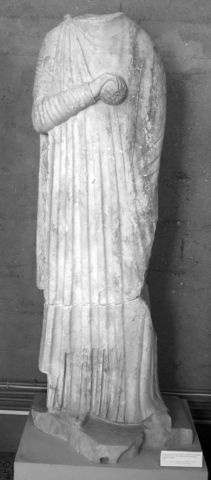
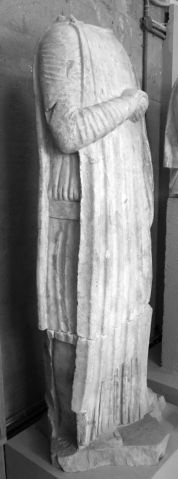
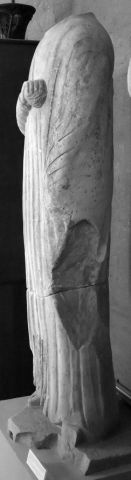
Headless statue of man wearing chlamys and holding mappa. Corinth (Achaea). Later fifth century.
Record details
Photographs
Bibliography
- Brown, A., Last Men Standing: Chlamydatus Portraits and Public Life in Late Corinth, Hesperia 81, 141-76, 2012, 150-1 figs. 13. 14
- de Grazia, C. E., American School of Classical Studies at Athens, "Excavations of the American School of Classical Studies at Corinth:
The Roman Portrait Sculpture," Ph.D. Dissertation
, Columbia University, 1973, pp. 286-8 no. 90 - Gehn, U., Ehrenstatuen in der Spätantike. Chlamydati und Togati, Wiesbaden 2012, 479-81 no. O 43
Discussion
PROVENANCE
Found June 27 and June 29, 1907. The two sections were found built into late walls continuing the Northwest Shops to the west on the northwest side of the Roman Forum (Agora). First published by Johnson 1924.
CURRENT LOCATION
Corinth Museum Roman Gallery, inv. no. S-819.
DESCRIPTION (OBJECT)
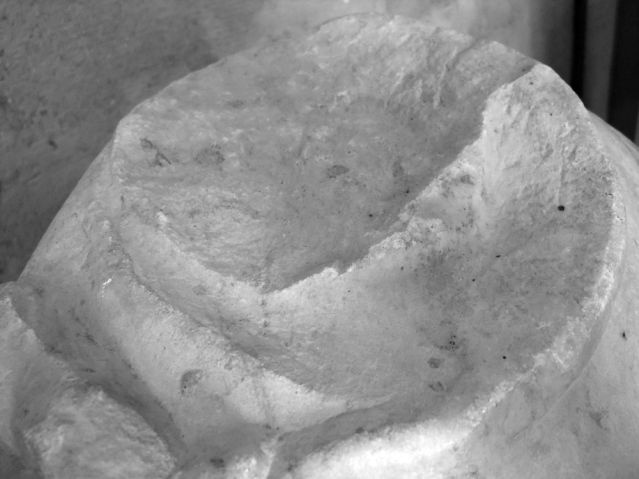
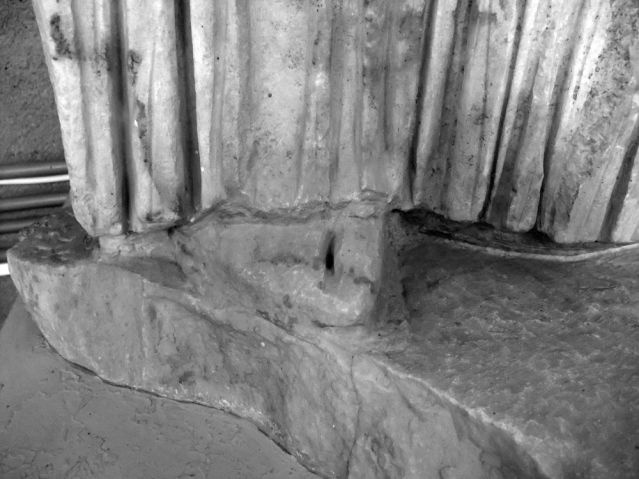
Life-sized male figure wearing a chlamys, preserved from neck to feet, including part of the plinth; statue and its plinth are from one block. Fine-crystal white marble with micaceous veins. The statue is joined at the waist from two fragments. The head is missing. There is damage at the left side at the knee, and at the front of the left foot. The plinth is damaged at the front corners. There is a rectangular clamp hole at the centre front of plinth. The figure is recarved from a female statue, with one toe of her naked feet and the folds of her chiton still visible above the plinth. The back is not modelled, and the double bend of the high-girt chiton with adjacent folds (of the female statue) is visible at armpit-height.
DESCRIPTION (SUBJECT)
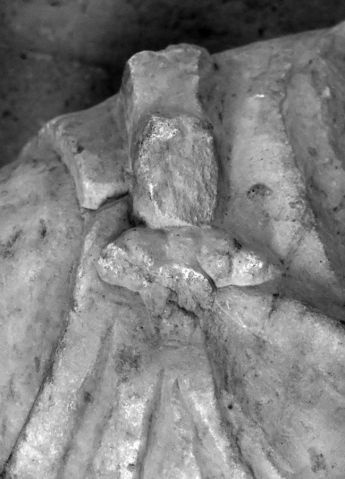
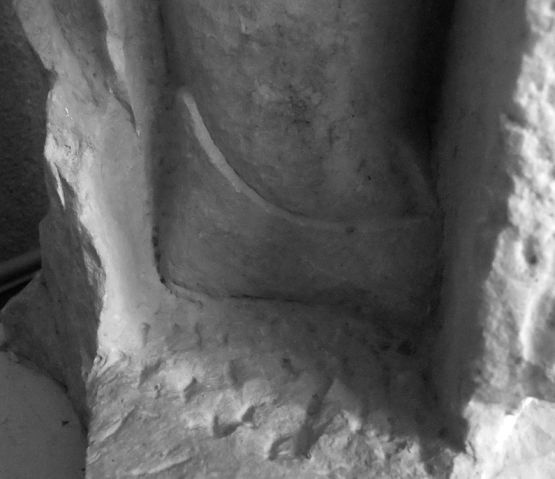
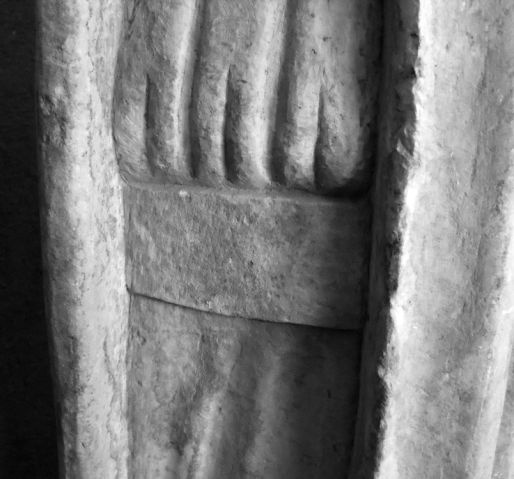
The late antique male wears an ankle-length chlamys covering his front and clasped by a three-knobbed crossbow fibula at the right shoulder. His left arm is hanging down, covered by the chlamys. His right arm folded across his chest, with his right hand grasping a rolled up handkerchief (mappa). A broad belt (cingulum) over the tunic is visible on his right side. At the right foot the marble has been cut to reveal the heel of the late Roman magistrate's shoe campagus).
DATE
The stiff posture and schematic rendering of folds (tunic at right side) suggest a significantly later date than the earliest Corinthian chlamydatus, from the theatre (LSA-15). The recarving of a female statue, leaving parts of the original visible, has seemed a desperate measure to scholars, and, along with the style of carving, gained the chlamydatus a 6th-century date (Johnson 1931, De Grazia 1973).
FURTHER DISCUSSION
This is probably the portrait statue of a proconsul of Achaia who had his seat in Corinth (Kollwitz 1941, 89; Foss 1990, 213), as are the other chlamydati from Corinth. Higher ranks in the late Roman administration, though, (pretorian prefect, vicar) cannot be ruled out completely.
The mappa is an unusual attribute for late antique chlamydati. In Corinth it is sometimes connected with the role of agonothete and might mark this man as a benefactor of games at Corinth, or at the nearby Sanctuary of Poseidon at Isthmia.
Discussion references
- De Grazia, C. E., American School of Classical Studies at Athens, Excavations of the American Achool of Classical Studies at Corinth. The Roman Portrait Sculpture, 1973, 286-8 no. 90, pl. 96
- Foss, C., Stephanus, Proconsul of Asia and Related Statues, History and Archaeology of Byzantine Asia Minor, (Reprint ed. p. III) Aldershot 1990, 213
- Johnson, F. P., Sculpture, 1896-1923: Corinth IX, 1, Cambridge, Mass. 1931, p. 151 no. 327
- Johnson, F. P. Byzantine Sculpture at Corinth, American Journal of Archaeology 28, 1924, 253-265, 254-6 no. 3, figs. 3a-b
- Kollwitz, J., Oströmische Plastik der theodosianischen Zeit, Berlin 1941, 90 no. 15, pl. 33
- Sande, S., Zur Porträtplastik des sechsten nachchristlichen Jahrhunderts, Institutum Romanum Norvegiae, Acta ad archeologiam et artium historiam pertinentia 6, Roma 1975, 65-106, 84-5
- Sturgeon, M. C., Sculpture: The Assemblage from the Theatre: Corinth IX, 3, Princeton 2004, 164
Cite: Last Statues of Antiquity, LSA-22 (Amelia Brown/ Ulrich Gehn).