
LSA-220
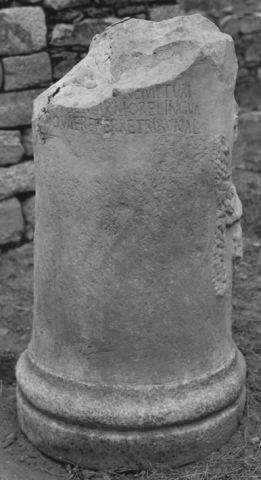
Round altar used for statue base of governor. Aphrodisias (Caria). Fourth century.
Record details
Photographs
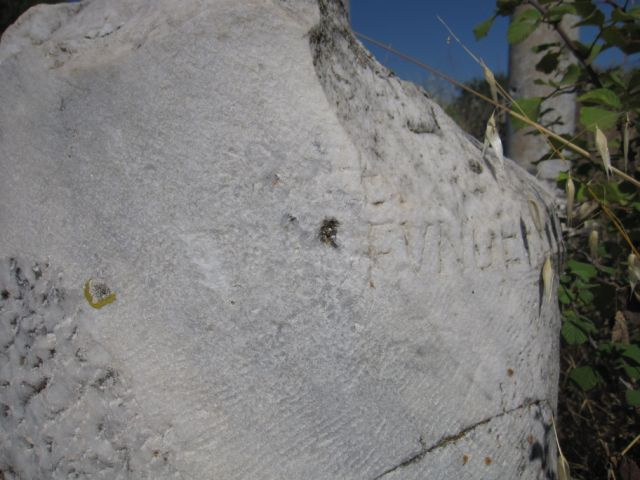
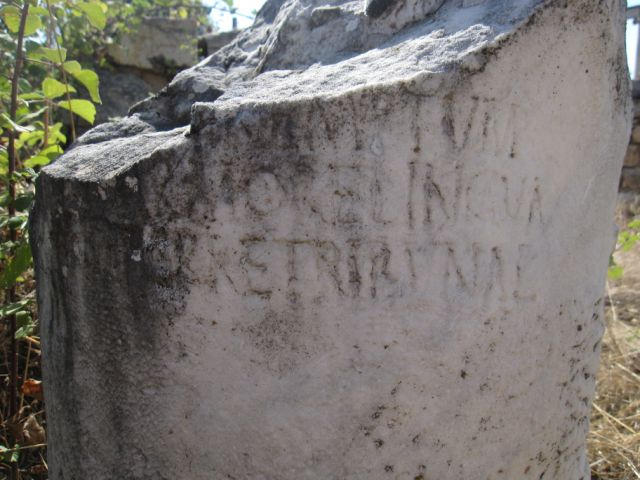
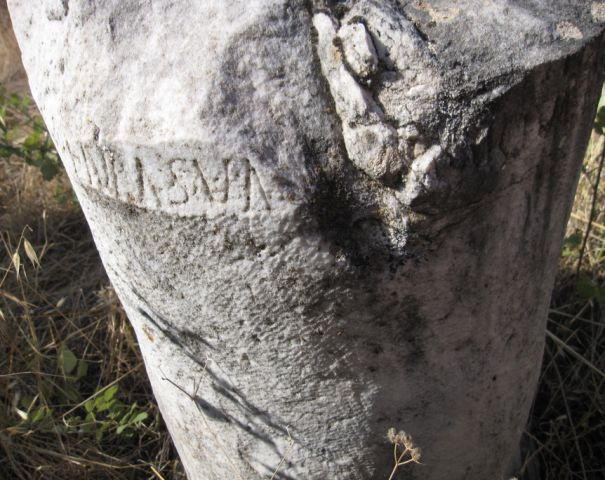
Inscription
[...] / [...]s / [...]n inemptum / e[... c. 20 ...]ii de marmore lingua / fundere iura sua o[..]rum quae referre tribunal / (5) vacat
Inscription translation
[...] not bought [...] from the marble [?in his own/in their] tongue, to pour out the laws and to ?recall, the tribunal of the [...] (?)
(Trans: C. Roueché)
Bibliography
- Roueché, C., Aphrodisias in Late Antiquity (Journal of Roman Studies Monograph 5), London 1989, 19-21, no. 8
Discussion
INSCRIPTION
Verse inscription, fragemnts of four lines lines preserved:
[...] / [...]s / [...]n inemptum / e[... c. 20 ...]ii de marmore lingua / fundere iura sua o[..]rum quae referre tribunal / (5) vacat
'... not bought ... from the marble [?in his own/in their] tongue, to pour out the laws and to ?recall, the tribunal of the ...(?)'. (Trans: C. Roueché)
Letter height 3 cm.
DESCRIPTION
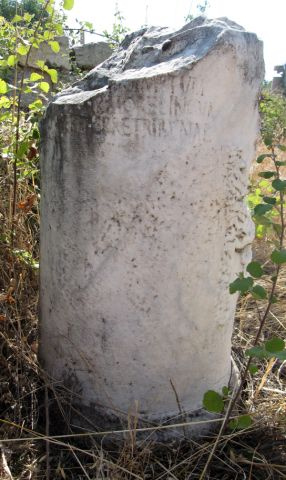
Round altar re-used as base. H: 95, Diam (at upper break): 47 cm, Diam (at lower moulding): 60 cm. White marble.
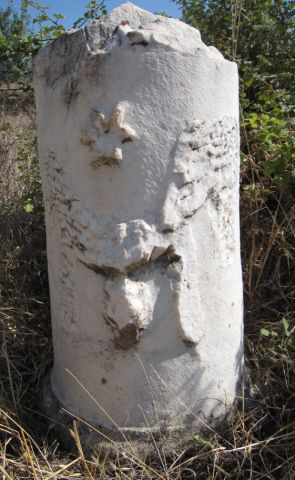
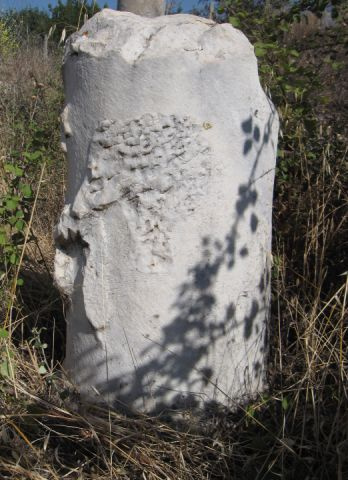
The upper portion and moulding of the base have broken off. The ends of the garland of its first use as an altar have been removed, either in conjunction with its re-use as a statue base or in conjunction with its final use in the house.
The surface has a consistent claw-chisel finish except where the garland has been removed and in the space for the inscription. Where the garland has been removed, points of the drill and pick work are visible. The surface for the inscription is smoothly finished.
The base is a re-used round altar. It has moulding below and probably had it also above. The garland, running around base has been deliberately and well removed at the front with the inscription but only partially removed at the back. There the ties of the garland have been taken away unevenly. The centre of the garland and the pine cone hanging from it have not been taken down as far as the other portions, and the end of the ribbon remains untouched on the proper right side. The flower above the garland has also been left intact.
PROVENANCE AND CURRENT LOCATION
Excavated in the North Temenos House, a late house built against the northern wall of the Sanctuary of Aphrodite. It was found in a corner of the small courtyard (forecourt) between corridor and a large apsidal hall. This, however, is clearly a position of re-use since the base is placed in the northeast corner with the inscription facing the corner.
HONORAND, AWARDER AND DATE
The inscription is in Latin and mentions language and justice. This suggests that the honorand was a governor. Both of these aspects are mentioned on the verse inscription on the base of Oecumenius (LSA-150 and LSA-151) which dates to the fourth century.
Roueché dates the inscription to the late third or early fourth century AD on the basis of the lettering which compares well to that of the Edict of Diocletian from the Basilica at Aphrodisias.
Honorific inscriptions in verse in Latin are rare and the earliest securely dated one comes from Rome and belongs to AD 351-2 ( LSA-1399). Other examples include a base from Africa, AD 361 ( LSA-2473), an imperial example for a Theodosius, AD 388-426 (LSA-2497), a base of AD 401 for a governor of Lucania and Bruttii (LSA-1808), a column for Marcian of 450-452 ( LSA-2461), and a lost plaque for a governor set up in Pannonia probably in the fifth century ( LSA-378) . These examples suggest that a fourth century date is more likely than a third century date for our base.
Cite: Last Statues of Antiquity, LSA-220 (J. Lenaghan).